


Launching a business in Spain through a Sociedad Limitada (SL – Spanish Limited Company) is often the most efficient way for foreign entrepreneurs, digital nomads and investors to operate here. It gives you limited liability, a professional image and access to the EU market – but the process and paperwork can feel overwhelming if you are not familiar with Spanish rules.
Below you will find a clear, step‑by‑step guide on how to create a limited company in Spain as a foreigner, what documents you need, typical timelines, costs, and the main legal and tax points to consider.
Understanding what a Spanish Limited Company actually is
In Spain, the standard private limited company is called Sociedad de Responsabilidad Limitada (SRL or SL). It is the closest equivalent to a Limited Company (Ltd) in the UK, an LLC in the US, or a GmbH in Germany.
The key feature is in the name: responsabilidad limitada. Your liability is limited to the capital you contribute. If the company fails, creditors generally cannot pursue your personal assets (home, savings, etc.), except in cases of fraud, gross negligence or personal guarantees.
- Legal personality: The SL is a separate legal entity from its shareholders.
- Capital company: Ownership is divided into “participaciones sociales” (quotas), not freely tradable shares on a market.
- Flexible size: You can have a single‑member SL (only one shareholder) or multiple partners, individuals or companies, Spanish or foreign.
For most foreign entrepreneurs, an SL is the default structure because it combines asset protection, relatively low capital requirements and a simpler management regime than a Public Limited Company (SA).
Key advantages of forming a Limited Company in Spain as a foreigner
Before you go into the paperwork, it helps to understand why this structure is usually chosen over registering as a sole trader (autónomo) or operating through a foreign company only.
Some of the main advantages are:
- Limited liability: Your risk is normally capped at the amount of share capital you contribute.
- 100% foreign ownership allowed: You do not need a Spanish partner. A foreign individual or foreign company can own 100% of the SL.
- Professional image: Many Spanish clients, banks and suppliers prefer to work with a company rather than an individual freelancer.
- Access to EU market: A Spanish SL is an EU company, which can simplify cross‑border operations within the Union.
- Tax planning options: You can combine company taxation with regimes such as the Beckham Law (Special Expat Regime) or double taxation treaties, depending on your situation.
On the other hand, an SL also brings ongoing obligations: bookkeeping, annual accounts, corporate tax returns and, if you have employees, payroll and social security. For many expats, this is precisely where a corporate lawyer in Valencia and a local tax team become essential.
Main requirements to set up a Limited Company in Spain
To understand how to create a Limited Company in Spain, start with the basic legal requirements. They are the same whether you are Spanish or foreign, but foreigners must handle a few extra identification and legalization steps.
Minimum share capital and contributions
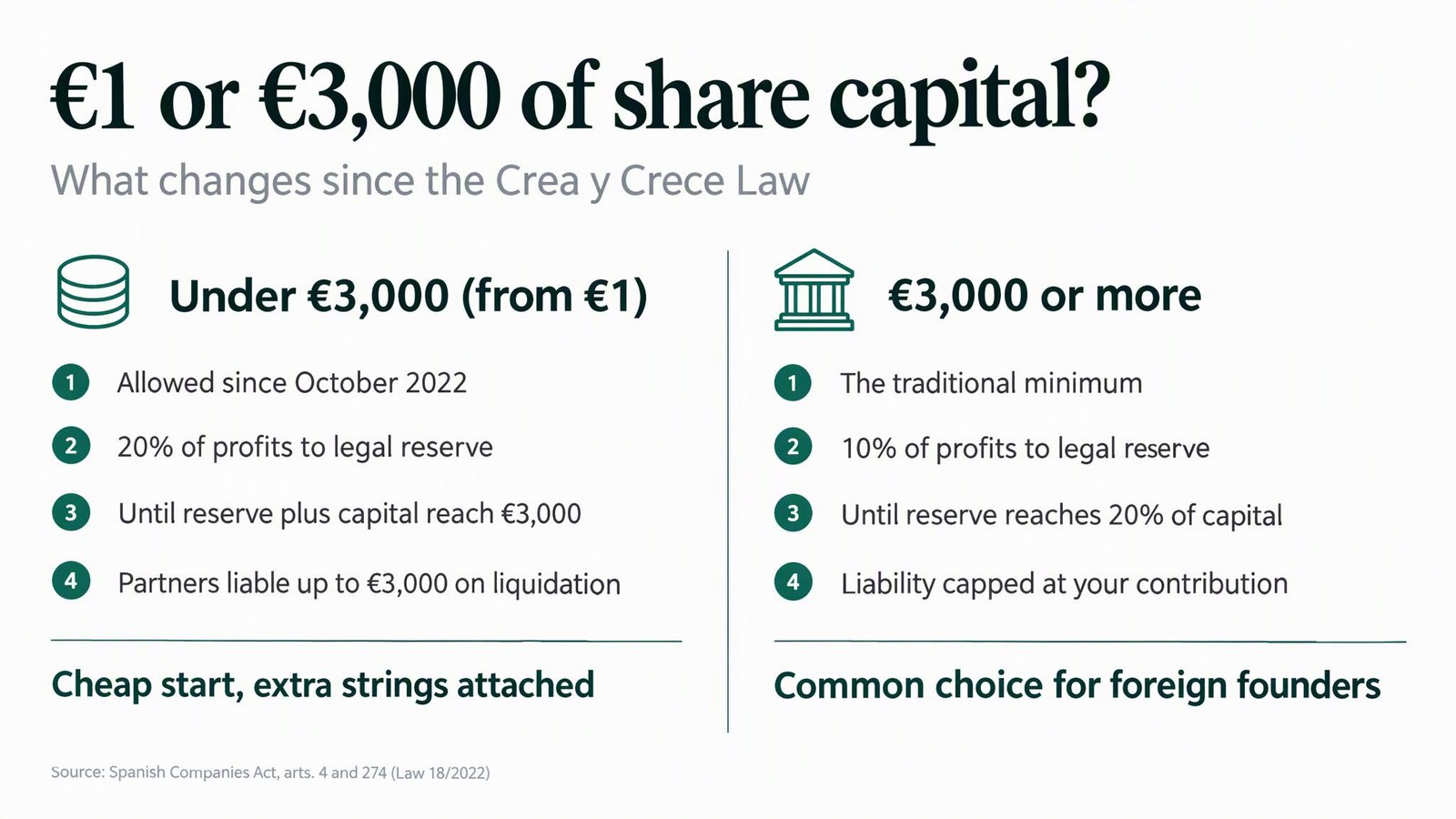
Since October 2022, Law 18/2022 (the “Crea y Crece” Law) has allowed an SL to be incorporated with just €1 of share capital, fully paid in at incorporation (article 4 of the Spanish Companies Act). The old €3,000 figure has not disappeared, though: it still works as a safeguard for creditors.
While the capital stays below €3,000:
- At least 20% of each year’s profit must go to the legal reserve until the reserve plus the capital reach €3,000.
- If the company is liquidated and its assets cannot cover its debts, the partners are jointly liable for the difference between €3,000 and the capital they subscribed.
With €3,000 or more, only the general rule applies (article 274): 10% of annual profit goes to the legal reserve until it reaches 20% of the capital, and your liability is capped at your contribution. In practice, many foreign founders still start with €3,000 or more, because a €1 company can raise eyebrows with banks and suppliers.
Contributions can be made:
- In cash (most common – you deposit the money into a Spanish bank account).
- In kind (assets such as equipment, vehicles, real estate). These require a clear valuation and detailed description in the deed.
Shareholders and directors
You will need at least:
- One shareholder (individual or company, resident or non‑resident).
- One director / administrator (can be the same person as the shareholder).
Directors can be:
- A sole director (administrador único).
- Joint or several directors (two or more, acting together or separately).
- A Board of Directors (consejo de administración), more common in larger structures.
Foreign directors and shareholders need to obtain Spanish tax identification numbers (NIE or NIF) and, if acting through a representative, a properly legalized power of attorney.
Foreign identification numbers: NIE, NIF and tax residency
The first real obstacle for many expats is not the company itself, but obtaining the right identification numbers. Without them, you cannot sign before a notary, open the company bank account or register with the tax office.
NIE and NIF for foreign individuals
If you are an individual (not a company) and you are not Spanish, you will need a NIE (Número de Identidad de Extranjero). This number is used for almost all legal and tax procedures in Spain, including company formation.
You can obtain a NIE:
- In Spain, at the Policía Nacional or immigration office.
- At a Spanish Consulate in your country of residence.
- Via a representative in Spain, using a power of attorney.
Once you have a NIE, it also serves as your personal tax identification number in Spain.
NIF for foreign companies investing in Spain
If a foreign company will be a shareholder of the new SL, that foreign entity must obtain a Spanish NIF (Número de Identificación Fiscal) for non‑resident legal persons.
To obtain it, you normally must file Form 036 with the Spanish Tax Agency (AEAT), attaching:
- Evidence of the company’s existence (incorporation deed, commercial registry certificate, etc.).
- A sworn translation into Spanish.
- Legalization or Apostille (Hague Apostille if your country is a signatory; otherwise, consular legalization).
- Identification and powers of the legal representative in Spain.
This step is very formal and often where delays happen, so planning ahead and using a local advisor is highly recommended.
Choosing and reserving the company name
The first “visible” step in practice is choosing what your company will be called. The name must be unique in Spain and end with “S.L.” or “S.R.L.”.
How to reserve your company name
You must request a negative name certificate (certificación negativa de denominación social) from the Central Mercantile Register (Registro Mercantil Central). This document confirms that no other company is registered with the same or confusingly similar name.
Key points:
- You can propose up to five alternative names, in order of preference.
- The registry checks availability and reserves the first available name.
- The name is reserved in your favor for six months from issue, but the certificate itself is valid for three months to sign the deed; if it expires, you can ask for a renewal.
This certificate must be given to the notary when signing the deed of incorporation, and the final company name must match exactly.
Opening the company bank account and depositing share capital
To create a Limited Company in Spain, you must prove that the share capital has been fully contributed. The standard and simplest method is a cash contribution deposited into a Spanish bank account.
Steps to open the account
Each bank has its own internal policies, but usually they will ask for:
- The name reservation certificate.
- Identification of the future shareholders and directors (passport, NIE/NIF).
- Basic information about the company’s activity and structure (for anti‑money‑laundering compliance).
Because the company is not yet incorporated, the account is often opened “on behalf of the company in formation”. You then deposit the capital and the bank issues a certificate of deposit for the notary.
Important details:
- The bank certificate is valid for two months, so the deed must be signed within that window (article 62 of the Spanish Companies Act).
- The funds stay in the account and are normally released once the deed is signed and the company has its tax ID; each bank applies its own practice.
- As an alternative, the founders of an SL can skip the certificate if they declare in the deed that they are jointly liable for the reality of their cash contributions, a shortcut worth discussing with your lawyer first.
Drafting the company bylaws in a way that actually fits your project
The bylaws (estatutos sociales) are the internal “constitution” of your SL. Many quick‑incorporation services use generic templates, but for foreign investors this is often a mistake: it can create serious problems later when you bring in new partners, sell the company or change management.
Core content of the bylaws
By law, the bylaws must include at least:
- Company name and corporate form (e.g. “Example Ventures, S.L.”).
- Registered office (must be in Spain).
- Corporate purpose – the activities the company is allowed to carry out (e.g. consulting, real estate investment, software development).
- Share capital, number and nominal value of the quotas (participaciones sociales).
- Structure of the management body (sole director, joint directors, board, etc.).
- Rules for shareholders’ meetings and adoption of resolutions.
Well‑drafted bylaws can also regulate:
- Restrictions or procedures for transferring quotas (pre‑emption rights, approval clauses, etc.).
- Specific rules for deadlock situations between partners.
- How and when profits can be distributed as dividends.
- Special rights for certain partners (e.g. veto rights, preferred dividends).
For multi‑partner projects, it is common to complement the bylaws with a separate shareholders’ agreement (private contract), which can include more detailed arrangements about exits, non‑compete obligations, vesting for founders, etc. Our startup lawyers usually draft both documents together so they do not contradict each other.
Signing the public deed of incorporation before a Spanish notary
The company legally comes into existence when the public deed of incorporation is signed before a Spanish Notary Public. This is a formal act where all the previous steps and documents are brought together.
What the deed must contain
The deed of incorporation typically includes:
- Identification of all founding shareholders (individuals or companies).
- A declaration of their intention to create an SL.
- Details of the capital contributions by each shareholder and the quotas they receive.
- The full text of the bylaws.
- Appointment of the directors / administrators and their acceptance of the role.
- The company’s CNAE code (economic activity classification).
All founding shareholders (or their representatives with power of attorney) must attend the notary appointment, bringing:
- Passports and NIE/NIF of individuals.
- For corporate shareholders: corporate documents, certificates of good standing, duly translated and legalized/Apostilled.
- Name reservation certificate.
- Bank certificate of capital deposit (if contribution is in cash).
- Draft bylaws.
- Powers of attorney, if someone signs on another’s behalf.
The notary checks the legality of the operation, drafts or finalizes the deed, and once signed, sends it electronically to the Tax Agency and the Mercantile Registry.
Obtaining the company’s Tax Identification Number (NIF)
At this stage, your SL exists, but you still need a tax ID number to operate: the company’s NIF. This is different from your personal NIE.
Provisional and definitive NIF
The process usually has two steps:
- Provisional NIF: Requested from the Tax Agency (AEAT), normally by the notary or your advisor, immediately after signing the deed. It allows you to start basic operations (e.g. issuing invoices).
- Definitive NIF: Once the company is registered in the Mercantile Registry, you apply (again via Form 036) to convert the provisional NIF into a permanent one, attaching:
- Copy of the public deed.
- Certificate of registration in the Mercantile Registry.
- Updated company details (activity, address, VAT status, etc.).
Without a NIF, the company cannot properly invoice, hire staff, or register for VAT (IVA), so this step is crucial.
Registering the company in the Mercantile Registry
To have full legal personality and appear in official records, the SL must be registered with the Provincial Mercantile Registry corresponding to its registered office.
What the registry does
After receiving the electronic copy of the deed from the notary, the registry:
- Reviews the deed and bylaws to ensure they comply with Spanish company law.
- Registers the company and its main data (name, address, capital, directors).
- Issues a registration certificate and arranges publication in the Official Gazette of the Mercantile Registry (BORME).
Standard deadlines:
- With standard bylaws filed through the CIRCE telematic system, the law gives the registry just 6 business hours to register the company once it receives the deed.
- With customized bylaws, the registrar has up to 15 business days (5 if the deed is filed through CIRCE), and any defect notice adds time, so complex structures can take several weeks.
Only once the SL is registered does it fully acquire legal personality and the directors can act with full powers in the name of the company.
Tax registrations and first fiscal obligations
In parallel with the corporate steps, you must also complete several tax registrations so that the company can legally do business in Spain.
Economic Activities Tax (IAE) and census declaration
All companies must register for tax purposes using Form 036 (the simplified Form 037 was abolished in February 2025). This “census declaration” includes:
- The company’s tax address.
- The economic activities it will perform (IAE headings).
- Whether it will be subject to VAT (IVA), withholding taxes, etc.
Regarding the Tax on Economic Activities (IAE) itself:
- Every new business is exempt during its first two tax years of activity in Spain.
- After that, companies with net turnover below €1 million remain exempt.
- Even if exempt, you still need to declare the activity and any future changes.
Corporate tax and accounting
An SL is subject to Corporate Tax (Impuesto sobre Sociedades). For tax years starting in 2026 (article 29 of the Corporate Tax Law, as amended by Law 7/2024):
- General rate: 25%.
- Newly created companies: 15% in the first tax year with a profit and in the following one.
- Microenterprises (net turnover under €1 million): 19% on the first €50,000 of taxable profit and 21% on the rest.
- Small companies (net turnover under €10 million): 23%.
- Certified startups (Law 28/2022, with ENISA certification): 15% in the first profitable year and the next three.
Asset‑holding companies do not qualify for the reduced rates, and special regimes apply in the Canary Islands, Ceuta and Melilla.
The company must also:
- Keep proper accounting records according to the Spanish General Accounting Plan.
- File annual accounts with the Mercantile Registry.
- Submit periodic tax returns (corporate tax, VAT, withholdings, etc.).
Social Security, employees and workplace notifications
If your SL will have employees in Spain, or if a director will be registered as self‑employed for management purposes, you must deal with the Social Security system and, in some cases, labor authorities. A labor law attorney can also prepare compliant employment contracts before your first hire.
Registering the company as an employer
Before hiring staff, the company must:
- Register with the General Treasury of Social Security using Form TA.6.
- Obtain a Contribution Account Code (Código de Cuenta de Cotización), which identifies the company as an employer.
Then, for each employee, you must:
- Ensure they are affiliated to Social Security (Form TA.1 if new).
- Register them under the appropriate scheme before they start working.
Workplace opening communication
If you open a physical workplace (office, shop, warehouse, etc.), you must notify the regional labor authority (in Valencia, the Generalitat Valenciana) before opening or within 30 days of doing so (Order TIN/1071/2010). This is mainly for occupational health and safety control.
Declaration of foreign investment and special cases
If you invest from outside Spain, you may also need to comply with Spain’s foreign investment reporting rules (Royal Decree 571/2023). These are mostly informative (statistical) but are still mandatory.
Standard foreign investment declaration
When a non‑resident person or company holds 10% or more of a Spanish company, including from incorporation, you generally must file:
- Form D‑1A with the Foreign Investment Registry of the Ministry of Economy, within one month of the investment.
Your legal advisor can file it on your behalf if you authorize them.
Investments from tax havens or sensitive sectors
If the money comes from a jurisdiction on Spain’s list of non‑cooperative jurisdictions (tax havens), the investment must be declared whatever its size and, where the foreign stake exceeds 50%, also before it is made (Form DP‑1). Investments by non‑EU/EFTA investors in sensitive sectors (e.g. defense, critical infrastructure, strategic technologies) may even need prior government authorization under Spain’s foreign investment screening rules.
In these cases, it is essential to obtain specific legal advice before transferring funds or signing any binding documents.
Typical timeline to create a Limited Company in Spain
The time it takes to form an SL depends heavily on how quickly you can obtain identification numbers (NIE/NIF) and collect foreign corporate documentation. Once that is ready, the purely Spanish steps can be relatively fast.
| Step | Approximate time |
|---|---|
| NIE/NIF for foreign individuals / companies | From a few days to several weeks, depending on consulate / police / documentation |
| Company name reservation | 24–72 hours |
| Open bank account and deposit capital | 1–7 days (varies by bank and AML checks) |
| Draft bylaws and prepare documentation | 1–3 days (if straightforward) |
| Notary appointment and signing of deed | Same day once appointment is scheduled |
| Provisional NIF | Same day or within 1–2 days |
| Registration in Mercantile Registry | From 3–15 business days, sometimes longer |
| Definitive NIF and full tax registrations | 1–5 days after registration |
In practice, once all foreign documentation is in order, many companies can be fully operational within 2–4 weeks. With careful planning and telematic procedures, some simple structures can be incorporated in around 7–10 days.
In‑person vs online incorporation: which is better for foreigners?
Spain offers two main ways to incorporate an SL: the classic in‑person route and a more modern online / telematic route through Entrepreneur Service Points (PAE) and the CIRCE system.
In‑person incorporation
This is the traditional method and is still very common, especially for foreign investors with customized structures.
- You (or your representative) handle each step: name certificate, bank account, notary, tax forms, registry filings.
- You have full flexibility to customize bylaws and structure.
- It is often preferable for more complex projects, multi‑partner companies, or when foreign corporate shareholders are involved.
Telematic / online incorporation
Through a PAE (Punto de Atención al Emprendedor) and the CIRCE system, the process runs electronically:
- Filling a Single Electronic Document (DUE).
- Automatic communication with the Tax Agency, Social Security and Mercantile Registry.
- Very short legal deadlines with standard bylaws: the notary must sign within 12 business hours and the registry must register within 6 business hours of receiving the deed.
- Since November 2023, an SL with cash‑only contributions can be incorporated fully online, with the notary acting by videoconference (Law 11/2023).
However, for foreigners, this route still requires NIE/NIF (and electronic identification for the online notary route) and does not remove the notary from the process. It is most suitable for simple, standard SLs where speed is more important than tailor‑made corporate design.
Ongoing obligations after creating your Limited Company
Once your SL is up and running, Spanish law imposes a set of continuous obligations. Ignoring them can lead to fines, director liability or even the company being struck off.
Corporate and accounting obligations
- Annual accounts: Prepare, approve in a shareholders’ meeting and file them with the Mercantile Registry every year.
- Corporate books: Keep and legalize mandatory corporate books (minutes book, shareholders’ register, etc.).
- Accounting records: Maintain accurate bookkeeping in accordance with Spanish standards.
Many foreign‑owned companies outsource this work to an accounting and tax agency in Spain so deadlines are never missed.
Tax obligations
- Corporate Tax (IS): Annual return plus installment payments, if applicable.
- VAT (IVA): Quarterly and annual returns, if your activities are VAT‑able.
- Withholdings: On salaries, professional invoices, rent, etc., with corresponding periodic returns.
Foreign directors or shareholders may also need to consider personal tax residency in Spain, the Beckham Law regime, and the interaction with their home country’s tax rules and double taxation treaties.
Special considerations for expats, digital nomads and non‑resident investors
While the legal steps to form an SL are the same for everyone, foreigners face some additional strategic questions that a local resident entrepreneur may not.
Where you live and where the company is based
Your personal tax residency is not automatically the same as the company’s tax residency. You can be a non‑resident in Spain but own a Spanish SL. However:
- If you spend more than 183 days in a calendar year in Spain or your main economic interests are here, you may become a Spanish tax resident.
- The SL itself is always a Spanish tax resident company, because it is incorporated under Spanish law and has its registered office in Spain.
This has implications for corporate tax, dividends, director remuneration and application of double taxation treaties.
Visas and work permits
Creating a Limited Company in Spain does not automatically grant you the right to live or work here. Depending on your nationality and situation, you may need a specific residence permit, such as:
- Entrepreneur visa, for innovative projects with a favorable report from ENISA; usually the natural fit if your Spanish SL will be your main business.
- Digital Nomad Visa, if you work remotely for employers or clients mainly outside Spain (as a professional, Spanish clients can be no more than 20% of your work).
- Other routes, such as permits for highly qualified professionals. The Non‑Lucrative Visa does not allow you to work, so it rarely suits an active founder, and the Golden Visa was abolished in April 2025.
Coordinating company formation with the right immigration strategy is crucial if you plan to live in Spain and actively manage the business from here.
Practical example: foreign entrepreneur setting up an SL in Valencia
Imagine a non‑EU software developer who wants to base their operations in Valencia (see why Valencia works well for startups) and bill European clients through a Spanish company.
The typical path might look like this:
- Secure the right residence permit (often the entrepreneur route with an ENISA report, since the Digital Nomad Visa is designed for income from abroad) and obtain a NIE.
- Reserve a company name and open a Spanish bank account in Valencia.
- Deposit the share capital (for example €3,000, even though €1 is now the legal minimum) and get the bank certificate.
- Work with a local legal‑tax advisor to draft bylaws that allow future investors and define clear rules for profit distribution.
- Sign the deed of incorporation before a Valencia notary (in person or via power of attorney).
- Obtain provisional and then definitive NIF, register for VAT and IAE.
- Register as an employer with Social Security, hire local staff when needed.
- Optimize personal taxation using the Beckham Law, if eligible (since 2023 it also covers certain entrepreneurs), and ensure double taxation relief with their home country.
With proper planning, this process can be completed in a few weeks, and the entrepreneur can operate legally, invoice clients across the EU, and enjoy life in Valencia while having a compliant Spanish corporate and tax structure.
Setting up your SL from abroad? Our bilingual team in Valencia handles the name certificate, bylaws, notary and tax registrations, and lines them up with your visa. Book a free consultation.
Frequently Asked Questions
Can I create a Spanish limited company if I do not live in Spain full‑time?
Yes. You can be non‑resident and still own and manage a Spanish SL. You will need a NIE (or NIF for foreign companies) and may need to grant a power of attorney to someone in Spain to handle formalities. What changes with your residence is how you, personally, are taxed on salary and dividends, not the possibility of forming the company.
Do I need to speak Spanish or translate documents to set up an SL as a foreigner?
You do not need to speak Spanish personally, but all official documents (deed, bylaws, tax forms) are in Spanish. Foreign corporate documents and some powers of attorney must be translated by a sworn translator and often legalized or Apostilled. If you do not speak Spanish, you should use an interpreter or representative for notary and tax procedures.
How much should I budget in total to create and maintain a limited company in Spain?
Beyond the share capital (legally from €1, often €3,000 or more, and it remains the company’s money), you should budget several hundred to a few thousand euros for notary fees, registry fees, translations, legalizations and initial tax/accounting setup, depending on complexity. Ongoing yearly costs include accounting, tax filings and possible payroll management, which usually exceed the initial one‑off costs over time.
Can I run my Spanish SL entirely online, or do I need a physical office?
You can operate many types of businesses through an SL without a traditional office, especially digital or service activities. You still need a registered address in Spain for legal and tax purposes, which can be your home or a virtual office, provided it meets local rules. A physical workplace is only mandatory when your activity or staff requirements make it necessary (e.g. shop, warehouse, factory).
Every case has its own details. Our English-speaking lawyers in Valencia can review your situation and advise you on the best way forward. Get in touch with us for tailored legal advice.
