

Many foreign owners bought their apartment in Valencia, Alicante or on the Costa Blanca years ago. The children are now adults, the property has gained value, and a question comes up at the kitchen table: should we hand it over now instead of leaving it in the will?
Gifting property in Spain to your children is possible whether or not you live here, but it is never a single tax decision. Spain taxes your child on what they receive and taxes you on the increase in value of the home you give away, so run both numbers before anyone signs.
Two taxpayers and three taxes
In the Valencia region, the child’s tax is usually small. The surprise for many parents is their own bill.
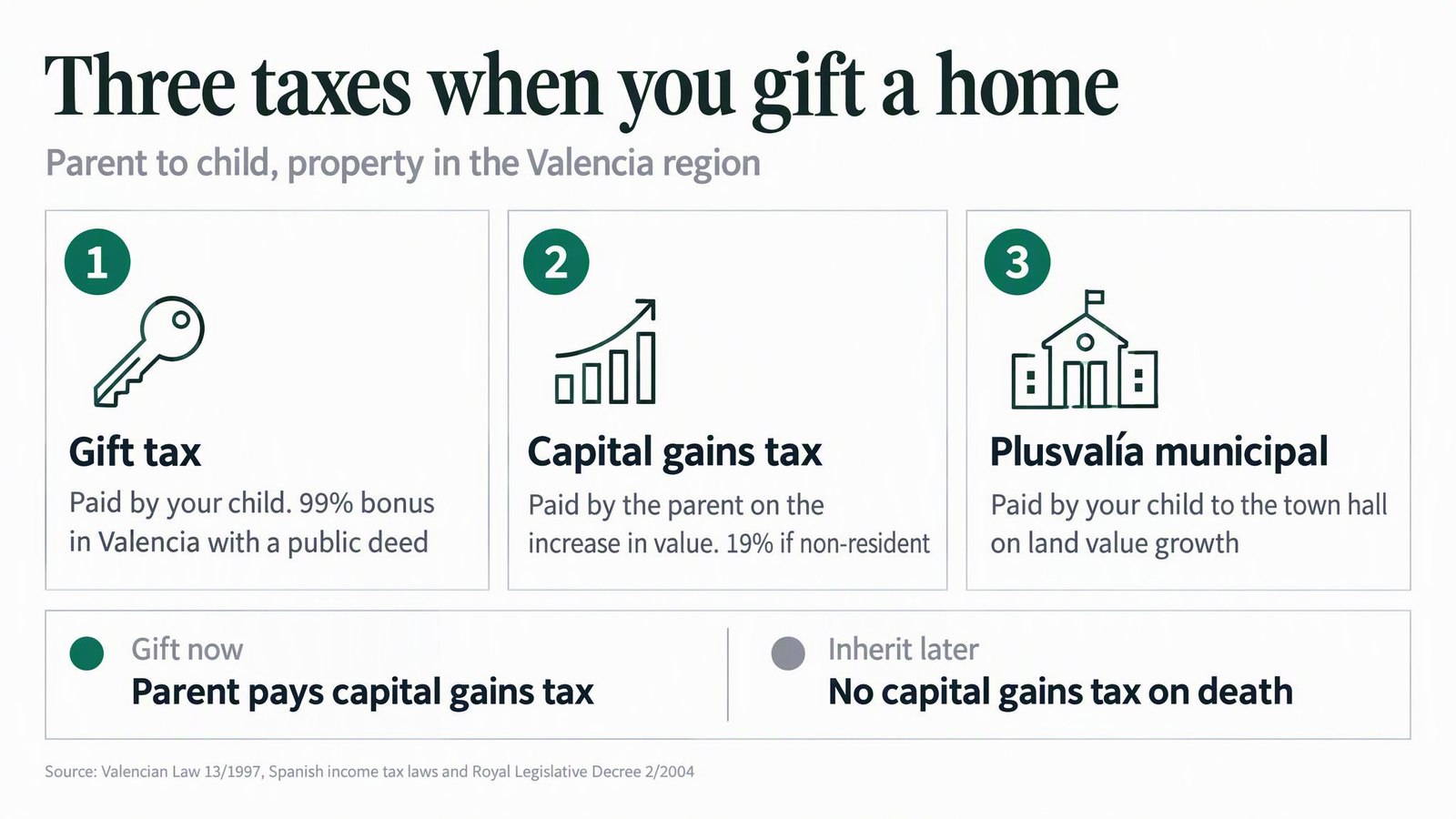
- Gift tax (Impuesto sobre Sucesiones y Donaciones): paid by your child on the value received.
- Capital gains tax: paid by you, the parent, because Spain treats the gift as a disposal of the property.
- Municipal capital gains tax (plusvalía municipal): paid by your child to the town hall on the increase in land value.
Notary and Land Registry fees come on top.
A notarial deed is compulsory
Spanish law does not accept an informal gift of a house. The Civil Code is explicit:
For a gift of real estate to be valid, it must be made in a public deed, individually stating the property given and the value of the charges the recipient must bear. (Art. 633 Spanish Civil Code, our translation)
Your child can accept in the same deed or in a separate one, but acceptance only takes effect if it happens while you are alive. Once signed, the deed is registered at the Land Registry so your child appears as the new owner. To prepare the signing, you will usually need:
- NIE numbers for you and your child (non-residents need a Spanish tax ID to file).
- Your title deed and the latest property tax (IBI) receipt.
- The cadastral reference value of the property on the date of the gift.
- Valid passports and, if someone signs on your behalf, an apostilled and translated power of attorney.
Gift tax for your child under Valencian rules
For real estate, what matters is where the property is, not where your child lives. A resident child is taxed under the rules of the region where the home is located (art. 32.2.b Law 22/2009), and a non-resident child has the right to apply those same rules (additional provision 2 of Law 29/1987). For a home in Valencia, Alicante or Castellón, both roads lead to Valencian law.
| Valencian rule | What it means for your child |
|---|---|
| Allowance, children aged 21 or over | €100,000 deducted from the taxable value |
| Allowance, children under 21 | €100,000 plus €8,000 for each year under 21, up to €156,000 |
| 99% bonus | Only 1% of the resulting tax is paid. It also covers spouses, parents, grandchildren and grandparents |
| Formal conditions | Public document (or formalized that way within the filing deadline) and a complete return, filed on time or before any request from the tax office |
| Five-year look-back | Earlier gifts from the same parent in the previous five years use up the same allowance |
These rules come from arts. 10 bis and 12 bis of Valencian Law 13/1997, in force in 2026. Here is how they work on a typical case:
- Cadastral reference value of the apartment: €300,000.
- Child aged 30 with existing wealth under roughly €390,000: €100,000 allowance, so €200,000 is taxable.
- Tax under the Valencian scale before the bonus: about €31,850.
- After the 99% bonus: about €320.
Your child files Form 651. A Spanish resident files with the Valencian Tax Agency within one month of the gift; a non-resident files with the Spanish Tax Agency (AEAT) within 30 working days. Because a gift moves wealth out of your future estate, we review it as part of estate planning for international families, not as a one-off transaction.
The cadastral reference value sets the numbers
For gift tax purposes, real estate is valued at its cadastral reference value (valor de referencia), published by the Spanish Cadastre. If you declare a higher value, the higher figure is used (art. 9.3 Law 29/1987). This single number drives most of the operation:
- It is the taxable value for your child’s gift tax.
- It also feeds your capital gains calculation: the value of the gift for income tax is the gift tax value, capped at market value (art. 36 Personal Income Tax Law).
- It can only be challenged by asking to correct the tax return or by appealing an assessment (art. 9.4 Law 29/1987).
Check it before signing: a reference value above the real market price inflates both taxes at once.
Capital gains tax for the parent who gives
Spain treats a gift as a disposal. Your gain is the value of the gift minus what the home cost you (price, purchase costs and improvements). A loss does not count: losses from gifts are excluded (art. 33.5.c Personal Income Tax Law).
| Parent resident in Spain | Parent not resident in Spain | |
|---|---|---|
| Tax and rate | Personal income tax, savings scale from 19% to 30% | Non-resident income tax, flat 19% on capital gains |
| How it is declared | In the annual income tax return | Form 210 |
| 3% withholding | Does not apply | Not applicable to gifts, because there is no price to withhold from |
Take the €300,000 apartment above, bought years ago for €180,000. Ignoring costs, the gain is €120,000. A non-resident parent would pay €22,800, and a resident parent about €26,480 under the savings scale. That is many times the €320 your child pays.
If you are a Spanish tax resident aged 65 or over and the property is your main home, the gain is exempt (art. 33.4.b Personal Income Tax Law). The Directorate General of Taxes has confirmed that this also applies to gifts, including gifts of the bare ownership (binding ruling V1261-25).
In a sale, the buyer must withhold 3% of the agreed price when the seller is non-resident (art. 25.2 Non-Resident Income Tax Law). With no price there is nothing to withhold, but the non-resident parent still has to file and pay the 19%. Your home country may also tax the gain, so check the relief available under its tax treaty with Spain.
Plusvalía municipal: the town hall’s share
The municipal tax on the increase in value of urban land is due on gifts too. In a gift, your child is the taxpayer (art. 106 Royal Legislative Decree 2/2004) and must declare it within 30 working days, while you must also notify the town hall (art. 110). Three rules can reduce the bill:
- If the land has not increased in value, there is no tax (art. 104.5).
- If the actual gain is lower than the standard calculation, your child can ask to be taxed on the actual gain (art. 107.5).
- On inheritance, town halls may grant up to a 95% reduction for children, spouses and parents (art. 108.4). That reduction does not cover gifts.
Gift now or leave it in your will?
In the Valencia region, children pay very little either way. The real differences lie with the parent’s taxes and with who controls the property in the meantime.
| Gift now | Inherit later | |
|---|---|---|
| Child’s tax in Valencia | €100,000 allowance and 99% bonus, with a public deed | 99% bonus for children also applies to inheritances |
| Parent’s capital gains | Taxed on the gain, unless an exemption applies | No tax: gains on death are not taxed (art. 33.3.b Personal Income Tax Law) |
| Plusvalía municipal | Full tax, paid by your child | The town hall may reduce it by up to 95% |
| Control of the property | Passes to your child, unless you keep a usufruct | You keep it for life |
| Base for your child’s future sale | The value used for the gift tax | The value used for the inheritance tax |
A gift tends to make sense when the gain is small, when the over-65 main home exemption applies, or when there is a clear reason to act now. Otherwise, waiting can avoid the parent’s capital gains tax entirely.
Risks to weigh before you sign
A gift is final. Look beyond tax at what it means for you, your other children and your child’s situation.
- Keeping a lifetime usufruct. You can give the bare ownership and keep the right to live in or rent out the home. Gift tax is then charged on the bare ownership only. A lifetime usufruct is valued at 70% when the holder is under 20, falling 1% for each additional year of age, with a 10% minimum (art. 26 Law 29/1987): for a 70-year-old parent, the bare ownership is 81% of the value.
- Collation and forced heirship. Under Spanish law, gifts to children count against their forced share (art. 819 Civil Code) and are brought into account when the estate is divided (art. 1035), unless you expressly waive this (art. 1036). Whether this applies depends on the law governing your succession (art. 23.2.i Regulation (EU) 650/2012).
- Limited revocation. You cannot take the property back because you change your mind. Spanish law allows revocation for ingratitude only in narrow cases, such as a crime against you or an unjustified refusal of maintenance (art. 648 Civil Code).
- Your child’s marriage. Under Spain’s community property regime, assets received as a gift are the recipient’s separate property (art. 1346 Civil Code). Under another regime, check how gifts are treated.
If the real goal is to help your child buy a home of their own, giving money instead avoids your capital gains tax altogether. Our guide to giving cash to your children the right way explains the steps that keep the Valencian bonus.
Thinking about gifting your Spanish home? We calculate both sides, your child’s gift tax and your own capital gains, before you sign, and we coordinate the deed when one of you lives abroad. Talk to our bilingual lawyers.
Frequently asked questions
Can each parent gift their half of the property separately?
Yes. If you own the home jointly, each parent gives their own share and counts as a separate donor. Under Valencian rules the allowance is measured per donor, so each share benefits from its own allowance.
Can I gift the property to my grandchildren instead?
Yes. In the Valencia region, grandchildren receive the same 99% bonus and allowances as children: €100,000, or up to €156,000 if under 21. Your capital gains tax does not change.
Will my child pay tax when they sell the property later?
Yes, on any gain. Their purchase value for income tax is the value used in the gift tax, plus the costs they paid. A realistic declared value today therefore also matters for the day they sell.
Do we both need to travel to Spain to sign the deed?
No. Either of you can sign through a power of attorney granted before a notary in your country, with an apostille and a sworn Spanish translation. Remember that your child’s acceptance must take place while you are alive.
Every case has its own details. Our English-speaking lawyers in Valencia can review your situation and advise you on the best way forward. Get in touch with us for tailored legal advice.
