

Owning a holiday home or a rental flat in Valencia while living abroad comes with a yearly tax routine that many owners only discover when a letter from the Spanish tax agency arrives. Non-resident property tax in Spain is due even if the property earns nothing, and the filing calendar for property income changed in 2026.
Below you will find what you must file every year, how much it usually costs, when each return is due and what happens if you fall behind.
Empty or holiday home: tax on imputed income
Spain assumes that a property you keep for your own use, or leave empty, gives you a notional income. Non-residents pay income tax on this imputed income with modelo 210, even if they never set foot in the property during the year.
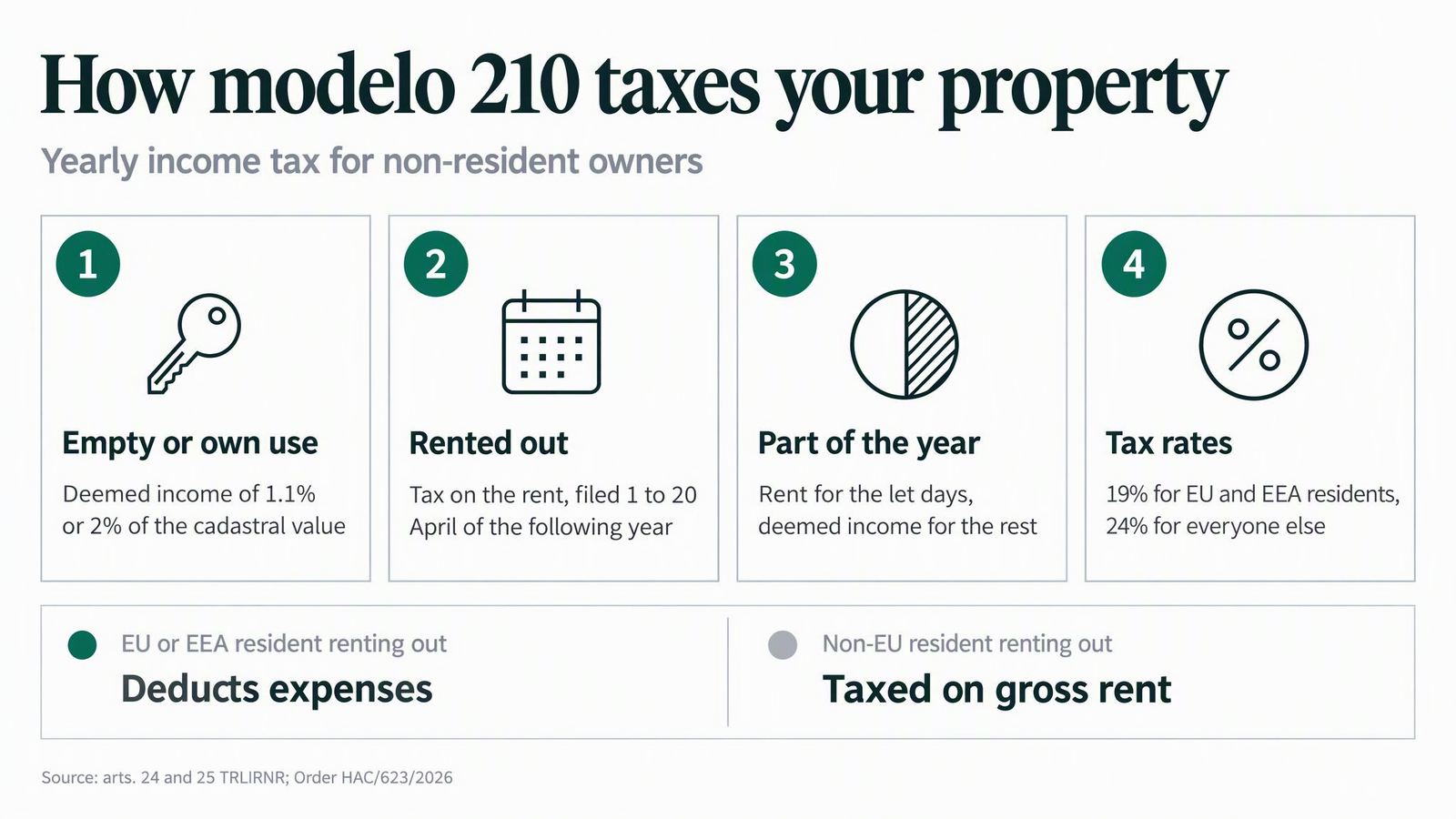
- Base: 2% of the cadastral value shown on the IBI receipt, or 1.1% if the town’s cadastral values were revised in a general valuation that took effect from 1 January 2012.
- No cadastral value yet: 1.1% applied to 50% of the purchase price, or of the value checked by the tax agency if that is higher.
- Proportional: the income is reduced for the days you did not own the property and split between co-owners according to their share.
- Rate: 19% for residents of the EU and EEA, 24% for everyone else, with no deductible expenses (art. 25 TRLIRNR).
The 1.1% imputation rate applies to properties located in municipalities where cadastral values have been revised, modified or determined through a general collective valuation procedure, provided they took effect from 1 January 2012. Additional provision 55 of Law 35/2006, as worded by Royal Decree-Law 26/2026 for tax years 2023 to 2026.
For example, a flat with a cadastral value of €150,000 in a town whose values were revised after 2012 generates imputed income of €1,650. An EU resident pays €313.50 and a UK or US resident €396.
The same decree-law, in force since 1 October 2026, replaces the flat percentages in the Spanish income tax law with a progressive scale from 1.1% to 3% from 2027. Decree-laws must be validated by Congress, so confirm how the new scale applies to non-residents before filing for 2027.
Renting it out: tax on the rent you receive
If you let the property, long term or to holidaymakers, the rent is taxed instead of the imputed income for the days it is rented. Any days the property stays empty or reserved for your own use still generate imputed income in proportion.
- EU and EEA residents: pay 19% on the net income, after deducting expenses directly linked to the rental under Spanish income tax rules, such as IBI, community fees, insurance, repairs, mortgage interest and depreciation (art. 24.6 TRLIRNR).
- Residents elsewhere: pay 24% on the gross rent, with no deductions under the current wording of the law.
- No resident reductions: the reductions Spanish residents apply to housing rentals are not available to non-residents (art. 24.1 TRLIRNR).
The ban on deductions for non-EU owners is under challenge. The Audiencia Nacional ruled on 28 July 2025 that a US resident could deduct rental expenses, and on 15 July 2026 the Supreme Court agreed to review the case. Until it rules, owners from the UK, the US or Canada may want advice on protecting their position for past years.
Keeping receipts, apportioning expenses to the days rented and filing on time is routine work for our tax and accounting team for non-resident owners, which prepares modelo 210 returns from Valencia every year.
The new modelo 210 calendar
Order HAC/623/2026, published in June 2026, changed when non-residents file modelo 210 for property income. Most owners now file once a year in spring instead of every quarter:
- Rental income from 2026 onwards: 1 to 20 April of the following year, whether you declare each payment separately or group the whole year. Direct debit runs from 1 to 15 April.
- Transition in 2026: rent for July to September 2026 declared separately is still due by 20 October 2026; rent for October to December 2026 moves to April 2027.
- Imputed income: the 2025 return is due by 31 December 2026. From 2026 income onwards, the window is 1 April to 31 December of the following year, with direct debit until 23 December.
- Returns with zero tax due: 1 to 20 January of the following year.
- Refunds: from 1 February of the following year and within four years.
- New form from 2027: modelo 210 adds boxes for days of ownership and ownership percentage, plus a breakdown of deductible rental expenses.
IBI: the local property tax
The Impuesto sobre Bienes Inmuebles (IBI) is a municipal tax that every owner pays, resident or not. It is charged on the cadastral value at the rate set by each town hall, and the full year is due from whoever owns the property on 1 January (art. 75 TRLRHL).
- Each town hall sets its own payment calendar, and many offer direct debit.
- The IBI receipt shows the cadastral value you need for modelo 210 and for the wealth tax.
- Unpaid IBI follows the property, so a later buyer can be pursued for it, which is why notaries check for IBI debts on every sale (art. 64 TRLRHL).
Wealth tax and the solidarity tax on large fortunes
Non-residents pay wealth tax (Impuesto sobre el Patrimonio) only on assets located in Spain, valued at 31 December. A property counts at the highest of its cadastral value, the value checked by the tax agency for other taxes or its purchase price, and debts taken on to buy it can be deducted (Law 19/1991).
| Wealth tax | Solidarity tax on large fortunes | |
|---|---|---|
| Allowance for non-residents | €700,000 | €700,000, plus a 0% band up to €3 million, so tax only bites above €3.7 million of net wealth |
| Who must file | Anyone with tax to pay, or whose Spanish assets exceed €2 million in gross value | Only those with tax to pay after deducting the wealth tax actually paid |
| Rates | State scale, or the regional one if you opt for it | 1.7%, 2.1% and 3.5% on the bands above €3 million |
| Form and deadline | Modelo 714, in spring of the following year (8 April to 30 June in 2026) | Modelo 718, 1 to 31 July of the following year |
Non-residents can choose the rules of the region where most of their Spanish assets are located (additional provision 4 of Law 19/1991). In the Comunitat Valenciana, however, the higher regional allowance (€1 million for 2025 and €2 million from 2026) is reserved for taxpayers who live in the region, so a non-resident owner should plan around the €700,000 state allowance.
The solidarity tax is a state tax, so it applies in Valencia as in the rest of Spain, outside the Basque Country and Navarre. It was created for 2022 and 2023 and has been extended until wealth taxation is reviewed within the reform of regional financing.
Do you need a tax representative in Spain?
Appointing a tax representative is not automatic. It depends on where you live and on what the tax agency asks of you:
- Non-resident income tax: residents outside the EU must appoint a representative resident in Spain if they operate through a permanent establishment, if they live in a country without effective exchange of tax information with Spain, or if the tax agency requires it because of the amount of income or the ownership of a property (art. 10 TRLIRNR). The appointment must be notified within two months.
- Wealth tax: a representative is needed when the tax agency requires it given the size of your Spanish assets, and failing to appoint one carries a €1,000 fine (art. 6 of Law 19/1991).
- Solidarity tax: taxpayers resident outside the EU must appoint a representative before the filing period ends.
- EU and EEA residents: as a rule, no representative is required, although many owners still use one to receive notifications on time.
Penalties for late or missing returns
| Situation | Consequence |
|---|---|
| You file late on your own initiative, before any notice | Surcharge of 1% plus 1% for each full month of delay; after 12 months, 15% plus late-payment interest (art. 27 of the General Tax Law) |
| The tax agency detects the unpaid tax first | The tax, interest and a penalty of 50% to 150% of the unpaid amount (art. 191 of the General Tax Law) |
| A return with no tax due is filed late | Fixed penalty of €200, halved to €100 if you file before being asked (art. 198 of the General Tax Law) |
Imputed income returns are the easiest to forget, because no money ever reaches your account. Missed years can be regularized voluntarily, and doing it before the tax agency writes to you keeps the cost to surcharges instead of penalties.
Annual tax calendar for non-resident owners
| Tax | What it covers | Form | Deadline |
|---|---|---|---|
| Rental income (2026 onwards) | Rent received during the year | Modelo 210 | 1 to 20 April of the following year |
| Imputed income for 2025 | Empty or own-use property | Modelo 210 | By 31 December 2026 |
| Imputed income (2026 onwards) | Empty or own-use property | Modelo 210 | 1 April to 31 December of the following year |
| IBI | Owner on 1 January | Municipal receipt | Set by each town hall |
| Wealth tax | Spanish assets at 31 December | Modelo 714 | Spring of the following year |
| Solidarity tax | Net wealth above €3 million at 31 December | Modelo 718 | 1 to 31 July of the following year |
These yearly obligations end when you sell, but the sale brings its own taxes: the buyer withholds 3% of the price and you file a separate modelo 210 for the gain, as explained in our guide to the taxes on selling property in Spain as a non-resident, so the final year deserves careful planning.
Not sure what you owe for your Spanish property? Our bilingual tax lawyers in Valencia review your situation, catch up on missed years and file every return on time, wherever you live. Ask us to review your property taxes and get a clear calendar for the year ahead.
Frequently asked questions
How many years back can the tax agency claim unfiled returns?
As a rule, four years, counted from the day after the filing period ends. For 2025 imputed income, due by 31 December 2026, that period would run until the end of 2030, unless something interrupts it.
Do I pay tax if family or friends use the property for free?
Yes. Lending the property without charging rent is not a rental, so you still declare imputed income on the cadastral value for the whole period it is not rented out.
Does owning the property through a company avoid wealth tax?
Often not. Shares in an unlisted company whose assets are at least 50% Spanish real estate are treated as located in Spain, so a non-resident shareholder can still be taxed on them.
Where do I find the cadastral value of my property?
It appears on the annual IBI receipt from the town hall. Owners can also check it online in the Electronic Office of the Cadastre, identifying themselves with a digital certificate or similar credentials.
Every case has its own details. Our English-speaking lawyers in Valencia can review your situation and advise you on the best way forward. Get in touch with us for tailored legal advice.
