


You bought a flat in Valencia years ago, you now live in London, Oslo or Toronto, and you finally have a buyer. Selling property in Spain as a non-resident works much like any other sale at the notary, with one important difference: the buyer does not pay you the full price. Three percent goes straight to the Spanish tax agency, and what happens next depends on your capital gain.
Here is every tax, document and deadline involved, so you know your real net proceeds before you sign.
The 3% retention: why the buyer keeps part of the price
Spanish law makes the buyer responsible for securing part of the seller’s tax. The rule is in art. 25.2 of the Non-Residents Income Tax Act (Royal Legislative Decree 5/2004, known as TRLIRNR):
When a non-resident without a permanent establishment sells a property located in Spain, the buyer must withhold and pay 3% of the agreed price as a payment on account of the seller’s tax.
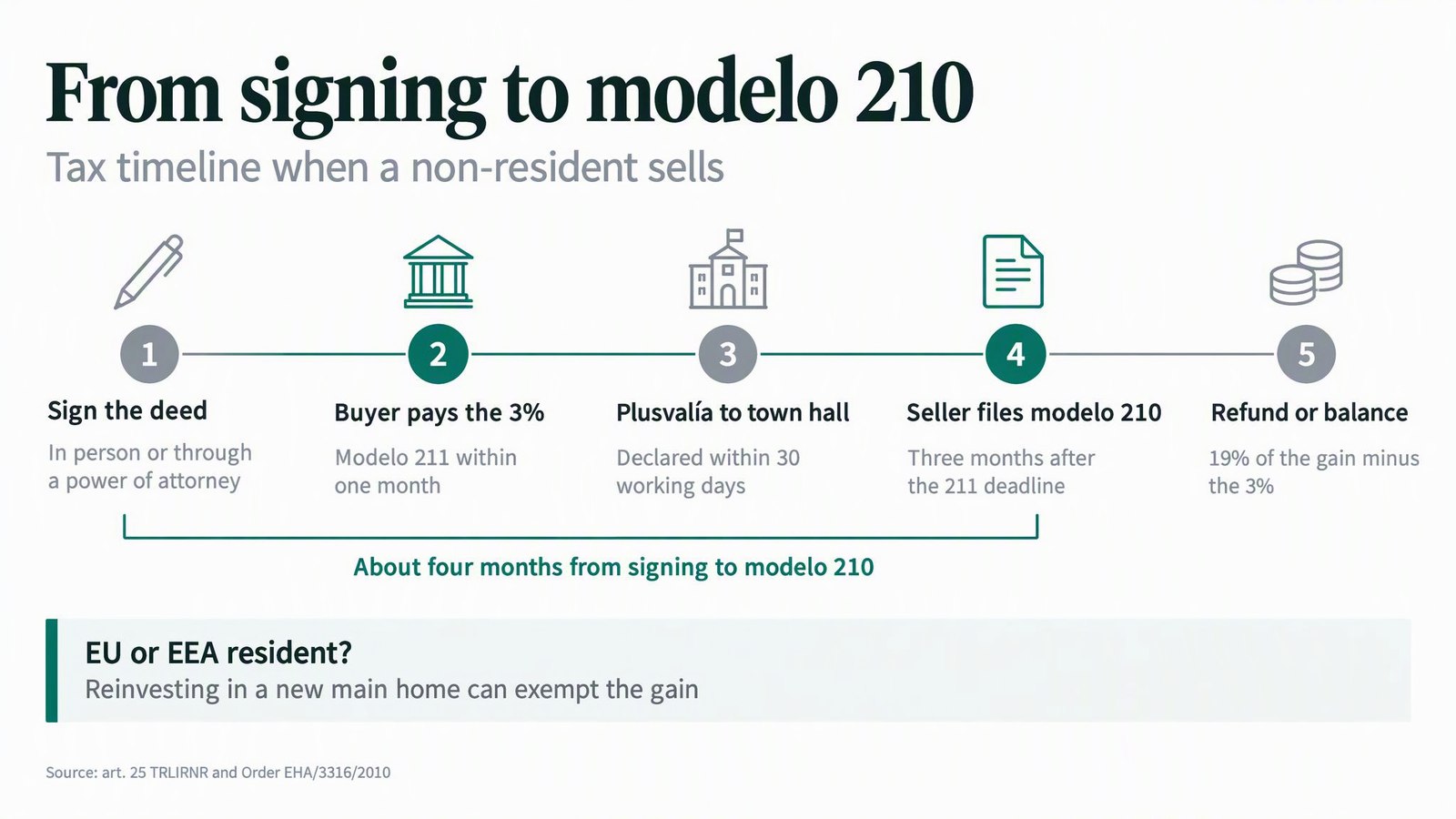
- Form: the buyer pays the 3% to the tax agency with modelo 211.
- Deadline: one month from the date of the sale.
- Your copy: the buyer must give you a copy of modelo 211, which you need to claim the amount in your own return.
- Protection for the treasury: if the buyer fails to pay, the property itself remains liable for the lower of the 3% and the tax due.
The 3% is only an advance. Your real bill is 19% of the gain, so the retention may turn out to be too much or too little.
How your capital gain is calculated
The taxable gain is the difference between what you obtain from the sale and what the property cost you, following Spanish income tax rules (art. 35 of Law 35/2006, applied to non-residents by art. 24.4 TRLIRNR).
- Acquisition value: the price you paid plus the taxes and costs of buying (transfer tax or VAT, notary, Land Registry, agency fees) and the cost of improvements. Ordinary repairs and maintenance do not count, and mortgage interest is excluded.
- Depreciation: if you rented the property out, the depreciation for those years (as a rule, 3% a year on the building, never the land) reduces the acquisition value.
- Transfer value: the actual sale price minus the costs and taxes you pay as seller, such as the estate agent’s commission or the municipal plusvalía. If the price is below market value, market value applies.
Keep every deed and invoice to justify each cost and improvement. A specialist legal service for selling your property in Spain gathers these documents before signing, so the gain is calculated correctly from day one.
An illustrative example for a home that was never rented out:
| Item | Amount |
|---|---|
| Purchase price | €200,000 |
| Purchase taxes and costs | + €20,000 |
| Improvements (new kitchen and windows) | + €15,000 |
| Acquisition value | €235,000 |
| Sale price | €320,000 |
| Selling costs (agency, plusvalía) | − €10,000 |
| Transfer value | €310,000 |
| Capital gain | €75,000 |
| Tax at 19% | €14,250 |
| 3% withheld by the buyer (on €320,000) | − €9,600 |
| Balance to pay with modelo 210 | €4,650 |
The 19% rate and what changes if you live outside the EU
Capital gains from selling Spanish property are taxed at a flat 19% for every non-resident individual, wherever they live (art. 25.1.f TRLIRNR). The 19% versus 24% split you may have read about applies to rental and imputed income, not to the gain on a sale.
Where you live still matters in other ways:
| EU or EEA resident | Resident elsewhere (UK, US, Canada…) | |
|---|---|---|
| Tax rate on the gain | 19% | 19% |
| Reinvestment exemption for a former main home | Available | Not available |
| Tax representative in Spain | Not required as a rule | Only if the tax agency requires it or there is no effective tax information exchange with your country |
Recovering or topping up the 3% with modelo 210
After the sale you file your own return, modelo 210, declaring the gain, applying the 19% rate and deducting the 3% the buyer paid. You must file it whatever the result: balance to pay, zero or refund.
- Deadline: within three months once the buyer’s one-month period for modelo 211 has ended, so roughly four months after signing (art. 5 of Order EHA/3316/2010, as amended by Order HAC/623/2026).
- Refunds: if the 3% exceeds your tax, or you sold at a loss, the difference is refunded to the bank account you indicate.
- Co-owners: each owner is taxed on their own share of the gain.
Missing this deadline is expensive. A late return carries surcharges, and if the tax agency detects an unpaid balance first, penalties start at 50% of the amount due (art. 191 of the General Tax Law).
Reinvestment exemption for EU and EEA residents
Residents of another EU member state, or of an EEA country with effective tax information exchange, can avoid tax on the gain from selling what was their main home in Spain if they reinvest the proceeds in a new main home (additional provision 7 TRLIRNR). The conditions follow Spanish income tax rules:
- The Spanish property must have been your main home, which as a rule means living there continuously for at least three years.
- It must still be your main home when you sell, or have been so at any time in the two years before the sale.
- The reinvestment must take place within two years of the sale (art. 41 of the Income Tax Regulation).
- If you reinvest only part of the money, only the proportional part of the gain is exempt. If the old home was financed, the amount to reinvest is reduced by the loan principal still pending at the time of sale.
The buyer still withholds the 3%. The exemption is applied in modelo 210 if you have already reinvested, or claimed later as a refund.
Plusvalía municipal: the town hall’s tax on land value
The town hall also charges the plusvalía municipal (IIVTNU), a tax on the increase in land value during your ownership, counting up to 20 years. Since Royal Decree-Law 26/2021 there are two methods, and you pay the lower result:
- Objective method: the land’s cadastral value at the time of sale multiplied by a coefficient that depends on the years of ownership. The maximum coefficients are set by law, and the latest update applies from 1 December 2026.
- Real gain method: the actual increase in land value, based on the difference between your sale and purchase prices and the share of the land in the cadastral value.
- No gain, no tax: if you can prove that the land did not increase in value, the sale is not subject to the tax (art. 104.5 TRLRHL).
The seller owes the tax, but when the seller is a non-resident individual the buyer becomes the substitute taxpayer (art. 106.2 TRLRHL), so buyers commonly hold back the estimated amount at signing. It must be declared within 30 working days of the sale, at a rate set by each town hall of up to 30%.
Documents and debts to clear before the notary
Buyers and notaries expect a clean file, so prepare these items before agreeing on a signing date:
- Energy performance certificate: a registered copy and the energy label must be attached to the sale contract (Royal Decree 390/2021). It is valid for up to ten years, or five if the rating is G.
- Community of owners certificate: in the deed you must declare that you are up to date with community fees and provide a certificate from the community secretary, unless the buyer expressly waives it. The property stays liable for unpaid fees of the current year and the three previous calendar years (art. 9.1.e of the Horizontal Property Act).
- IBI receipts: the property is liable for unpaid IBI, and the notary must ask about pending debts (art. 64 TRLRHL). The year’s IBI is owed by whoever owned the property on 1 January, so many contracts split it pro rata.
- Mortgage cancellation: any outstanding loan is usually repaid at signing from the price, and the bank’s cancellation deed is then recorded at the Land Registry.
Selling without travelling to Spain: power of attorney
You do not need to fly in for the signing. A power of attorney granted in your country of residence lets a trusted person or your lawyer sign the deed for you:
- At a Spanish consulate: the consul acts as a notary, and the document can be used in Spain without an apostille or translation.
- Before a local notary: the power needs the Hague Apostille (or legalization if your country is not part of the convention) and a sworn translation if it is not in Spanish.
- Content: it should include specific powers to sell the identified property, receive the price, deal with the plusvalía and cancel any mortgage.
Step-by-step checklist for a non-resident seller
- Gather your file: passport, NIE, purchase deed, invoices, last IBI receipt and cadastral reference.
- Order the certificates: energy performance certificate and community debt certificate (the secretary has seven calendar days to issue it).
- Estimate your taxes: the gain, the 19% tax, the 3% and the plusvalía, and check the reinvestment exemption if it applies.
- Sign the private contract with the buyer, usually with a deposit (arras).
- Sign the public deed at the notary, in person or through a power of attorney: the buyer withholds the 3% and usually the plusvalía, and any mortgage is cancelled.
- Collect the buyer’s modelo 211 once it has been paid within the month.
- File modelo 210 within the following three months to pay the balance or claim your refund.
The year of the sale still counts for your annual obligations: until the day you sell, you owe tax on imputed income or rent, as explained in our guide to the yearly taxes for non-resident property owners, so leave nothing pending.
Selling your Spanish home from abroad? Our bilingual lawyers in Valencia check your figures, coordinate the notary and file modelo 210 for you, so the 3% comes back when it should. Schedule a consultation with our team before you accept an offer.
Frequently asked questions
Will I also pay tax on the gain in my home country?
Possibly. Spain taxes the gain because the property is here, and your country of residence may tax it too. Tax treaties usually avoid double taxation with a credit for the Spanish tax, so keep proof of payment.
What happens if I sell at a loss?
You still file modelo 210, declaring the loss, to recover the full 3% the buyer withheld. For the plusvalía, a sale with no increase in land value is not taxed, but you must declare it and prove it with the deeds.
What if the buyer never pays the 3%?
The buyer faces penalties, and the property remains liable for the lower of the retention and your tax. Ask for the paid modelo 211 soon after signing, because you need it to deduct the 3% in your own return.
Does Brexit change anything for UK sellers?
UK residents are treated like any other non-EU resident. The gain is still taxed at 19%, but the reinvestment exemption for a former main home in Spain is not available to them.
Every case has its own details. Our English-speaking lawyers in Valencia can review your situation and advise you on the best way forward. Get in touch with us for tailored legal advice.
