


Thousands of international couples build their life in Valencia, Alicante or Madrid without ever becoming Spanish. When the relationship ends, the first questions are rarely emotional ones: can we divorce here at all, will a Spanish judge apply British, German or American law, and will the divorce be valid back home?
The good news is that divorce in Spain for foreigners follows clear EU rules. In most cases, if you both live in Spain, Spanish courts can hear the case and Spanish law applies. What changes is the paperwork, the route you choose and how you protect your children and your assets across borders.
Can you get divorced in Spain if you are not Spanish?
Nationality is not the main test. Spanish courts decide whether they can hear a divorce under Regulation (EU) 2019/1111 (known as Brussels II ter), which looks above all at where the spouses habitually live. Under Article 3 of that regulation, Spanish courts have jurisdiction if, among other options:
- Both spouses are habitually resident in Spain.
- Spain was your last common habitual residence and one of you still lives here.
- The respondent (the spouse who receives the claim) lives in Spain.
- You file a joint application and either of you lives in Spain.
- The applicant has lived in Spain for at least one year before filing, or six months if they are also a Spanish national.
- Both spouses are Spanish nationals.
In practice, an expat couple who have settled in Spain can almost always divorce here. A specialist divorce lawyer for international couples will check the facts first, because filing in the wrong country can waste months and, in some cases, let the other spouse “win the race” to a court system that suits them better.
Which country’s law will the judge apply?
Jurisdiction (which court) and applicable law (which rules) are two different questions. Spain takes part in Regulation (EU) 1259/2010, known as Rome III, which decides the law that governs the divorce itself.
Spouses can choose the applicable law in writing, but only among certain options. If they have not chosen, Article 8 of Rome III sets a cascade:
- The law of the country where both spouses are habitually resident when the case is filed.
- Failing that, the law of their last common habitual residence, if it ended less than a year before filing and one spouse still lives there.
- Failing that, the law of their common nationality.
- Failing that, the law of the court where the case is heard.
For most couples living in Spain, the result is Spanish divorce law, which is one of the most straightforward in Europe: no fault, no separation period and no need to prove that the marriage has broken down.
What Spanish law requires to divorce
Under the Spanish Civil Code (arts. 81, 86 and 87 CC), either spouse can ask for a divorce once three months have passed since the wedding. The other spouse cannot block it. The three-month wait does not apply when there is a risk to the life, physical integrity or freedom of the applicant or the children.
The key document is the regulatory agreement (convenio regulador, art. 90 CC). It sets out what happens after the divorce:
- Custody of the children and the visiting schedule.
- Who uses the family home and for how long.
- Child support and, if appropriate, spousal compensation.
- How the shared assets and debts are divided.
Three routes: notary, mutual consent in court or contested divorce
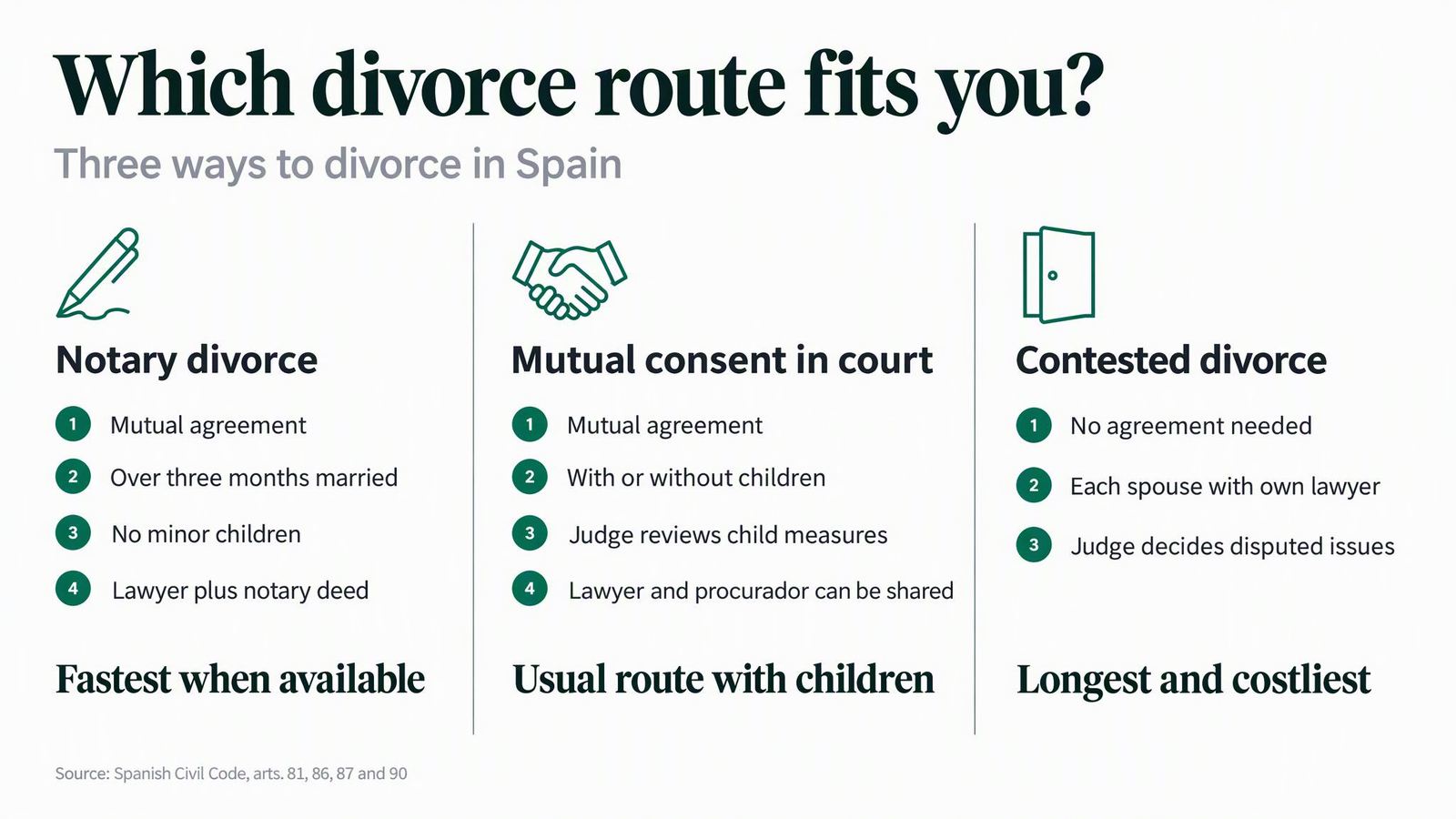
How fast and how expensive your divorce will be depends mostly on whether you agree. Spanish law offers three routes, and the notary option is the quickest when it is available.
| Route | When it is possible | Who you need | What to expect |
|---|---|---|---|
| Notary divorce | Mutual agreement, more than three months married and no minor children or adult children who need support measures | A lawyer to draft the agreement and a notary; both spouses sign in person | Usually the fastest option, often a matter of weeks once you agree |
| Mutual consent in court | Mutual agreement, with or without children | Lawyer and court representative (procurador), which can be shared | The judge and the public prosecutor review any measures for the children |
| Contested divorce | No agreement on one or more issues | Each spouse with their own lawyer and procurador | A full court case, which commonly takes many months |
A contested case can turn into a mutual consent divorce at any point if you reach an agreement. Negotiating early is usually the best way to keep costs and stress under control, especially when one spouse lives abroad.
Step by step: how an international divorce works in Spain
- Legal check: confirm that Spanish courts have jurisdiction and which law applies.
- Documents: gather the marriage certificate (legalized or apostilled and translated if issued abroad), children’s birth certificates, NIE or passports and proof of residence.
- Agreement or claim: draft the regulatory agreement or, if there is no agreement, the divorce claim.
- Signature: sign at the notary or file at the family court of your place of residence.
- Decision: the notary deed or the court decree dissolves the marriage.
- Registration: the divorce is noted in the Spanish Civil Registry where the marriage is recorded, or where it needs to be registered.
If your marriage took place abroad and was never registered in Spain, your lawyer will tell you whether it needs to be registered first. Foreign documents need an apostille (or legalization) and a sworn translation into Spanish.
Children: custody, support and moving abroad
Decisions about the children follow their own rules. Under Brussels II ter, the courts of the country where the child habitually lives are generally the ones that decide custody and visiting rights, even if the parents are not Spanish.
Spanish family courts look at the best interests of the child. Shared custody is frequent when both parents are involved and live close to each other, but each case is assessed on its own facts.
A parent cannot unilaterally move children to another country after a separation. Relocation needs the other parent’s consent or a court decision; otherwise it can amount to international child abduction under the 1980 Hague Convention.
What happens to your property and assets
Dividing assets depends on your matrimonial property regime, which is not always Spanish even if you divorce in Spain. For marriages celebrated after 29 January 2019, Regulation (EU) 2016/1103 generally points to the law of your first common habitual residence after the wedding. For older marriages, Spanish courts apply their own conflict rules, which often lead to the law of your common nationality.
This matters a great deal if you own a home in Spain: under some laws everything acquired during the marriage is shared, under others each spouse keeps what they bought. We explain the options in our guide to what happens to your Spanish property in a divorce.
Will your Spanish divorce be valid in your home country?
Within the European Union, a Spanish divorce decree is recognized in the other EU countries without any special procedure, under Brussels II ter. The picture is different outside the EU.
- United Kingdom: since Brexit, recognition in England and Wales follows the Family Law Act 1986. A divorce obtained through proceedings in Spain is generally recognized if, when the case started, either spouse was habitually resident or domiciled in Spain, or was a Spanish national.
- Notary divorces outside the EU: if you need the divorce recognized in a non-EU country, check beforehand whether that country accepts a notarial deed. A court decree is often the safer choice.
- Foreign divorces in Spain: a divorce granted outside the EU (including a UK divorce) usually needs to be recognized in Spain through exequatur under Law 29/2015 before it can be recorded in Spanish registries or used to sell property.
Thinking about recognition before filing avoids a common trap: being divorced in one country and still married on paper in another.
Planning a divorce in Spain? Our bilingual family lawyers in Valencia explain your options in English, coordinate documents from abroad and protect your children and assets. Book a free consultation.
Frequently asked questions
Can we divorce in Spain if we married in another country?
Yes. Where you married does not decide where you divorce. What matters is habitual residence and, in some cases, nationality. You will need your foreign marriage certificate with an apostille and a sworn Spanish translation.
Do both spouses have to be in Spain to sign?
For a notary divorce, yes: both spouses must sign the deed in person before the Spanish notary (art. 82 CC), and a power of attorney is not enough. In a court divorce, a spouse who lives abroad can usually be represented by a lawyer and procurador, although the court may ask them to ratify the agreement, and courts handle this differently.
Can I divorce in Spain if my spouse does not want to?
Yes. Spanish law does not require the other spouse’s consent or any reason. If there is no agreement, the case goes to court as a contested divorce, and the judge decides on the disputed issues.
How long does an international divorce take in Spain?
It depends on the route and on how quickly foreign documents arrive. A notary divorce can be completed in weeks, a mutual consent court divorce usually takes a few months, and a contested case commonly takes much longer.
Every case has its own details. Our English-speaking lawyers in Valencia can review your situation and advise you on the best way forward. Get in touch with us for tailored legal advice.
