


Most international couples who separate in Spain are not looking for a court battle. They have already agreed who keeps the apartment, how to split the savings and what happens with the pension back home, and they want the simplest legal way to make it official. For many of them, that way is a notary divorce in Spain: a mutual consent divorce signed as a public deed, without a judge.
Since July 2015, Spanish law has allowed couples without minor children to divorce by mutual consent before a notary. The procedure works well for expats, but the details decide how fast it goes: certificates issued abroad, a spouse who lives in another country and the recognition of the divorce back home. Here is the practical side, with and without children.
Who can divorce before a notary in Spain
The notary route is regulated in arts. 82 and 87 of the Civil Code and art. 54 of the Notaries Act (Ley del Notariado). It is only available if every one of these conditions is met:
- Full agreement on the divorce and on all its effects. A partial agreement does not qualify.
- More than three months have passed since the wedding.
- There are no minor children who are not emancipated, and no adult children with court-ordered support measures assigned to their parents.
- Both spouses sign in person, assisted by a practicing lawyer. One lawyer can advise both of you when there is no conflict.
- The notary practices where you had your last common home, or where either of you lives.
Adult children who have no income of their own and still live in the family home must also consent, before the notary, to the measures that affect them. And although Spanish consuls act as notaries for many purposes, they cannot authorize a divorce deed (art. 87 CC).
Being a foreigner does not exclude you, but it adds checks. The notary must be satisfied that Spain has jurisdiction under Regulation (EU) 2019/1111 and that the agreement complies with the applicable law, which is why an English-speaking divorce lawyer in Valencia normally reviews those points before you book the appointment.
Notary, court clerk or judge: which mutual consent route fits you
Spanish law offers three ways to formalize an agreed divorce. The right one depends mainly on your children and on whether both of you can sign in Spain.
| Notary | Court clerk | Family court judge | |
|---|---|---|---|
| When available | No minor children or adult children with support measures | Same conditions as the notary | Always, and the only option with minor children |
| Professionals | Lawyer (one can act for both) | Lawyer and court representative (procurador), which can be shared | Lawyer and procurador, which can be shared |
| How you consent | Both spouses sign the deed in person | Each spouse ratifies the petition separately | Each spouse ratifies the petition separately |
| Who reviews the terms | The notary | The court clerk (letrado de la Administración de Justicia) | The judge, with a report from the public prosecutor on the children |
| Divorce takes effect | When the deed is signed | When the decree becomes final | When the judgment becomes final |
If the notary or the court clerk considers that a clause could be harmful or seriously prejudicial to one spouse or to an affected adult child, they will warn you and close the file. From then on, only a judge can approve the agreement (art. 90.2 CC).
The notary is usually the quickest route because no court calendar is involved. The court routes, however, are more flexible when one spouse cannot travel to Spain, as explained below.
Documents for an international couple: apostille and sworn translation
Most delays come from paperwork issued abroad, so request it early. A typical file includes:
- Passports and NIE of both spouses.
- The full marriage certificate.
- Proof of residence, such as the municipal registration certificate (padrón), which shows which notary or court is competent.
- Birth certificates of any children.
- Property papers if the agreement divides assets: title deeds, Land Registry extracts, mortgage statements and bank balances.
- Any prenuptial agreement or marriage contract, whether signed in Spain or abroad.
Public documents issued outside Spain usually need an apostille and a sworn translation into Spanish by a translator appointed by the Spanish Ministry of Foreign Affairs. Between EU countries, Regulation (EU) 2016/1191 removes the apostille for civil status documents such as marriage certificates, and an optional multilingual standard form can make the translation unnecessary.
If you married abroad and the marriage was never recorded in Spain, that does not block the divorce. Following a 2021 resolution of Spain’s registries authority, the notary sends the deed and your marriage documents to the Central Civil Registry so that the marriage is recorded as the basis for the divorce entry.
Step by step: how a notary divorce works for expats
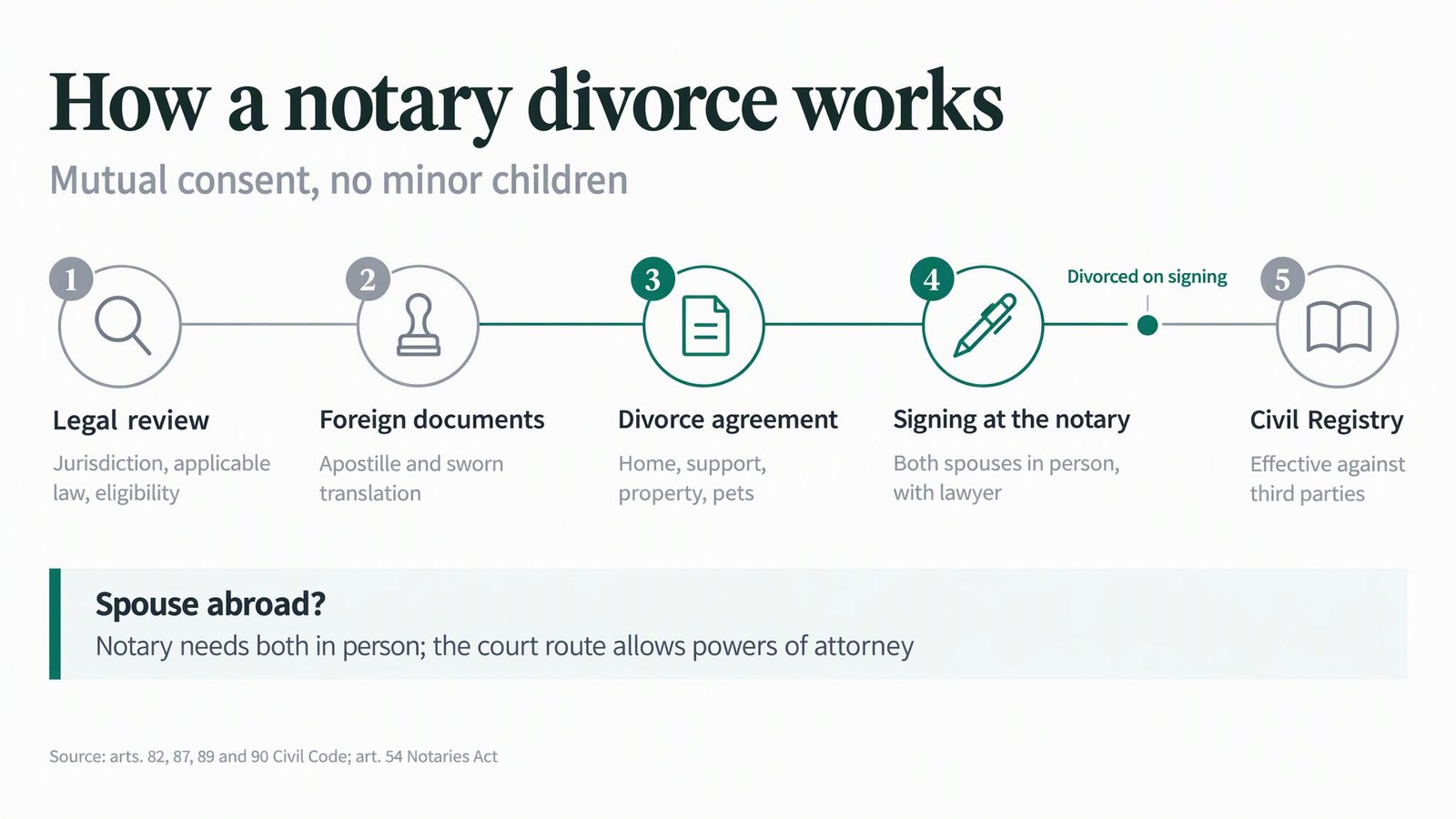
- Initial review: your lawyer confirms that Spain has jurisdiction, which law applies and whether you qualify for the notary route.
- Documents: you gather certificates, apostilles and sworn translations, plus the papers on any property you will divide.
- Agreement: the lawyer drafts the regulatory agreement and you both review it until every clause is settled.
- Appointment: you book a notary at your last common home or where either of you lives.
- Signature: both spouses sign the deed in person, with the lawyer present. The divorce takes effect at that moment (art. 89 CC).
- Registration: the divorce is recorded in the Civil Registry, which is what makes it effective against third parties acting in good faith.
If either of you does not understand Spanish well, you can ask for the deed in two columns, Spanish and English, or bring an interpreter of your choice (art. 150 of the Notarial Regulation). Once signed, the agreements in the deed can be enforced directly if one spouse fails to comply, without starting a new lawsuit (art. 90.2 CC).
What the divorce agreement must include
The heart of any agreed divorce is the regulatory agreement (convenio regulador). Under art. 90 CC, it must cover, at least and where relevant:
- The care of the children, how parental authority is exercised and the time each parent spends with them (court route only).
- Who keeps any pets, how time with them is shared and who pays for their care.
- Who uses the family home and its furniture.
- Contributions to family expenses and child support, with how they are updated and secured.
- The liquidation of the matrimonial property regime, when there is one to liquidate.
- Any compensatory payment to the spouse whose finances are worse off after the divorce (art. 97 CC).
For international couples, a good agreement goes beyond the legal minimum. It should fix the currency of every payment, explain how support is paid if one of you moves country and say what happens to bank accounts, investments or pensions held abroad.
Property deserves particular care, because the rules that govern your assets are not always Spanish even when the divorce is. If you own a home together, read our guide to dividing Spanish property in an international divorce before you sign.
Divorcing when one spouse lives abroad
This is the most common obstacle for expat couples, and the answer is very different at the notary and in court. The Civil Code is explicit about the notary route:
“The spouses must take part in the signing personally, although they must be assisted by a practicing lawyer.” (art. 82 CC, applied to divorce by art. 87 CC)
In practice, a power of attorney is not enough for a notary divorce: both of you must sign personally before the Spanish notary. If one spouse cannot travel, the court route is usually the solution:
- Power of attorney: the spouse abroad grants a power to the lawyer and the procurador, signed before a local notary (with apostille and sworn translation) or at a Spanish consulate. With a Spanish digital certificate, it can also be granted online through the courts’ electronic portal (art. 24 LEC).
- Ratification: after filing, each spouse must confirm the petition separately (art. 777.3 LEC). Some courts accept ratification by the procurador under a special power of attorney that includes the full agreement; others require the spouse to ratify personally, sometimes through another court or by videoconference. Check how your court works before filing.
Registration and recognition outside Spain
Within the EU (except Denmark), Regulation (EU) 2019/1111 treats divorce agreements formalized by a public authority like court decisions: they are recognized without any special procedure, provided Spain had jurisdiction. Ask the notary for the EU certificate set out in Annex VIII of the Regulation if you will use the divorce in another Member State. Outside the EU, the picture changes:
- United Kingdom: the Family Law Act 1986 treats divorces obtained “by means of proceedings” differently from others and does not fully define proceedings, so the recognition of a notarial divorce in England and Wales is less settled than that of a court decree. If you will need it there, decide the route with that in mind.
- United States: recognition is a matter of state law, generally based on comity, so the answer can vary from one state to another.
- Other countries: some authorities are unfamiliar with divorces granted by a notary. A court decree with an apostille and translation is often the safer document.
Think about where you will use the divorce, whether for a new marriage, a pension or a property registry, before choosing between notary and court.
Have you agreed on the divorce but not on the route? Our bilingual team in Valencia checks your documents, explains every clause of the agreement in English and coordinates the signing with your travel plans. Request your free consultation and we will tell you which route fits your case.
Frequently asked questions
Can we divorce at a notary if our only child is over 18?
Yes, as long as the child has no court-ordered support measures assigned to the parents. If the adult child has no income and still lives at home, they must also consent before the notary to the clauses that affect them, such as support.
Can we choose which country’s law governs our divorce?
Yes, within limits. Under art. 5 of Regulation (EU) 1259/2010 (Rome III), you can agree on the law of your habitual residence, of your last common residence if one of you still lives there, of either spouse’s nationality, or of the court hearing the case.
What happens if one of us changes their mind?
Before signing at the notary, either spouse can walk away. In court, if one spouse does not ratify the petition, the case is closed and the divorce can only continue as a contested case (art. 777.3 LEC).
Can we change the agreement after the divorce?
Yes. Measures agreed before a notary or a court clerk can be changed by a new agreement that meets the same requirements. Measures approved by a judge can also be modified by the court when the children’s needs or the spouses’ circumstances change (art. 90.3 CC).
Every case has its own details. Our English-speaking lawyers in Valencia can review your situation and advise you on the best way forward. Get in touch with us for tailored legal advice.
