

A familiar scene in Valencia: an expat family has settled here, the eldest child has found a job and wants to buy a first apartment, and the parents want to help with the deposit. The money may sit in a UK, Dutch or US account, and nobody is sure whether Spain will tax it.
Cash gifts to children in Spain are usually cheap in the Valencia region, but only if the paperwork is right. The tax falls on your child, depends on where they live, and the generous regional bonus is lost if the gift is not formalized properly. This guide covers money only; gifting a property you already own works very differently.
When Spain taxes a gift of money
Spanish gift tax (Impuesto sobre Sucesiones y Donaciones) is paid by the person who receives the gift. Where you, the parent, live does not decide whether Spain taxes it. What matters is your child’s tax residence and where the money is.
| Your child’s situation | Spanish gift tax? | Which regional rules |
|---|---|---|
| Lives in Spain | Yes, on any gift, wherever the money comes from (art. 6 Law 29/1987) | The region where your child spent most days in the previous five years (arts. 28 and 32 Law 22/2009) |
| Lives abroad, money in Spain | Yes, on money held in Spain (art. 7 Law 29/1987) | The region where the money was held longest in the previous five years (additional provision 2 Law 29/1987) |
| Lives abroad, money abroad | No | Not applicable |
Tax residence follows Spanish income tax rules: as a rule, spending more than 183 days a year in Spain makes your child resident. Families who arrived recently, or who moved between regions, should check the five-year rule before the transfer, because it decides which region’s rules apply.
Your own country may also tax the gift on your side. If a similar tax is paid abroad on a gift of money held outside Spain, a child resident in Spain can deduct it from the Spanish tax, within limits (art. 23 Law 29/1987).
Gift tax in Valencia for children, spouses and parents
In 2026, the Valencian rules for close family combine an allowance that reduces the taxable amount with a bonus on the tax itself (arts. 10 bis and 12 bis of Valencian Law 13/1997):
- Children under 21: €100,000 allowance plus €8,000 for each year under 21, up to €156,000.
- Children aged 21 or over, spouses and parents: €100,000 allowance. Grandchildren and grandparents get the same allowances.
- 99% bonus on the resulting tax for spouses, parents, children, grandchildren and grandparents.
- Five-year look-back: gifts from the same donor in the previous five years count toward the same allowance.
Take €150,000 given by one parent to a 30-year-old child with modest existing wealth. After the €100,000 allowance, €50,000 is taxable, the tax is about €4,976, and the 99% bonus brings it down to about €50. If each parent gives €75,000 of their own money, each gift stays within its own allowance and no tax is due, although the returns must still be filed. Because these allowances work per donor and over five years, they are worth using as part of long-term gift and inheritance planning rather than one transfer at a time.
Deed, source of funds and payment trail
The Valencian allowance and bonus are not automatic. Both require the gift to be made in a public document, or formalized that way within the filing deadline. For money, the law adds a further condition:
When the gift consists of cash or bank deposits, the bonus only applies if the origin of the funds is duly justified and the document formalizing the gift states that origin and identifies the actual means by which the gift is delivered. (Art. 12 bis.4 Valencian Law 13/1997, our translation)
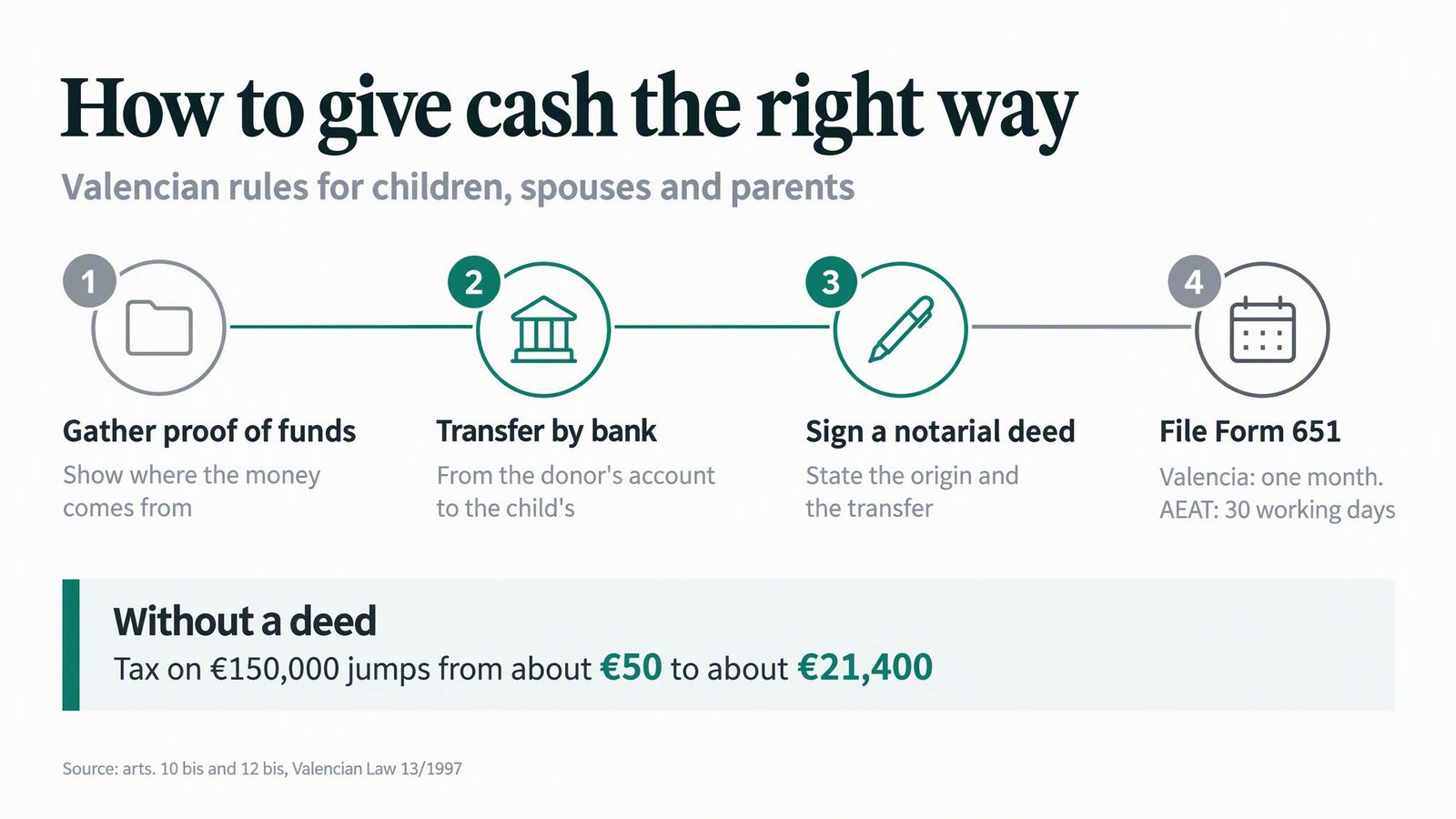
In practice, a compliant cash gift follows four steps:
- Gather proof of funds: statements or documents showing where the money comes from, such as savings or the sale of an asset.
- Transfer by bank: from the donor’s account to the child’s account, never in banknotes.
- Sign a notarial deed: before a Spanish notary, stating the amount, the origin of the money and the transfer details.
- File Form 651: with the deed attached, within the deadline that applies to your child.
Small gifts have a lighter route. If gifts of money between the same donor and child do not exceed €4,000 over three years, a document signed digitally through a qualified trust service can replace the notarial deed, as long as the origin of the funds is shown.
Filing Form 651 on time
The child, not the parent, files the return. Where and when depends on residence:
- Child resident in the Valencia region: Form 651 with the Valencian Tax Agency, within one month of the gift.
- Child not resident in Spain: Form 651 with the Spanish Tax Agency (AEAT), within 30 working days. Non-residents can apply the rules of the region where the money was held and need a Spanish tax ID.
- Late filing: the 99% bonus only covers money fully declared in a return filed on time, or late but before any request from the tax office (art. 12 bis.3 Valencian Law 13/1997).
The cost of getting it wrong is real. On the same €150,000 gift without a deed or proof of funds, the allowance and the bonus both disappear and the tax rises to about €21,400 instead of about €50.
Family loans as an alternative
Some parents prefer to lend rather than give, either because they want the money back or because they want to treat several children equally. A family loan is not a gift, so there is no gift tax, but it must look and work like a real loan.
| Cash gift | Family loan | |
|---|---|---|
| Document | Notarial deed stating origin and payment method | Written loan contract; a private document is enough |
| Tax form | Form 651 (gift tax) | Form 600, filed by the borrower: the loan is exempt from transfer tax (art. 45.I.B.15 Royal Legislative Decree 1/1993) but must be declared |
| Valencian deadline | One month | One month from signing |
| Repayment | None | Real repayments, ideally by bank transfer, on the agreed schedule |
Two points deserve attention. If the lender is a Spanish tax resident, income tax law presumes that loans earn a return unless proven otherwise (art. 6.5 Personal Income Tax Law), so an interest-free loan needs to be clearly documented. And a loan that is never repaid can be treated as a disguised gift; since it was never declared as a gift, the 99% bonus would not protect it.
Moving the money: cash declarations and the bank
Bank transfers from abroad do not need to be declared at the border, whatever the amount. Physical cash is different. Under art. 34 of Law 10/2010 on anti-money laundering, you must declare in advance:
- Cash and other means of payment of €10,000 or more carried into or out of Spain (Form S1 within the EU, Form E1 for countries outside the EU).
- Movements of €100,000 or more within Spain.
- Undeclared amounts can be provisionally seized by customs or police (art. 35 Law 10/2010).
Your child’s bank will also look at the transfer: Spanish banks must monitor operations against what they know about the customer, including the origin of the funds (art. 6 Law 10/2010). Three documents answer most questions before they become a blocked payment:
- The notarial gift deed.
- Proof of where the money comes from.
- A transfer record showing the money left the donor’s own account.
If what you want to pass on is a home you already own rather than money, the tax picture changes completely, because you would also pay tax on the gain. We cover that case in our guide to gifting a Spanish property to your children, with a side-by-side comparison of gifting now and inheriting later.
Helping your child buy a home in Spain? We draft the gift deed or the family loan, prepare Form 651 or Form 600 and make sure the Valencian bonus applies. Get advice before you transfer the money.
Frequently asked questions
Is there a tax-free amount I can give each year in Spain?
Spain has no general annual gift exemption. Every gift is in principle taxable for the recipient. In the Valencia region, close family relies on the allowance and the 99% bonus instead, and the allowance counts all gifts from the same donor over five years.
Does my child pay income tax on the money as well?
No. Income that is subject to gift and inheritance tax is not subject to personal income tax (art. 6.4 Personal Income Tax Law). Any interest the money earns after the gift is, of course, taxed as normal income.
Can both parents give money in the same deed?
Yes. Each parent is a separate donor for the part that comes from their own funds, and each gift benefits from its own allowance. The deed should make clear how much each parent gives and from which account.
Do I, as the parent, pay any Spanish tax on a cash gift?
Giving euros does not create a capital gain for you in Spain. That is the key difference with gifting assets that have grown in value, such as property or shares, where the donor may owe tax on the gain.
Every case has its own details. Our English-speaking lawyers in Valencia can review your situation and advise you on the best way forward. Get in touch with us for tailored legal advice.
