


When you buy a home or investment property in Spain, one of the earliest strategic decisions is who should appear as owner on the title: you personally, or a company (Spanish or foreign). This choice affects your taxes, privacy, financing options and even how easy it will be to sell or pass the property on in the future.
There is no universal “best” option. The right structure depends on your profile as an expat or foreign investor, the value of the property, whether you will live in it, rent it out or hold several properties, and your tax position in Spain and abroad.
Understanding the basic options for owning Spanish property
Broadly, international buyers in Spain use three ownership models:
- Personal ownership – you (or you and your partner) appear as individuals on the title deed.
- Spanish company ownership – usually a Sociedad Limitada (S.L.), Spain’s standard limited liability company.
- Foreign company ownership – e.g. a UK Ltd, US LLC or holding company that buys directly in Spain.
Each option has different implications for income tax, wealth tax, capital gains tax, inheritance, privacy, banking and compliance. For most expats and digital nomads buying a main home or holiday home, personal ownership is more efficient. For larger portfolios or purely investment-driven purchases, a company may be worth considering.
Key question: buying property via a company or as an individual in Spain?
Before choosing, it helps to be very clear on three points:
- Intended use: Will this be your main residence, a holiday home, a long-term rental, a short-term tourist rental, or part of a wider portfolio?
- Your tax residency: Are you (or will you become) Spanish tax resident, or remain non-resident? Will you use regimes like the Beckham Law?
- Investment scale: Is this a single apartment in Valencia, or the first of several properties you expect to acquire?
With those answers, you can start comparing the pros and cons of buying as an individual versus through a company.
When buying in your own name is usually the better choice
For many expats, retirees and digital nomads relocating to Valencia or elsewhere in Spain, personal ownership is the simplest and most tax-efficient approach, especially when:
- It is your main home or a family holiday home.
- You buy one or two properties rather than building a large portfolio.
- You do not need corporate structuring or asset segregation.
Advantages of buying Spanish property as an individual
1. Simpler process and lower ongoing costs
Buying as an individual is straightforward: you obtain a NIE, open a bank account, sign the purchase deed and then comply with standard personal tax obligations.
- No company incorporation costs or share capital.
- No annual company accounts, corporate tax returns or bookkeeping fees.
- Fewer interactions with the Spanish Tax Agency (Agencia Tributaria).
For a typical foreign buyer with one property, the annual accounting and compliance costs of a company often exceed any tax savings.
2. Favorable treatment for your main residence
If you become tax resident in Spain and the property is your habitual residence, Spanish law offers several advantages that only apply to individuals, for example:
- Potential capital gains tax relief when you sell your main home and reinvest the proceeds in a new main residence (subject to conditions and time limits).
- Specific main-home allowances: in wealth tax, up to €300,000 of the value of your main home is exempt, and in inheritance tax close relatives can apply a reduction on the deceased’s main home, subject to conditions.
- In some municipalities, rebates on local property tax (IBI) for large families.
A company cannot treat a property as a “main residence”; it is always a business asset, which changes the tax logic completely.
3. Clear rules for personal use
If you own the property personally and use it yourself, the tax rules are relatively clear:
- As a non-resident owner, you pay non-resident income tax each year on an imputed income of 1.1% or 2% of the cadastral value (1.1% where the value was revised from 1994 onward), taxed at 19% if you live in the EU/EEA or 24% otherwise.
- As a Spanish tax resident, if the property is your main home, you do not pay imputed income tax on it.
When a company owns the property and you use it personally, the company is expected to charge you a market rent under related-party rules. That rent is taxable income for the company, and if nothing is charged, the tax office can adjust the company’s profit and treat the free use as a taxable benefit for you. This often makes company ownership unattractive for pure personal use.
4. Easier mortgage access for many foreign buyers
Spanish banks are generally more comfortable lending to individual borrowers than to newly created property companies, especially when the buyer is a foreigner with no Spanish business track record. As an individual you typically benefit from:
- More lenders willing to consider your application.
- Lower down payments than those usually required from companies.
- More competitive interest rates and fewer additional guarantees.
Disadvantages of buying in your own name
1. Limited expense deduction for rental activity
If you rent out the property, you pay tax on rental income in your personal tax return (or via non-resident income tax, IRNR). The rules differ depending on whether you are Spanish tax resident and, if not, whether you live in the EU/EEA:
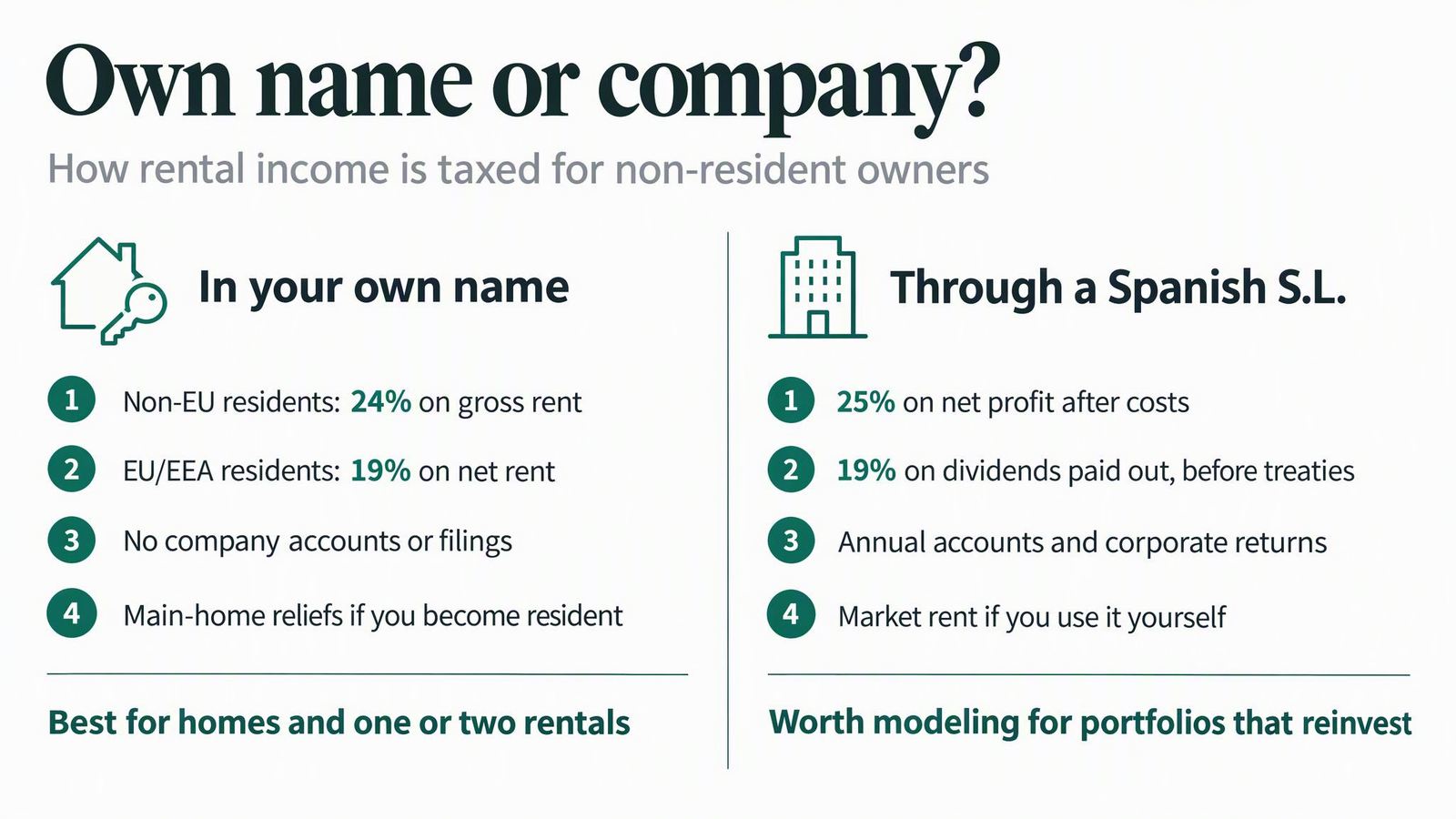
- Non-resident owners from outside the EU/EEA are taxed at 24% on gross rental income, with no deduction for running costs.
- Non-resident owners living in the EU/EEA pay 19% on net rental income, after deductible expenses.
- Spanish tax residents can deduct expenses, and long-term residential rentals can reduce net rental income by at least 50%, but the rest is taxed at progressive rates that can exceed the 25% corporate rate.
For a single modest rental, this is still often simpler than running a company. But as rental activity scales, the inability to optimize deductions can become a real disadvantage.
2. Direct exposure of the asset to personal liabilities
Owning property personally means it forms part of your personal estate. In the event of claims, divorce, or business liabilities in your home country, the Spanish property may be reachable by creditors, depending on the jurisdiction and enforcement mechanisms.
Using a properly structured company can create a degree of asset segregation, although cross-border enforcement is a complex, case-specific issue that requires specialist advice.
3. Less flexibility for complex succession planning
For straightforward family situations, personal ownership plus a Spanish will prepared with an inheritance lawyer is usually sufficient. But if you have:
- Heirs in multiple countries,
- Children from different relationships, or
- Substantial international assets,
it may sometimes be easier to manage succession via company shares than via direct property co-ownership. This is more relevant for higher-net-worth profiles.
When buying through a Spanish company can make sense
Buying Spanish property via a Spanish S.L. is relatively common among professional investors and non-resident landlords, but it is not a default solution for every foreign buyer. It tends to be interesting when:
- The property is clearly an investment asset, not a personal home.
- You plan to rent it out long term or operate tourist rentals with the proper registration.
- You hold or plan to hold multiple properties in Spain.
- You already operate a business and want to integrate Spanish real estate into a corporate structure.
Key tax advantages of using a Spanish S.L. for property
1. Deductibility of running costs and financing
An S.L. that owns a rental property can deduct a wide range of expenses from its taxable income:
- Community fees, IBI (local property tax) and waste collection tax.
- Insurance, utilities, internet and security systems.
- Maintenance, repairs and certain improvements.
- Marketing, property management fees and cleaning (for rentals).
- Interest on loans and, where applicable, intra-group loans (subject to transfer pricing rules).
The resulting net profit is taxed at the Spanish corporate tax rate of 25%. A company that simply holds and rents out property usually counts as a holding company (entidad patrimonial) for corporate tax, so the reduced rates for small businesses introduced from 2025 do not apply to it. For non-resident individuals taxed at 24% on gross rental income with no deductions, the company route can still be a major improvement.
Example: A non-EU investor earns €30,000 in annual rent and has €12,000 in annual running costs.
- As an individual non-resident: taxed at 24% on €30,000 = €7,200 (no cost deduction).
- Through an S.L.: profit = €18,000; tax at 25% = €4,500. Tax saving ≈ €2,700/year while the profit stays in the company.
The saving shrinks when you take the money out. If the company pays the remaining €13,500 to you as a dividend, Spain withholds 19% (€2,565) from a non-resident shareholder, unless a double tax treaty reduces that rate. The total then reaches €7,065, almost the same as owning directly, and that is before accounting fees. The numbers work best when profits stay in the company to be reinvested.
2. Potential VAT (IVA) advantages on certain operations
In some structures, especially for new builds or commercial properties intended for genuine economic activity, a company may be able to deduct VAT on the purchase and ongoing expenses. This is highly technical and depends on the activity (tourist rentals with hotel-type services, offices, co-living, etc.). Long-term residential rentals are exempt from VAT, so this rarely helps with an ordinary rental apartment, and it is not available to individuals buying for personal use.
3. Flat corporate tax rate vs progressive personal rates
Individuals who are Spanish tax resident may face progressive income tax rates that can exceed 40% in higher bands. A company pays a flat 25% on profits, and dividends later paid to resident shareholders are taxed at savings rates of 19% to 30%. For high-income investors, this rate differential can be relevant, especially when profits are reinvested rather than extracted as personal income.
4. More flexible structuring for multiple investors
If you buy with partners (friends, siblings, business associates), an S.L. allows you to:
- Define ownership via share percentages,
- Set decision-making rules in the bylaws or shareholders’ agreement, and
- Buy and sell shares without changing the name on the property title.
This can simplify exits, buy-outs and bringing in new investors compared to complex co-ownership arrangements between individuals.
Non-tax advantages of buying via a Spanish company
1. Limited liability and asset ring-fencing
In an S.L., liability is generally limited to the company’s assets. If the property is involved in a legal dispute (for example, a serious tenant claim or construction-related litigation), your personal assets are more insulated than if you owned directly, subject to proper corporate governance and no personal guarantees.
2. A degree of privacy
When the company is listed as owner in the Land Registry, your name does not appear as the direct property owner. However:
- Spanish anti-money-laundering law requires disclosure of beneficial owners (individuals holding or controlling more than 25% of the company).
- The Spanish Tax Agency can easily identify who stands behind the company.
So this is not a way to hide from the authorities, but it may provide some privacy from casual public searches.
3. Easier share transfers in some scenarios
In certain cases, particularly with commercial property or portfolios, selling the company’s shares instead of the property itself can be more flexible from a legal perspective. The tax side must be checked carefully: Spanish anti-avoidance rules can apply transfer tax to share sales in property-rich companies when they are used to avoid the tax on a direct sale. This is a sophisticated strategy that must be analyzed case by case.
Disadvantages and hidden costs of using a company
1. Higher set-up and annual maintenance costs
Creating and running an S.L. entails:
- Incorporation costs (notary, Mercantile Registry, legal fees).
- Share capital: legally from €1 since 2022, although until capital reaches €3,000 part of the profits must go to a reserve and the founders may have to cover the shortfall if the company is wound up without enough assets.
- Ongoing accounting, bookkeeping and annual corporate tax returns.
- Possible payroll and social security if you employ staff or pay yourself a salary.
Our guide to creating a limited company in Spain as a foreigner explains the process step by step. For a single mid-range apartment in Valencia, these fixed costs can erode or exceed any tax benefit, especially if rental income is modest or the property is not rented year-round.
2. Personal use triggers “market rent” issues
Spanish tax rules expect that if a shareholder or director uses a company-owned property:
- The company charges a market rent to that person, creating taxable rental income for the company.
- If no rent (or a low rent) is charged, the tax office can adjust the company’s income and treat the free use as a taxable benefit for the shareholder.
This means that using a company simply to hold your holiday home or main residence is usually tax-inefficient and can be challenged by the tax authorities.
3. More complex banking and financing
It is possible for a company to obtain a Spanish mortgage, but:
- Fewer banks are willing to lend, especially to foreign companies.
- Down payments are often higher than for individuals.
- Interest rates and fees can be less favorable.
- Banks may require personal guarantees from directors or shareholders.
This added complexity is rarely justified if you are simply buying a home for yourself.
4. Risk of being seen as aggressive tax planning
Using companies (especially foreign ones) purely to reduce Spanish taxes without genuine economic activity can attract scrutiny. The Spanish Tax Agency actively looks at:
- Foreign companies with no real substance owning Spanish homes used by their shareholders.
- Structures designed solely to avoid inheritance tax or wealth tax.
While owning through a company is legal, using it as a shell to evade tax is not and can lead to reassessments, penalties and, in serious cases, criminal proceedings.
Owning Spanish property through a foreign company
Some investors consider buying Spanish real estate through an existing UK Ltd, US LLC or other foreign entity. This can occasionally make sense for larger corporate groups, but for private buyers it often brings more problems than benefits.
Potential drawbacks of foreign-company ownership
1. Complex compliance and recognition
To buy in Spain, a foreign company must:
- Provide apostilled and translated corporate documents (articles, good standing, director appointments).
- Obtain a Spanish tax number (NIF) and often appoint a tax representative in Spain.
- Comply with Spanish anti-money-laundering and beneficial ownership disclosure rules.
This adds cost and administrative friction that many private buyers underestimate.
2. Possible “permanent establishment” issues
If the foreign company’s activity in Spain is considered a permanent establishment (for example, a regular rental business managed locally), it may become subject to Spanish corporate tax and other obligations as if it were a local company, without enjoying the simplicity of an S.L.
3. Limited tax benefit vs a Spanish S.L.
In most cases, the Spanish taxes on the property (transfer tax or VAT, IBI, non-resident income tax, plusvalía) will be the same whether the buyer is Spanish or foreign. The perceived advantages of foreign-company ownership often disappear once double-tax treaties and anti-abuse rules are taken into account. And if the company is resident in a tax haven (a jurisdiction Spain classes as non-cooperative), it must also pay a special annual levy of 3% of the cadastral value of its Spanish properties.
For many investors, if a corporate structure is justified, incorporating a Spanish S.L. is cleaner and more manageable than forcing a foreign entity into the Spanish system.
Comparing key aspects: individual vs company ownership
| Aspect | Individual ownership | Spanish S.L. ownership |
|---|---|---|
| Best suited for | Main homes, holiday homes, small-scale rentals | Investment properties, portfolios, commercial activity |
| Set-up complexity | Low | Medium–high (incorporation, bylaws, NIF, etc.) |
| Ongoing admin costs | Low (personal tax returns only) | Higher (accounts, corporate tax, possibly payroll) |
| Rental income taxation | Personal income tax or IRNR; no deductions for non-EU non-residents | 25% corporate tax on net profit after broad expense deductions |
| Main residence benefits | Yes (for residents: potential CGT relief, allowances) | No – always a business asset |
| Personal use complexity | Simple; clear rules | Company must charge market rent; corporate tax on that rent |
| Mortgage access | Generally easier, better terms | Fewer banks, higher down payments, more guarantees |
| Privacy in Land Registry | Your name visible as owner | Company name visible; beneficial owners disclosed to authorities |
| Asset protection | Property exposed to personal liabilities | Limited liability (with proper structure) |
| Succession planning | Via wills and inheritance law; can be simple | Succession via share transfers; more flexible for complex estates |
Practical scenarios for expats, investors and digital nomads
Scenario 1: Digital nomad buying an apartment in Valencia to live in
You move to Valencia under the Digital Nomad Visa, plan to stay several years and buy a €350,000 apartment as your main home. You might rent a room occasionally, but it is primarily for personal use.
Most appropriate structure: Individual ownership
- A company structure adds cost and complexity without clear tax benefit.
- You may benefit from main residence rules as a Spanish tax resident.
- Mortgage and day-to-day management are simpler in your own name.
Scenario 2: Non-resident investor buying several rental properties
A non-EU investor acquires three apartments in Valencia for long-term rental, with a combined value of €900,000. The properties will be professionally managed and are not for personal use.
Most appropriate structure: Spanish S.L. (or group structure) worth serious analysis
- Significant rental income and costs make corporate tax and deductions attractive.
- Clear separation between personal assets and the Spanish rental business.
- Profits reinvested within the company are taxed at 25%; dividends paid out later bear additional tax.
This is exactly the kind of case where our real estate investment lawyers model both structures before the first purchase.
Scenario 3: Retired couple buying a holiday home used a few months per year
A retired EU couple buys a €250,000 coastal property they will use themselves and occasionally lend to family. They remain tax resident in their home country and do not plan to rent it out commercially.
Most appropriate structure: Individual co-ownership
- Company ownership would force them to pay “market rent” to their own company.
- No real economic activity to justify a corporate structure.
- Non-resident imputed income tax is manageable and predictable.
Scenario 4: Entrepreneur integrating Spanish real estate with an existing business
An entrepreneur already operates a consulting company and wants to buy an office in Valencia plus a small co-living building. The properties will be used for business and revenue-generating activity.
Most appropriate structure: Corporate ownership (potentially via a dedicated Spanish S.L.)
- Real economic activity justifies a corporate structure.
- Possibility to deduct VAT and expenses depending on use.
- Asset protection and clear separation from personal estate.
Key Spanish taxes to keep in mind, whichever structure you choose
Whether you buy as an individual or via a company, you will encounter a series of Spanish taxes at purchase, during ownership and on exit (our legal guide to buying property in Spain as a foreigner covers the full purchase process):
- At purchase:
- Transfer Tax (ITP) on resale properties: around 6–10% in most regions, and in the Valencian Community 9% since 1 June 2026 (11% above €1 million). A company generally pays the standard rate; the reduced rates for young buyers or large families are only available to individuals.
- VAT (IVA) of 10% on new homes, plus Stamp Duty (AJD) of roughly 0.75–1.5% depending on the region (1.4% in the Valencian Community).
- During ownership:
- IBI (annual local property tax) based on cadastral value.
- Non-resident income tax (IRNR) or personal income tax (IRPF) on rental income or imputed income, or corporate tax if a company owns the property.
- Possible Wealth Tax and, for net wealth above €3 million, the national solidarity tax on large fortunes.
- On sale:
- Capital Gains Tax: resident individuals pay savings rates of 19–30%, non-residents 19%, and companies include the gain in their 25% corporate tax. If the seller is a non-resident, the buyer must withhold 3% of the price and pay it to the Tax Agency on account of the seller’s tax.
- Plusvalía Municipal (local tax on the increase in land value). Since late 2021 you can pay on the actual gain if it is lower than the standard calculation, and nothing is due if there is no gain.
- On death or gifts:
- Inheritance and gift tax: in the Valencian Community, spouses, children and parents currently benefit from a 99% rebate, and non-resident heirs can generally apply these regional rules. A company does not avoid this tax: your heirs inherit the shares instead of the property.
The choice between individual and corporate ownership does not eliminate these taxes, but it can change who pays them, at what rate, and with what deductions.
How to decide between buying as an individual or via a company
When you ask yourself “Should I buy property in Spain through a company or as an individual?”, a practical way to approach the decision is:
- Clarify your objectives:
- Is this primarily a home, or primarily an investment?
- Do you expect to hold one property or build a portfolio?
- Will you live in Spain and become tax resident, or remain non-resident?
- Roughly quantify the numbers:
- Expected rental income (if any) and realistic running costs.
- Estimated corporate compliance costs and dividend taxes vs potential tax savings.
- Consider cross-border effects:
- How will Spanish income and gains interact with your home country’s tax rules?
- Are there double taxation treaties that change the picture?
- Assess non-tax priorities:
- Do you need asset protection or privacy beyond what personal ownership gives?
- Is succession planning via company shares attractive for your family situation?
- Get tailored legal and tax advice:
- Have a Spanish lawyer and a specialist tax lawyer model both scenarios based on your specific facts.
- Ensure your structure also fits with visas, residency plans and any special regimes (Digital Nomad Visa, Beckham Law, etc.).
At Spain Legal Estate we regularly help expats, foreign investors and digital nomads in Valencia analyze whether to buy in their own name or via a company, taking into account immigration status, double taxation treaties, wealth and inheritance planning and the practical realities of living and investing in Spain.
Not sure which structure fits you? Share your residency plans, budget and intended use of the property, and our bilingual team in Valencia will model both options with your real numbers before you sign any deposit contract. Book a free consultation.
Frequently Asked Questions
How do I know from a tax point of view when a company structure really becomes worth it?
A company usually becomes worthwhile when you have several rental properties or one high‑yield asset, with significant deductible costs (interest, management, maintenance) and a clear profit motive. If annual corporate compliance (accountant, filings, legal) is lower than the tax you save by deducting expenses and using the 25% corporate rate, and you plan to reinvest rather than pay out most of the profit as dividends, a company may make sense. Below that threshold, personal ownership is usually more efficient.
Can I start by buying in my own name and later move the property into a company?
Yes, but moving a personally owned property into a company is a taxable transfer, not a simple “paper move”. Whether you sell it to the company (which then pays transfer tax on the purchase) or contribute it as share capital, you will normally pay tax on any capital gain and municipal plusvalía, plus notary and registry costs. Because of these extra taxes and fees, it is important to model both options before buying; restructuring later is often expensive and only justified for larger investments or major strategy changes.
Does owning through a company reduce Spanish inheritance or wealth tax automatically?
No. Shares in a property‑holding company are still part of your taxable estate and net wealth, and Spanish wealth tax treats shares in companies whose assets are mainly Spanish real estate as Spanish assets. In some cases, corporate structures can help organize who inherits, or combine with regional allowances, but they do not eliminate these taxes by default and poorly designed setups may be challenged as tax avoidance.
What are the main risks if I use a foreign company just to hold a Spanish home I use personally?
The tax office may treat the structure as abusive if there is no real business activity. You risk being taxed as if you received a benefit in kind, facing adjustments for uncharged market rent, and possibly being deemed to have a permanent establishment in Spain with corporate tax obligations. If the company sits in a tax haven, a 3% annual levy on the cadastral value also applies. You add translation, registration and compliance burdens without clear advantages, which can lead to higher overall costs and more scrutiny.
Every case has its own details. Our English-speaking lawyers in Valencia can review your situation and advise you on the best way forward. Get in touch with us for tailored legal advice.
