


Working remotely for a UK company or for your own international clients while living on the Mediterranean is no longer a daydream. Spain’s residence route for international teleworkers lets British citizens live in cities like Valencia, Barcelona or Málaga while keeping their UK-based job or freelance clients, legally and within a clear framework.
This guide is written specifically for UK nationals who want to get the digital nomad visa in Spain: who qualifies in 2026, how much income you need, which documents to prepare and how to apply, either from the UK or from inside Spain. If you would rather have a team prepare and file the application for you, see our digital nomad visa service.
Understanding Spain’s digital nomad residence permit for UK citizens
After Brexit, UK nationals lost their automatic right to live and work in Spain. To stay longer than 90 days in any 180-day period, you now need a visa or residence permit. For remote workers, that route is the so‑called digital nomad visa: technically, the visa and residence authorization for international teleworking created by Spain’s Startup Law (Law 28/2022), which added it to Law 14/2013 on entrepreneurs and international mobility.
This permit allows you to live in Spain while working remotely, using exclusively digital tools, for companies located outside Spain. You can base yourself in Valencia, travel around the Schengen Area and still remain employed by your UK company or keep invoicing your international clients.
- Target applicants: remote employees, contractors and freelancers working mainly for non-Spanish entities.
- Main benefit for UK citizens: long-term lawful residence in Spain without needing a Spanish employment contract.
- No more 90/180 limit in Spain: once you are resident, the short-stay tourist rule no longer caps your time in Spain.
Key features UK citizens should know
While it is often called a “visa”, there are really two documents, depending on where you apply. For UK citizens, the main features are:
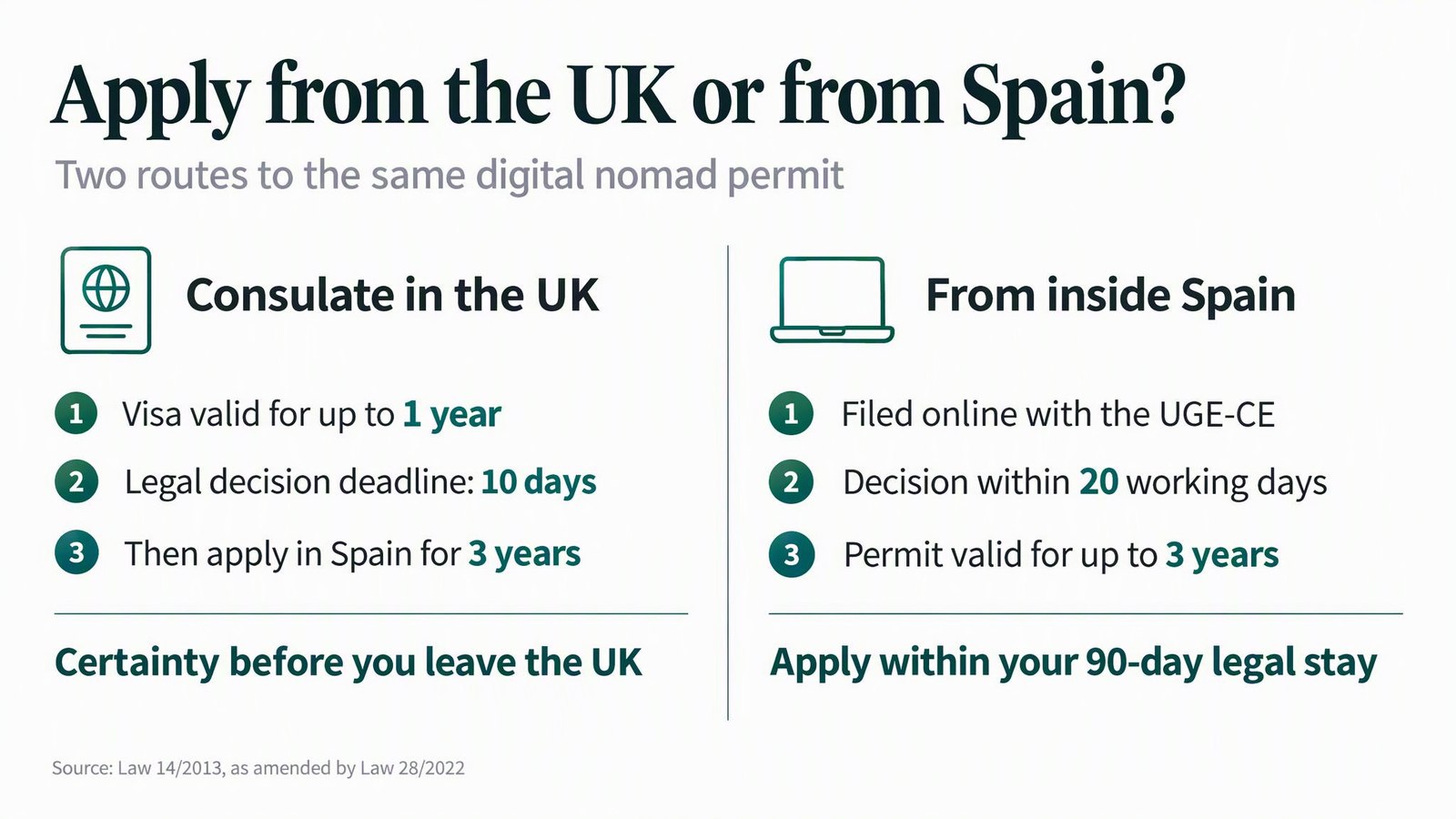
- Consular visa (applied for from the UK): valid for up to 1 year. The visa itself is your residence title during that year; within the 60 days before it expires, you apply in Spain for a residence authorization.
- Residence authorization (applied for from inside Spain): valid for up to 3 years, after which you receive your foreigner identity card (TIE).
- Renewals: the authorization can be renewed for two-year periods as long as you still meet the conditions. After five years of continuous legal residence you can apply for long-term residence.
- Work scope: employees may only work for companies based outside Spain; self-employed professionals may do up to 20% of their professional activity for Spanish clients.
- Family inclusion: spouse or partner, children and dependent parents can join you on linked permits.
- Path to citizenship: British nationals generally need 10 years of legal residence (time on this permit counts), plus Spanish language and culture tests.
Since the Golden Visa was abolished in April 2025, this route and the Non‑Lucrative Visa are the main options for Britons who want to live in Spain without a Spanish employer. The key difference is that the digital nomad route lets you keep working and earning actively. Our guide to Golden Visa alternatives compares the other routes.
Eligibility criteria for UK citizens seeking Spain’s digital nomad visa
To use this route successfully, you must meet a combination of personal, professional and financial requirements. These are set at national level, but consulates and the immigration office may read the paperwork slightly differently.
Below is an overview of what UK citizens need to demonstrate in 2026.
Professional profile and remote work relationship
Spain wants to ensure that applicants are genuine professionals with stable, ongoing remote work. You will need to show:
- Remote work set‑up: your role can be carried out entirely online from Spain (for example, software developer, designer, consultant, marketer, accountant or customer support).
- Foreign employer or clients: your employer or main client base must be outside Spain; for most UK citizens, this will be a UK‑registered company or international clients.
- Relationship of at least 3 months: you must have been working with your current employer or main clients for at least three months before applying.
- Company track record: your employer or main client company must have been operating for at least 1 year.
If you are an employee of a UK company, you will normally need:
- An employment contract confirming your position, salary and that you can work remotely from Spain.
- A letter from the company confirming its activity, how long it has been operating and that you are authorized to work from Spain.
Employees cannot combine the permit with work for a Spanish company: the 20% allowance only applies to self-employed professionals.
If you are self-employed or a freelancer, you will typically need:
- Service contracts with one or more non‑Spanish clients.
- Evidence that no more than 20% of your professional activity is for Spanish clients.
- Proof that your activity is carried out online (for example, portfolio, website, LinkedIn profile or invoices).
Qualifications and experience requirements
The law requires digital nomad applicants to be qualified professionals. You must show either:
- A university degree or postgraduate degree, or a qualification from a recognized vocational training center or business school, or
- At least 3 years of relevant professional experience in your field.
For UK citizens without a degree, the experience route is often the best option. In practice, this usually means providing:
- Reference letters from past employers describing your role and dates.
- Contracts or invoices showing long-term activity in the same sector.
- Evidence of professional certifications or industry memberships, if available.
Financial requirements and income thresholds for UK applicants in 2026
The financial requirement is one of the most important elements of a successful application. Spain wants to ensure that you can support yourself and your family without relying on Spanish public funds.
The benchmark is Spain’s national minimum wage (Salario Mínimo Interprofesional, or SMI). For 2026, Royal Decree 126/2026 set the SMI at €1,221 per month in 14 payments, or €17,094 per year.
2026 income thresholds for a UK digital nomad in Spain
The main applicant must show a monthly income equal to 200% of the SMI, with additional amounts for each family member:
| Applicant type | Rule | Minimum income in 2026 (approx.) |
|---|---|---|
| Main applicant (UK citizen) | 200% of SMI | €2,849 per month (€34,188 per year) |
| First family member (e.g. spouse or partner) | +75% of SMI | + €1,068 per month |
| Each additional family member | +25% of SMI | + €356 per month |
These figures spread the annual SMI over 12 months. Some consulates instead apply the percentages to the 14-payment monthly SMI (about €2,442 per month for the main applicant), but the annual total is the same, so it is safer to plan on the higher monthly figure. As a guide, a couple would need to show roughly €3,917 per month, and a couple with one child about €4,274. If the SMI changes, the thresholds change with it, so check the figure in force when you apply.
Accepted proof of income for UK citizens
For British applicants, the following documents are commonly used to prove income:
- Employees: recent UK payslips (usually the last 3–6 months), employment contract and bank statements showing salary payments.
- Freelancers/contractors: invoices to foreign clients, bank statements, annual accounts and, where possible, a letter from your UK accountant summarizing annual income.
- Business owners: company accounts, dividend statements, director’s salary evidence and proof that the company is active and solvent.
Documents in English generally need a sworn translation into Spanish, and UK public documents need an apostille.
Required documents for a UK citizen’s digital nomad visa application
Preparing your documentation properly is often the difference between a smooth approval and months of delays. The exact checklist varies slightly between the consulate and the immigration office, but most UK applicants need the following core items.
Core personal and legal documents
- Valid passport: with enough validity for the period you are requesting, plus a copy of all pages.
- Completed application form(s): the national visa form if you apply at a consulate, or the residence authorization form if you apply from inside Spain.
- Recent passport photographs that meet Spanish standards.
- Criminal record certificates: from every country where you have lived in the last 2 years (for most Britons, an ACRO Police Certificate), issued within the last 6 months, apostilled and translated into Spanish.
- Signed declaration that you have had no criminal record in the last 5 years.
Work, income, insurance and social security documents
- Employment or service contracts: with your UK employer or foreign clients, showing remote work and a relationship of at least 3 months.
- Company documents: a company register extract (for example, from Companies House) showing that the company has existed for at least 1 year and, for employees, the employer’s letter authorizing remote work from Spain.
- Proof of income: payslips, invoices, bank statements, accountant letters and tax returns.
- Curriculum vitae (CV): showing your education and work history, aligned with the 3‑year experience rule if you rely on experience instead of a degree.
- Degree certificate or proof of professional experience: apostilled and translated where required.
- Health insurance: public or private cover with an insurer authorized to operate in Spain. UK travel insurance is not sufficient.
- Social security: either proof of registration with Spanish Social Security (your employer’s, or your own as self-employed) or a UK certificate of coverage (commonly called an A1) issued by HMRC, confirming that you stay in the UK National Insurance system.
Documents for accompanying family members
If you include family in your application, you will also need:
- Marriage certificate or proof of partnership: apostilled and translated.
- Birth certificates for children: apostilled and translated.
- Proof of financial dependency: for adult children or parents, where applicable.
- Health insurance: family members must also be fully covered.
Because UK documents are now “third‑country” documents for Spain, apostille and sworn translation steps are crucial. Missing or incorrect legalization is a common reason for refusal or requests for further information.
Where and how a UK citizen can apply for Spain’s digital nomad visa
As a British national, you have two routes to start your application, depending on where you are when you apply.
Option 1 – Applying from the UK through a Spanish consulate
Many UK citizens prefer to start the process while still in the UK. In this case, you apply for the teleworking visa at the Spanish Consulate General that covers your UK address:
- Edinburgh: Scotland, Northern Ireland and part of northern England (Cleveland, Cumbria, Durham, Northumberland and Tyne and Wear).
- Manchester: Wales, the Isle of Man, North West England (except Cumbria), Yorkshire and the Humber, and the East and West Midlands.
- London: the rest of England.
In London, applications are submitted through BLS International, the consulate’s visa application center; check your own consulate’s website for how it handles appointments.
The typical steps are:
- Gather and legalize documents: ACRO certificate, apostilles, sworn translations, contracts, proof of income and social security evidence.
- Book an appointment: slots can be limited, so plan ahead.
- Submit your application in person: pay the visa fee and hand over your complete file.
- Wait for a decision: the legal deadline is 10 days, although requests for more documents or an interview can extend it.
- Collect your visa and travel to Spain: you normally have one month to collect it once granted.
After arrival in Spain:
- Your visa is your residence title for its validity (up to 1 year), so you do not need a TIE during that first year.
- Register your address at the town hall (empadronamiento).
- Within the 60 days before the visa expires, apply online to the Unit for Large Companies and Strategic Groups (UGE-CE) for a residence authorization of up to 3 years, and then request your TIE.
This route gives you certainty before you give up your UK home, but you must wait for the visa before moving.
Option 2 – Applying from within Spain as a UK visitor
Alternatively, many UK citizens enter Spain as visitors under the 90/180‑day rule and apply for the residence authorization from inside Spain. The key condition is that you must still be in Spain legally on the day you apply. Since the EU Entry/Exit System became fully operational in April 2026, your entries and exits are recorded digitally, so your day count is easy to check at the border (see our guide to Spain’s entry requirements).
The usual steps are:
- Enter Spain lawfully as a UK visitor.
- Prepare your documentation, ideally with apostilles and sworn translations already sorted in the UK.
- File the application electronically with the UGE-CE, usually through an authorized legal representative in Spain.
- Await the decision: the UGE-CE must decide within 20 working days; if it does not, the application is deemed approved (positive administrative silence).
- Get your TIE: book your fingerprint appointment with the police and collect your residence card.
This route lets you stay in Spain, for example in Valencia, while your application is processed, and it takes you straight to the 3-year authorization. But timing is tight: if your 90 days run out before you file, you lose this option and risk an overstay. Our guide to living in Spain without residency explains the penalties.
A realistic timeline for UK applicants
Because several UK and Spanish institutions are involved, timing is everything. A realistic plan for many British applicants looks like this:
- 3–4 months before your move: confirm eligibility and choose your route; request your ACRO certificate; gather work and income evidence; agree remote-work terms with your employer or clients and ask HMRC about a certificate of coverage if you will stay in UK National Insurance.
- 2–3 months before: apostille and translate your documents; buy Spanish-compliant health insurance; book the consulate appointment if you are applying from the UK.
- 1–2 months before: submit your application and answer any requests for more information quickly.
- On approval: collect your visa (consular route) or your resolution (in-country route), register your address and plan your TIE and tax set-up.
Keep the six-month validity of your criminal record certificate in mind: if the process drags on, it may expire before you file.
Including your family on your Spanish digital nomad permit
One of the biggest advantages of this route for UK citizens is that it can cover your close family under linked residence authorizations.
- Spouse or registered partner: including civil partners where the relationship is legally recognized.
- Children: minors and adult children who are financially dependent on you.
- Dependent parents: subject to stricter proof of dependency.
To include family members, you must meet the higher income thresholds shown above (+75% of the SMI for the first family member and +25% for each additional one), provide apostilled and translated marriage or birth certificates, and show health insurance for everyone. Family members can apply together with you or join you later, and their permits allow them to study and work in Spain.
What changes once you are approved: tax and social security at a glance
Getting the permit is only half the plan. Once you live in Spain, three questions come up quickly:
- Tax residency: spending more than 183 days a year in Spain, or having your main economic interests here, usually makes you a Spanish tax resident, taxed on your worldwide income.
- Beckham Law: remote employees who have not been Spanish tax residents in the previous five years can opt for a flat 24% rate on employment income up to €600,000; self-employed freelancers generally cannot. See our Beckham Law guide.
- Social security: either you keep paying UK National Insurance under an HMRC certificate of coverage, or you (or your employer) contribute in Spain.
We explain all of this in detail in our guide to living in Spain on a digital nomad visa as a British resident. Because every cross-border situation is different, a personal review with a tax lawyer before you move is strongly recommended.
Common pitfalls UK citizens should avoid when applying
Applications from British digital nomads are frequently delayed or refused for avoidable reasons. Being aware of them in advance can save you time and money.
- Insufficient or unstable income: relying on very new contracts or fluctuating freelance income without a clear track record, or income that only just meets the lower 14-payment figure.
- Criminal record problems: using the wrong type of certificate, submitting one older than six months, forgetting the apostille or sworn translation, or leaving out a country where you lived in the last two years.
- Inadequate health insurance: presenting UK travel insurance instead of a policy from an insurer authorized to operate in Spain.
- Missing social security evidence: no HMRC certificate of coverage and no Spanish registration.
- Poorly drafted employer letters: letters that do not clearly authorize remote work from Spain or fail to show that the company has been operating for at least one year.
- Misreading the 20% rule: employees cannot work for Spanish companies; the allowance only applies to self-employed professionals.
- Missing legalizations: marriage and birth certificates not apostilled or not translated into Spanish by a sworn translator.
Because interpretation can vary between offices, many UK citizens choose to work with an experienced Spanish immigration and tax team, which aligns the application with tax planning from day one.
Moving from the UK to Valencia? Our bilingual immigration team checks your eligibility, prepares your documents and files your application with the consulate or the UGE-CE, coordinating the tax side from the start. Book a free consultation.
Frequently Asked Questions
Can I switch from Spain’s digital nomad permit to another type of residence, like a work permit or non‑lucrative visa, without leaving Spain?
In many cases you can modify your status from within Spain when your current permit is close to expiring, provided you meet the requirements of the new permit (for example, a Spanish job offer for a work permit). You must apply before your existing authorization runs out and follow the specific modification procedure set out in Spanish immigration rules.
What happens if I lose my remote job or my income drops below the required level while I’m in Spain on the digital nomad permit?
You are expected to maintain the conditions under which your permit was granted, including sufficient income and ongoing remote work. If your situation changes, you should restore the required income quickly or switch to another legal route. Failing to do so can lead to problems at renewal or, in serious cases, the start of a revocation process.
Can I buy property in Spain as a UK digital nomad and does it affect my residence status?
You are free to buy property in Spain while holding a digital nomad permit, and you can use it as your main residence or as an investment. Owning property alone does not change the conditions of your digital nomad status or automatically grant long‑term residence or citizenship, but it can help demonstrate ties to Spain when renewing or applying for other permits.
Are UK digital nomads allowed to work for Spanish clients or take occasional local projects while living in Spain?
It depends on how you work. If you are self-employed, up to 20% of your professional activity can be for Spanish clients, as long as the majority remains with foreign clients. If you are an employee, the permit only covers work for companies based outside Spain. If Spanish work becomes your main activity, you would need to change to a residence and work authorization designed for local employment or self-employment in Spain.
Every case has its own details. Our English-speaking lawyers in Valencia can review your situation and advise you on the best way forward. Get in touch with us for tailored legal advice.
