


Planning a trip to Spain and not sure if you need a visa, how long you can stay, or what documents you must show at the border? Entry rules depend on your nationality, how long you intend to stay, and whether you will just visit as a tourist or live, work or study in Spain. Understanding these entry requirements in advance will help you avoid problems at the airport and choose the right visa or residence permit if you want to stay longer.
Understanding whether you need a visa to enter Spain
The first step is to determine if you actually need a visa to enter Spain, or if you can come visa‑free. This depends mainly on your passport and the length and purpose of your stay.
Spain is part of the Schengen Area, a group of European countries that share common rules on short‑term entry. If you do not meet those common conditions, or if you want to stay longer than 90 days, you will need a visa or residence permit before traveling.
Visa‑exempt nationals for short stays in Spain
Citizens of many countries can enter Spain for short stays without a visa. For these travelers, the key rule is the well‑known “90 days in any 180‑day period” in the Schengen Area.
In general, you do not need a visa for a short stay in Spain if:
- You are an EU/EEA or Swiss citizen traveling with a valid passport or national ID, or
- You hold a passport from a Schengen visa‑exempt country (for example the UK, USA, Canada, Australia, New Zealand, Japan and many others), and
- Your total stay in the Schengen Area will not exceed 90 days within any rolling 180‑day period, and
- You are not going to carry out paid work or long‑term activities that require a residence permit.
Typical reasons you can enter Spain visa‑free include:
- Tourism and holidays
- Visiting friends or family
- Short business trips (meetings, conferences, fairs)
- Short, non‑remunerated courses or training
- Attending cultural or sports events
Example: A Canadian tourist flying to Valencia for 3 weeks in summer, then returning home, does not need a visa. A US citizen spending 60 days visiting family in Spain can also enter visa‑free, as long as the 90/180‑day limit is respected. If you plan to work remotely from Spain on a regular basis, look at a proper residence route instead of repeated tourist stays.
When you definitely need a visa to go to Spain
You will need a visa to enter Spain if you do not fall into one of the visa‑exempt categories above. The most common situations where a visa is required are:
- You are a citizen of a country that is not on the Schengen visa‑exempt list.
- You want to stay in Spain for more than 90 days (for example to live, work, study or retire).
- You intend to carry out paid work, run a business, or perform other activities that go beyond simple tourism or short visits.
- You are moving to Spain with your family (family reunification, accompanying spouse, children, etc.).
In these cases, you must usually apply for a Schengen visa (type C) for short stays, or a long‑stay visa (type D) if you plan to live in Spain. The exact visa will depend on your purpose: student visa, work visa, non‑lucrative visa, digital nomad visa, family visa, and others.
Important: The question “Do I need a visa to go to Spain?” cannot be answered only by where you come from. Immigration officers will also consider how long you will stay and what you will do in Spain. If you are unsure, it is advisable to consult a Spanish consulate or a specialist immigration lawyer.
Passport rules and basic entry requirements for Spain
Even if you do not need a visa, you must still meet specific entry requirements to cross the Spanish border. Border guards will check your passport, travel plans and sometimes your financial means and health insurance.
These rules apply to most non‑EU/EEA travelers coming to Spain as visitors. Failing to meet them can result in being refused entry at the border.
Passport validity and document requirements
Spain follows the passport rules of the Schengen Borders Code. Your passport must:
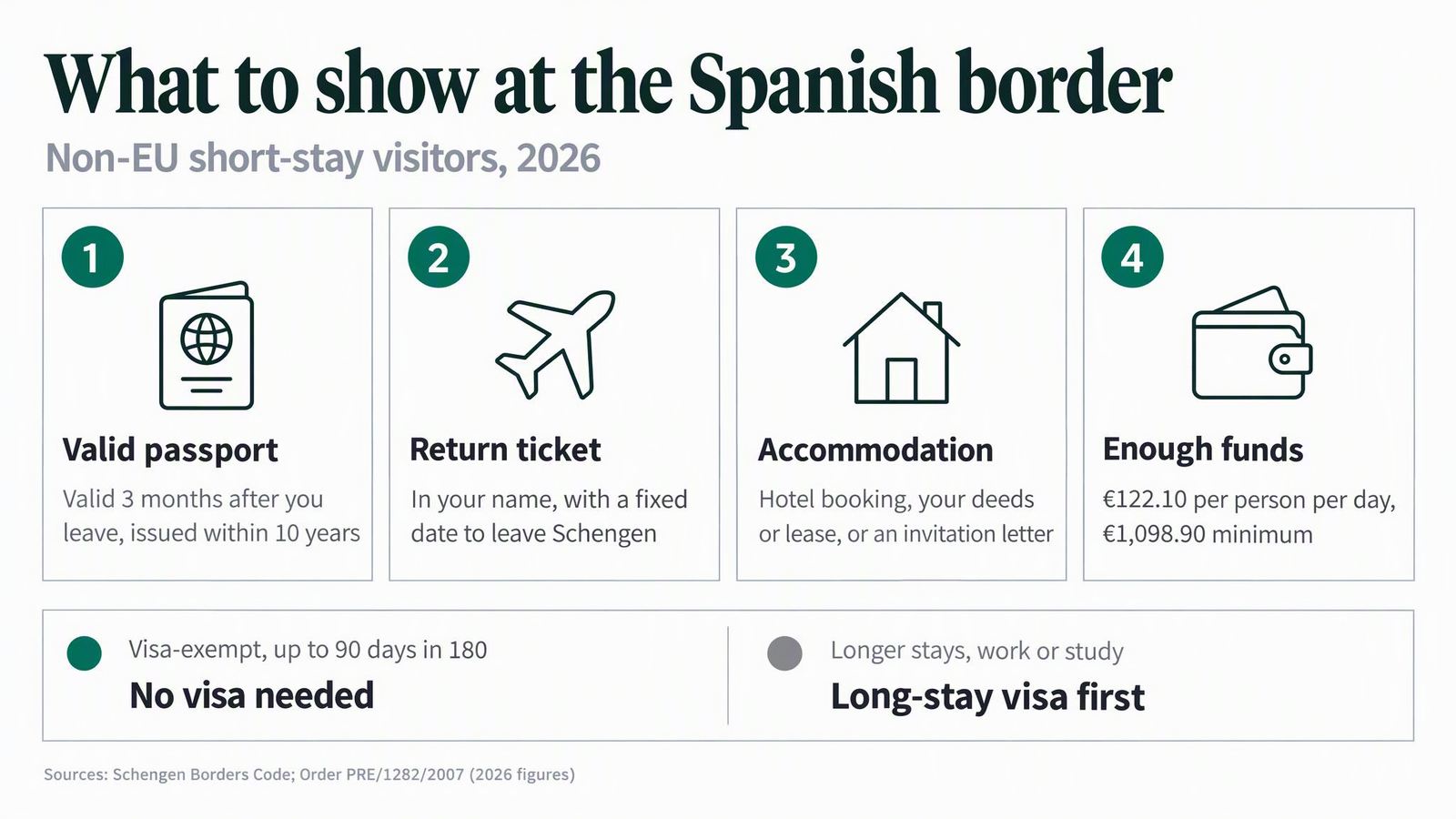
- Be valid for at least 3 months beyond the date you plan to leave the Schengen Area, and
- Have been issued within the last 10 years on the date you enter Spain.
It is also essential that:
- Your passport is in good condition (not heavily damaged).
- It has blank pages for any visas you need.
- It has not been reported as lost or stolen.
Some travelers can enter using a national identity card instead of a passport (for example EU/EEA and Swiss citizens). However, if you are from outside the EU/EEA/Switzerland, you should always travel with a valid passport.
Tip: Airlines may apply their own checks. If your passport does not meet Schengen validity rules, you might be denied boarding even before reaching Spain.
Proof of purpose of stay, accommodation and funds
At border control, Spanish officers may ask you to demonstrate that your visit is genuine and that you can support yourself financially during your stay. You may be asked to show:
- Return or onward ticket in your name, with a fixed date, confirming when you plan to leave the Schengen Area.
- Proof of accommodation, such as:
- Hotel or rental booking confirmation.
- Property deeds or rental contract if you own or rent a home in Spain.
- A formal letter of invitation (carta de invitación) if you are staying with friends or family.
- Proof of sufficient financial means for your stay, for example:
- Cash, certified checks or travelers’ checks.
- Credit or debit cards, together with an up‑to‑date bank statement or passbook.
- Travel medical insurance covering emergencies during your stay (especially if you are applying for a Schengen visa).
Spain sets the minimum funds by law. Under Order PRE/1282/2007, non‑EU visitors must be able to show 10% of the Spanish gross minimum wage per person for each day of their stay, with an overall minimum of 90% of that wage however short the trip. With the 2026 minimum wage set at €1,221 a month (Royal Decree 126/2026), that means €122.10 per person per day and at least €1,098.90 in total. The same Order does not accept letters from banks or online bank printouts as proof, so bring an up‑to‑date statement or passbook if you rely on cards. The idea behind these checks is simple: you must show that you will not become a burden on the Spanish social system during your visit.
How the 90/180‑day Schengen rule works in practice
For many visitors, the most confusing part of Spain’s entry rules is the calculation of how long they can stay without a visa. The Schengen rule is not “90 days per country”; it is “90 days in any 180‑day period” across the entire Schengen Area.
This means that your time in Spain is counted together with your time in other Schengen countries like France, Italy, Portugal, Germany, etc. Overstaying, even by a few days, can lead to fines, entry bans, or problems obtaining visas in the future.
Calculating your allowed stay in Spain
To see if you are within the limit, you must look back over the last 180 days (a rolling window) from each day you are present in the Schengen Area and count how many days you have already spent there.
Some key points:
- Both the day of entry and the day of exit are counted as full days.
- Time spent in any Schengen country counts towards the same 90‑day total.
- If you leave the Schengen Area, the clock does not “reset”; instead, the 180‑day window rolls forward day by day.
Example: You are a US citizen. You spend 60 days in Spain in spring, then 20 days in Italy in summer. You have used 80 out of your 90 days in the Schengen Area. You only have 10 days left until enough time has passed for earlier days to “fall out” of the 180‑day window.
Consequences of overstaying your visa‑free period
If you stay in Spain or any other Schengen country longer than 90 days in any 180‑day period without an appropriate visa or residence permit, you may face serious consequences:
- A fine of €501 to €10,000, because staying irregularly is a serious infringement under Spain’s immigration law (Organic Law 4/2000).
- An overstay record in the EU Entry/Exit System, which now counts your days automatically.
- Possible expulsion, which carries an entry ban of up to five years.
- Difficulties obtaining future visas or residence permits.
We explain these sanctions, and how the immigration and tax clocks differ, in our guide on how long you can live in Spain without residency.
In exceptional cases (for example, serious illness or canceled flights that make it impossible to leave), visa‑exempt visitors may request an extension of stay (prórroga de estancia) from the police while their stay is still valid. It is capped at three additional months and requires proof of the exceptional reason, funds, travel insurance and a return ticket (Article 49 of the Immigration Regulation, Royal Decree 1155/2024).
Short‑stay visas for Spain (Schengen type C)
If you are not from a visa‑exempt country, or if the Spanish consulate requires it for your situation, you will need a short‑stay Schengen visa (type C) to visit Spain for up to 90 days in any 180‑day period.
This visa allows you to travel not only in Spain, but also throughout the Schengen Area during its validity, as long as you respect the 90/180‑day rule and the purpose of your stay.
Who needs a short‑stay Schengen visa for Spain
You must apply for a Schengen visa if:
- Your nationality is listed as visa‑required for Schengen short stays.
- You are planning a short visit (tourism, family visit, business, cultural events, etc.) of up to 90 days.
- You do not already hold a valid residence permit or long‑stay visa from a Schengen country.
Even with a Schengen visa, border officers can still ask you to prove the purpose of your visit and your financial means. A visa is not an automatic guarantee of entry; final decisions are made at the border.
Basic documents and process for a Schengen visa
While exact requirements vary slightly by consulate, you will usually need to provide:
- A valid passport meeting Schengen rules.
- Completed visa application form and recent passport photos.
- Proof of travel plans (flight bookings, itinerary).
- Proof of accommodation (hotel, rental, invitation letter, etc.).
- Proof of financial means for the stay and return.
- Travel medical insurance covering at least €30,000 for emergencies in the Schengen Area.
- Supporting documents depending on the purpose of your trip (for example, business invitation, conference tickets, etc.).
Applications are usually submitted at the Spanish consulate (or its official visa application center) in your country of residence. Processing times vary, so it is advisable to apply well in advance of your planned travel date.
Long‑stay visas and residence permits for Spain (over 90 days)
If you want to live in Spain for more than 90 days, you move out of the “simple visitor” category and into the world of long‑stay visas and residence permits. This includes those who plan to work, study, retire, or join family members in Spain.
Long‑term immigration is more complex and usually requires careful planning and legal guidance, especially if you are also investing in property or managing cross‑border tax issues.
Common options to stay in Spain longer than 90 days
Some of the most popular routes for non‑EU citizens to live in Spain include:
- Non‑Lucrative Visa (NLV) – for people who want to live in Spain without working locally (often retirees or financially independent individuals).
- Digital Nomad Visa – for international teleworkers who work remotely for foreign employers or clients while living in Spain.
- Work visas – for employees hired by Spanish companies or highly qualified professionals.
- Student visas – for long‑term studies, including university degrees and certain training programs.
- Family reunification – for spouses, partners, and dependent relatives of residents in Spain.
- Entrepreneur visa – for those launching an innovative business project in Spain.
These options usually require a type D long‑stay visa and a subsequent residence card in Spain. Each has its own financial, documentation and timing requirements. Note that buying property no longer leads to residency: the investor “Golden Visa” was abolished by Organic Law 1/2025 with effect from 3 April 2025 (see our guide to Golden Visa alternatives for property investors).
Residence permits and how they relate to entry requirements
When you receive a long‑stay visa, you are allowed to enter Spain for the purpose specified in that visa. After arrival, you usually must:
- Register your address with the Town Hall (empadronamiento).
- Apply in person for your foreigner identity card (TIE), generally within one month of arrival.
- Comply with any additional conditions (health insurance, tax registration, etc.).
Once you hold a valid Spanish residence permit, your time in Spain no longer counts as a tourist stay, and you can make short visits to other Schengen countries of up to 90 days in any 180‑day period, while your principal residence remains in Spain. After five years of continuous legal residence, you can apply for long‑term residency. Staying compliant with both immigration and tax rules is essential, particularly for expats, foreign investors and digital nomads.
Entry rules for EU/EEA and Swiss citizens
Citizens of EU and EEA countries, as well as Switzerland, enjoy freedom of movement in Spain. Their situation is simpler, but there are still formalities if they intend to live in Spain long term.
Understanding these rules is crucial if you are moving with an EU partner, or if you have dual nationality and want to choose the best way to enter and reside in Spain.
Short stays for EU/EEA/Swiss nationals
For visits under 90 days, EU/EEA and Swiss citizens can enter Spain with a valid:
- Passport, or
- National identity card.
No visa is required, and they are not subject to the 90/180‑day rule in the same way as non‑EU nationals. However, they should still carry valid ID and may be asked to show proof of accommodation or financial means in rare cases.
Living in Spain longer than 3 months as an EU citizen
EU/EEA and Swiss citizens who intend to stay in Spain for more than 3 months must usually:
- Register in the Central Register of Foreigners (Registro Central de Extranjeros) within three months of arrival (Royal Decree 240/2007), and
- Obtain a registration certificate (often a green card or paper).
They may need to show that they are:
- Employed or self‑employed in Spain, or
- Students with sufficient resources and health insurance, or
- Have enough resources not to become a burden on the Spanish social assistance system, plus health coverage.
Family members who are non‑EU nationals may need to apply for a residence card of a family member of an EU citizen, which has its own entry and documentation requirements.
New border systems: EES is live, ETIAS is still to come
Spain applies the EU’s new digital border systems for non‑EU visitors. The first, the Entry/Exit System, is already running at the Schengen Area’s external borders; the second, ETIAS, has not started yet.
Knowing how they work will help you prepare for biometric checks at the border and plan future trips.
The Entry/Exit System (EES) and what it means for travelers
The Entry/Exit System (EES) is an EU database that electronically records the entry and exit of non‑EU nationals visiting the Schengen Area for short stays. It started on 12 October 2025 with a gradual rollout and has been fully operational since 10 April 2026, replacing the manual stamping of passports.
In practice:
- Your passport data, date and place of entry/exit are recorded electronically.
- Your biometric data (fingerprints and a facial image) are collected on your first entry and reused on later trips; your record is kept for three years.
- The system automatically calculates how many days you have spent in the Schengen Area and flags any overstay.
At airports, seaports and land crossings, you may be directed to a self‑service kiosk or special booth to register your biometrics before seeing a border officer. Children under 12 are not fingerprinted, but their photo is still taken.
ETIAS: the travel authorization that has not started yet
The European Travel Information and Authorisation System (ETIAS) will require visa‑exempt travelers (for example from the US, UK, Canada or Australia) to obtain an online authorization before their trip. As of September 2026 it is not yet in operation: the EU had targeted the last quarter of 2026, but no start date has been confirmed and press reports point to 2027. Once launched, it will cost €20 (free for applicants under 18 or over 70) and be valid for up to three years, with a transition period at the start. Check the official EU travel website before you book.
Residence card holders and the end of passport stamps
With EES fully running, border guards no longer stamp the passports of short‑stay visitors; your entries and exits are recorded digitally instead. It is still wise to keep boarding passes and tickets in case you need to prove when and where you entered or left.
If you are a legal resident in Spain (for example, you hold a TIE card), you are not registered in EES. Always carry and present your residence card together with your passport at border control, so you are not treated as a short‑stay visitor and your time is not counted under the 90/180‑day rule.
Special situations: minors, Gibraltar, cash and customs
Beyond visas and passports, Spain has additional rules on traveling with minors, crossing certain borders, and bringing money or goods into the country. These are part of the wider entry requirements and can affect your journey if you are not prepared.
Being aware of these details helps you avoid delays, fines or confiscation of goods at the border.
Unaccompanied minors and children traveling to Spain
Under Spanish law, anyone under 18 is considered a minor. When children travel to Spain, especially if they are not accompanied by both parents, extra documentation may be required.
Situations to consider:
- Minors traveling alone or with only one parent may need a parental authorization or consent form, depending on the country of origin.
- If an unaccompanied minor comes to the attention of Spanish authorities (for example, due to a criminal incident or hospitalization), they may be treated as vulnerable and placed in a minors’ center until a parent or guardian is located.
- EU/EEA minors traveling with an ID card should carry documentation proving parental permission when not accompanied by both parents.
Requirements vary by nationality, so you should always check with your airline and your home country’s authorities before traveling.
Gibraltar crossings, customs and carrying cash
If you are entering Spain via Gibraltar, note that the UK–EU agreement on Gibraltar has applied provisionally since 15 July 2026:
- Immigration checks for the Schengen Area now take place at Gibraltar’s airport (and, if needed, its port) rather than at the land border with La Línea.
- The land crossing is becoming a fluid frontier, so the long queues of past years should ease.
- The new arrangements are still settling in, so check the latest UK and Gibraltar government guidance before you travel.
Regarding customs and money:
- There are strict rules on bringing certain goods into Spain (for example, limits on alcohol and tobacco, and restrictions on meat, milk and related products from outside the EU).
- You cannot normally bring meat, milk or products containing them from non‑EU countries, with limited exceptions (such as baby food or specific medical foods).
- If you are carrying €10,000 or more in cash or equivalent (including travelers’ checks), you must declare it when entering or leaving Spain. Failure to declare may result in seizure of the funds and fines.
These rules apply regardless of whether you need a visa; they are part of the general entry requirements and are strictly enforced by customs officers.
From tourist to resident: when you should not enter on a simple visit
Many people start by visiting Spain as tourists and then decide to stay longer, buy property, or work remotely from cities like Valencia. However, trying to “convert” a tourist stay into long‑term residence without proper planning can create legal and tax complications.
If your real intention is to live in Spain, it is usually better to enter with the correct long‑stay visa from the beginning, rather than repeatedly using the 90‑day tourist allowance.
Why your real purpose of stay matters at the border
When you answer “Do I need a visa to go to Spain?” you must be honest about your plans. Spanish authorities distinguish clearly between:
- Genuine short visits (tourism, family, business trips), and
- Long‑term stays for residence, work, study or retirement.
Entering as a “tourist” while actually planning to live and work in Spain can lead to:
- Refusal of entry if the border officer believes you are not a genuine visitor.
- Problems when later applying for residence permits, especially if you have overstayed.
- Unclear tax residency status, which can affect your income tax, wealth tax and reporting obligations in Spain and your home country.
If your plan is to move to Spain, purchase property, or establish your business base here, it is strongly advisable to obtain tailored legal and tax advice in advance.
Examples: digital nomads, retirees and foreign investors
Here are some typical scenarios where entering Spain on the wrong basis can cause difficulties, and where a proper visa or residence route is usually recommended:
- Digital nomad: A US software developer wants to live in Valencia and work remotely for a US company for at least a year. Coming in repeatedly as a “tourist” every 90 days is risky and may create tax problems. A digital nomad visa or other residence route is more appropriate.
- Retiree: A British couple buy an apartment on the Costa Blanca and plan to spend 8–9 months a year in Spain. They cannot legally do this on visa‑free entry alone; they usually need a non‑lucrative visa or another residence permit, and should plan for Spanish tax residency (see our guide to retiring to Spain from the UK).
- Foreign investor: An investor from Latin America wants to acquire several rental properties in Valencia and manage them personally. Since buying property no longer gives residency, besides property law and tax planning they need a residence route that fits their activities (for example, a non‑lucrative visa if they only receive passive income, or an entrepreneur or self‑employment route if they run a business).
In each of these cases, a careful analysis of immigration status, tax residency, and entry requirements is essential before booking flights or signing contracts.
How specialized legal advice can help you navigate Spain’s entry rules
Spanish immigration and entry rules can seem straightforward for a simple holiday, but they quickly become complex when you add elements like remote work, property investment, family relocation, or cross‑border taxation. The official information is often spread across different websites and does not always reflect your specific situation as an expat, foreign investor or digital nomad.
Working with a boutique firm that combines immigration, tax and real estate expertise in Spain—especially in destinations like Valencia—can help you choose the right route from the start and avoid costly mistakes.
What a specialist firm can do for your move to Spain
A multidisciplinary team can assist you with:
- Clarifying whether you need a visa to go to Spain based on your nationality, travel history and plans.
- Choosing and applying for the most suitable visa or residence permit (digital nomad visa, non‑lucrative visa, work or entrepreneur routes, family reunification, etc.).
- Handling NIE/TIE procedures, registration, and local formalities once you arrive.
- Coordinating your tax residency, taking advantage of regimes like the Beckham Law where applicable, and avoiding double taxation.
- Advising on property purchases, due diligence and asset protection if you plan to buy a home in Spain as a foreigner or acquire an investment property.
- Supporting British clients, who are now non‑EU for immigration purposes, through our legal support for UK investors.
- Planning for long‑term goals such as Spanish citizenship, cross‑border inheritance and estate planning.
By aligning your immigration status with your tax and personal plans from the beginning, you can enjoy Spain—whether for a short visit or a new life—knowing that you are meeting all entry requirements and building a secure legal position for the future.
Not sure which visa fits your plans? Our bilingual immigration team in Valencia can review your nationality, travel history and goals, and prepare the right application before you book your flights. Book a free consultation.
Frequently Asked Questions
How can I quickly check if my nationality needs a visa to enter Spain?
Use the official visa checker or country lists published on the website of the Spanish Ministry of Foreign Affairs or your nearest Spanish consulate. These tools let you select your nationality and trip purpose to see whether you are visa‑exempt or must apply for a Schengen or long‑stay visa before traveling.
Can I extend my stay in Spain beyond 90 days without leaving the country?
In most cases, no. The 90‑day visa‑free period (or short‑stay visa) cannot simply be extended because you wish to stay longer. Extensions are only granted in exceptional situations such as force majeure or serious illness, and for a maximum of three additional months. If you know you want to stay longer than 90 days, you should apply for an appropriate long‑stay visa before entering Spain.
Does having a return ticket guarantee that I will be allowed to enter Spain?
No. A return or onward ticket is just one of several elements border officers may check. Even with a ticket, you can be refused entry if you do not meet other entry requirements, such as sufficient funds, acceptable accommodation, valid travel documents, or if the officer doubts the real purpose of your stay.
If I already have a valid Schengen visa from another country, do I need a separate visa for Spain?
Generally not. A valid Schengen short‑stay visa issued by any Schengen country allows travel to Spain as long as the visa is still valid, you respect the 90/180‑day rule, and your main destination or first entry rules are respected. However, border officers in Spain can still check that your visit matches the purpose and conditions of the visa.
Every case has its own details. Our English-speaking lawyers in Valencia can review your situation and advise you on the best way forward. Get in touch with us for tailored legal advice.
