


Moving to Spain as an expat or remote worker can dramatically change your tax situation. One of the most powerful tools to legally reduce your tax bill is the so‑called “Beckham Law” – a special regime that lets certain new residents be taxed more like non‑residents, at a flat rate, and only on Spanish‑sourced income.
Used correctly, it can mean paying a flat 24% instead of marginal rates of up to almost 54% on your salary, avoiding tax on your worldwide wealth, and simplifying your Spanish tax life for several years. Used incorrectly – or applied for too late – it can mean losing the benefit entirely and facing back taxes and penalties.
Below you will find a clear, practical guide to Beckham Law in Spain: how to apply, taxes and requirements, written for expats, remote employees, entrepreneurs and foreign investors who want to understand if this regime fits their situation.
What the Beckham Law is and why it was created
The so‑called Beckham Law is the informal name for Spain’s Special Expatriate Tax Regime (Régimen fiscal especial para trabajadores desplazados a territorio español), regulated in Article 93 of the Spanish Personal Income Tax Act (Law 35/2006) and its implementing Regulations, as amended by Law 28/2022 (the Startups Law) with effect from 1 January 2023.
Its purpose is simple: attract foreign talent, investment and high‑value professionals by offering a more favorable tax treatment during their first years in Spain. Instead of being taxed as a normal resident on worldwide income under progressive rates, qualifying individuals may opt to be taxed:
- Only on Spanish‑sourced income (with some important nuances), and
- At a flat rate similar to that applicable to non‑residents.
The regime became famous when footballer David Beckham benefited from it after joining Real Madrid, hence the nickname “Beckham Law”. Today, professional athletes are excluded, but the scope has been expanded to include:
- Remote workers employed by foreign companies (including holders of the Spanish Digital Nomad Visa).
- Entrepreneurs and startup founders.
- Highly qualified professionals providing services to Spanish startups.
- Professionals in training, research, development and innovation (R&D+i).
- Certain company directors.
For many new residents, especially in regions with high top tax rates like the Valencian Community, this regime is a key part of their expat tax planning.
How taxation works in Spain with and without the Beckham Law
To understand the benefits, it helps to compare how you would be taxed with and without the special regime.
How standard Spanish tax residency works for expats
Without the Beckham Law, if you become a tax resident in Spain (usually by spending more than 183 days per calendar year here, or having your main economic or family center in Spain), you are subject to:
- Personal Income Tax (IRPF) on your worldwide income at progressive rates whose top marginal rate in 2026 depends on the region:
- Almost 54% in the Valencian Community (53.85% above €200,000).
- 50% in Catalonia.
- 45% in Madrid.
- Potential Wealth Tax (and, for net wealth above €3 million, the Solidarity Tax on Large Fortunes) on your global assets, depending on thresholds and region.
- Full reporting obligations, including Modelo 720 for assets abroad worth more than €50,000 per category.
This means that, as a normal resident, Spain can tax your salary from abroad, your dividends from foreign companies, your rental income from properties in other countries, and your foreign investment portfolio, subject to double taxation treaties.
How the Beckham Law changes your tax position
If you qualify for and opt into the Beckham Law, you are still considered a tax resident in Spain, but for income tax purposes you are treated in many ways like a non‑resident. In practice, this usually means:
- Your employment income is taxed at a flat rate of 24% up to €600,000 a year, and at 47% on the part above that amount.
- You are generally taxed only on Spanish‑sourced income (with an important exception for employment income – see below).
- Your foreign assets are outside Spanish Wealth Tax (you pay only on assets located in Spain), and the Tax Agency’s criterion is that you do not file Modelo 720 for them.
The regime applies for the tax year in which you become resident plus the following five tax years (so up to six years in total), provided you continue to meet the conditions.
| Aspect | Standard resident regime | Beckham Law regime |
|---|---|---|
| Tax base | Worldwide income | Mainly Spanish‑sourced income |
| Employment income rate | Progressive (from about 19% up to almost 54%, depending on region) | Flat 24% up to €600,000, 47% above |
| Wealth Tax | On worldwide assets (above thresholds) | Generally only on Spanish assets |
| Foreign asset reporting (e.g. Modelo 720) | Yes, if thresholds exceeded | Typically not required for assets abroad |
| Use of deductions and allowances | Yes (family, housing, etc.) | Very limited; mostly not available |
In practice, the Beckham Law is usually more beneficial for medium‑high and high earners, especially those with significant foreign assets.
Who can apply for the Beckham Law regime
The Beckham Law in Spain does not apply automatically. You must meet specific requirements and then formally opt in. Broadly, it is aimed at workers, professionals, entrepreneurs and investors who move to Spain for work‑related reasons.
General eligibility conditions
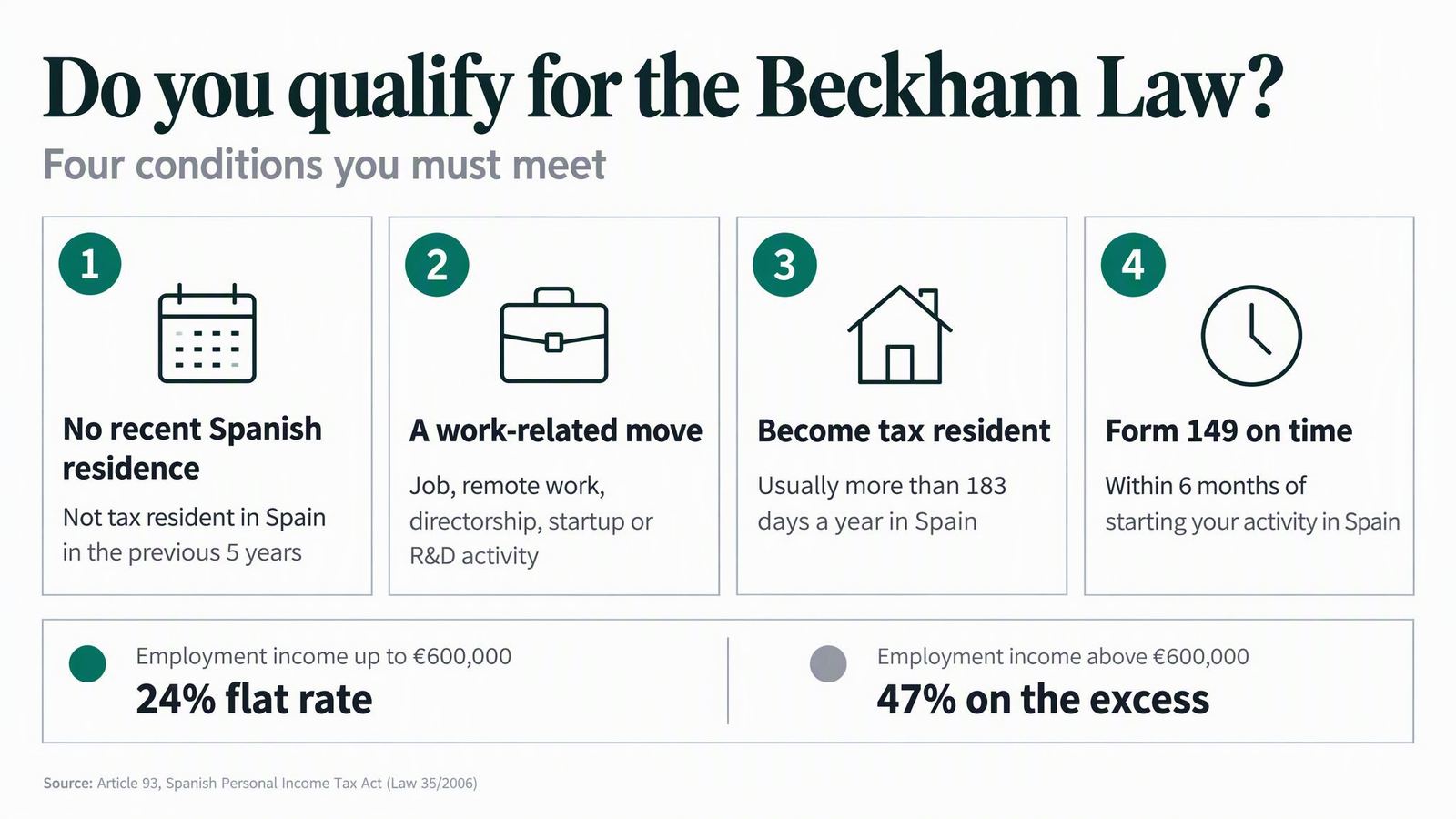
To benefit from the Beckham Law regime, you must typically meet all of the following:
- No tax residency in Spain in the previous 5 years before your move.
- Become a tax resident in Spain as a result of your move (generally by staying more than 183 days during the calendar year).
- Move to Spain because of work – your relocation must be directly linked to an eligible work, professional or entrepreneurial activity.
- No income via a permanent establishment in Spain (with specific exceptions for certain entrepreneurs and professionals, as explained below).
- Apply within the legal deadline and with the correct documentation.
These conditions are interpreted strictly by the Spanish Tax Agency, so a detailed analysis of your situation is essential.
Eligible profiles under the Beckham Law
Since Law 28/2022 took effect on 1 January 2023, the following types of profiles can apply, provided the other requirements are met:
- Employees hired in Spain by a Spanish company to work in Spanish territory.
- Employees transferred to Spain by a foreign employer, keeping their original contract but working for or under the direction of a Spanish group company.
- Remote workers in Spain for a foreign employer, especially those holding an international telework / Digital Nomad Visa, who perform their work mainly online from Spain.
- Company directors (administradores) of a Spanish company:
- If the company has a genuine economic activity in Spain, there is no strict shareholding limit.
- If the company is considered an asset‑holding/patrimonial entity, the director’s shareholding must stay below the 25% that would make the company a related party.
- Entrepreneurs carrying out an innovative entrepreneurial activity of special economic interest for Spain under Law 14/2013, usually backed by a favorable report from ENISA (the route behind the entrepreneur visa).
- Highly qualified professionals working as independent professionals (autónomos) providing services to accredited Spanish startups, where those services represent more than 40% of their total business, professional and employment income.
- Professionals in training, research, development and innovation (R&D+i), including researchers and university teachers, subject to the same 40% income test.
In addition, certain family members of the main applicant can also opt into the regime (see below).
Who cannot apply for the Beckham Law
Some categories are explicitly excluded or, in practice, cannot meet the requirements:
- Professional athletes and sports professionals (this group was removed from the regime after the original “Beckham” controversy).
- Freelancers / self‑employed workers in Spain who:
- Do not qualify as entrepreneurs under the innovation/startup rules, and
- Do not qualify as highly qualified professionals providing services to startups or in R&D+i activities.
- Individuals who have been tax resident in Spain in any of the previous 5 tax years.
- Individuals whose income is considered obtained through a permanent establishment in Spain, outside the specific exceptions allowed by the law.
Whether you are treated as having a “permanent establishment” can be complex, particularly for partners in foreign transparent entities (US LLCs, UK LLPs, German KGs, etc.), and should be reviewed case by case.
Key requirements to apply for the Beckham Law in Spain
The Spanish tax authority will look closely at whether you truly satisfy all requirements. The main conditions can be grouped as follows.
You must not have been a Spanish tax resident in the last five years
You cannot have been considered a tax resident in Spain in any of the five tax years before the year in which you move and seek to apply the Beckham regime.
Spain considers you a tax resident if any of the following apply:
- You stay more than 183 days in Spain during the calendar year (sporadic absences usually count as days in Spain unless you prove tax residence in another country).
- Your main economic interests (business, investments, management center) are located in Spain.
- Your spouse (not legally separated) and minor dependent children habitually reside in Spain, unless you prove otherwise.
The tax agency may request evidence (foreign tax returns, tax residency certificates, etc.) to verify that you were not resident in Spain in those years.
You must acquire tax residency in Spain because of the move
The regime is only for individuals who actually become tax resident in Spain as a result of their move. In practice, this usually means:
- You will spend more than 183 days in Spain during the calendar year of your move, and
- This stay is directly linked to your new work or activity in Spain.
The regime is meant for people who physically relocate to Spain to work, and it starts in the first tax year in which you are Spanish tax resident. If you arrive late in the year and do not reach 183 days, that first year is usually the following one; the six‑month deadline to opt in, however, still runs from the start of your activity (see below), so do not wait.
Your move must be for work‑related reasons
This is one of the most scrutinized requirements. There must be a clear causal link between your move to Spain and the start of your work or professional activity. Typical evidence includes:
- A job offer or employment contract dated before your arrival in Spain.
- A transfer letter from your employer ordering your relocation to Spain.
- A Digital Nomad Visa or entrepreneur/highly qualified professional permit obtained in connection with your planned activity in Spain.
Long gaps between arrival and the start of work can raise doubts. While a short interval (a few weeks) is usually acceptable, longer delays should be carefully justified and documented.
You must not earn income through a permanent establishment in Spain (with limited exceptions)
In general, the Beckham Law assumes you are a worker or professional without a permanent establishment in Spain, similar to a non‑resident. This means:
- You cannot normally carry out a broad freelance or business activity in Spain as an autónomo, unless it falls within the specific categories of:
- Innovative entrepreneurial activity of special economic interest.
- Highly qualified professional services to accredited startups.
- Recognized training, research, development and innovation activities.
Special caution is needed if you are a partner in foreign tax‑transparent entities (LLC, LLP, KG, etc.). The Spanish tax authority may consider that your share of profits is obtained through a permanent establishment in Spain if you manage the activity from here, which would disqualify you from the regime.
You must submit the application on time and with complete documentation
The deadline is strict. You must communicate your option for the Beckham regime (Form 149) within six months from:
- The start date of your activity shown in your Spanish Social Security registration, or in the documents that keep you in your home country’s system (such as an A1 certificate), or
- If Social Security registration is not required, the start date of your activity shown in the supporting documents.
Missing this deadline means you lose the right to opt for the regime, even if you meet all the other requirements.
It is equally important to submit complete and accurate documentation. If the tax office asks for additional documents and you cannot provide them within the short deadlines (often 10 working days), your application may be rejected.
How the Beckham Law taxes your income in practice
Once you know you qualify, the key question is what you will actually pay once you are in the regime.
Taxation of employment income under the Beckham regime
Under the Beckham Law, your employment income is taxed at special flat rates instead of the normal progressive IRPF scale:
- 24% on employment income up to €600,000 a year.
- 47% on the portion exceeding €600,000.
The key nuance is that, although the regime is often described as taxing only “Spanish‑sourced income”, the law deems all employment income you earn while under the regime to be obtained in Spain, even when the employer is foreign. The exception is income linked to work you did before moving (see the FAQ on stock options below).
Example: A software engineer moves to Valencia, works remotely for a US company, earns €150,000 per year and qualifies for the Beckham regime. Instead of facing marginal tax rates that could exceed 50% under the standard regime in Valencia, they pay a flat 24% on their €150,000 salary (plus possible social security contributions), resulting in a much lower overall burden.
Taxation of investment income and capital gains
The Beckham Law does not exempt you from tax on Spanish‑sourced investment income and capital gains. Typically:
- Dividends, interest and capital gains derived from Spanish assets are taxed on the regime’s own savings scale, from 19% up to 28% depending on the amount.
- Foreign‑sourced investment income and capital gains are normally outside the Spanish tax base under the regime, provided they are not considered Spanish‑sourced under specific rules.
This is particularly attractive for expats with significant foreign portfolios who relocate to Spain but keep their investments abroad.
Wealth Tax, Solidarity Tax and property‑related taxes
Under the Beckham regime, the law treats you like a non‑resident for Wealth Tax purposes (obligación real). That means:
- Only your Spanish assets are subject to Wealth Tax (if the applicable thresholds are exceeded).
- Your foreign wealth is not taxable in Spain.
- The same applies to the national Solidarity Tax on Large Fortunes: only Spanish assets count.
Local Property Tax (IBI) continues to apply to Spanish real estate you own, just as for any other owner, so if you plan to buy a home in Spain as a foreigner, budget for it. Rental income from Spanish property is taxed under the Beckham regime rules as Spanish‑sourced income.
Inheritance and gift tax
The Beckham Law does not change the general rules on Inheritance and Gift Tax. However, because you are treated similarly to a non‑resident in some respects, the applicable rules and rates may differ compared to those for ordinary residents, and inheritance planning can be optimized depending on where the heirs/donors are resident and where the assets are located.
Benefits of the Beckham Law for expats and foreign investors
When used correctly, the Beckham regime can offer a powerful combination of tax savings and simplification for expats, digital nomads and foreign investors in Spain.
Main advantages of the Beckham regime
- Flat 24% rate on employment income up to €600,000, instead of progressive rates that reach 45%–54% at the top, depending on the region.
- Taxation focused on Spanish‑sourced income, leaving most foreign income and foreign capital gains outside the Spanish tax net (with special rules for employment income performed from Spain).
- Wealth Tax limited to Spanish assets, which is crucial for individuals with large foreign portfolios or property holdings abroad.
- No Modelo 720 filing for assets abroad, according to the Tax Agency’s criterion, which simplifies compliance.
- Benefits can extend to family members (spouse and children) if they move with you and meet specific conditions.
- Compatible with remote work for foreign employers and with Spain’s Digital Nomad Visa, making Spain highly attractive for international teleworkers.
For many high‑earning professionals and investors relocating to cities like Valencia, Madrid or Barcelona, these advantages can tilt the balance in favor of Spain compared with other European destinations.
Disadvantages and limitations you should consider
The Beckham Law is not always the best choice. Some key drawbacks include:
- No general access to standard deductions (family, housing, certain tax credits) that ordinary residents can use to reduce their taxable base.
- Less favorable treatment for lower incomes: if your salary is modest, the progressive resident scale plus deductions may result in a lower effective rate than the flat 24%.
- Limited use of Double Taxation Treaties in some scenarios, because you are taxed under a non‑resident‑style regime while still being a resident; the interaction can be complex and sometimes less beneficial.
- Time‑limited benefit: the regime applies only for your first year of Spanish tax residence plus the following five years. Afterwards, you become fully taxed as a normal resident.
- Strict formalities and deadlines: if you miss the six‑month window or submit incomplete documentation, you may lose the benefit entirely.
- Not available for all profiles, especially many “classic” freelancers or small business owners who cannot qualify under the entrepreneurial or highly qualified categories.
Because of these trade‑offs, a personalized tax residency analysis is essential before choosing whether to opt for the Beckham Law or remain under the standard resident regime.
How to apply for the Beckham Law in Spain step by step
The application process is relatively straightforward administratively, but the strategy and documentation behind it are crucial. Below is an overview of how to apply.
Step 1 – Become (or prepare to become) a tax resident in Spain
You should plan your move so that you will spend more than 183 days in Spain during the calendar year and have your work contract or activity ready. This may involve:
- Securing an employment contract or transfer letter.
- Obtaining the Digital Nomad Visa or other relevant residence permits (entrepreneur, highly qualified professional, researcher, etc.).
- Arranging housing, school for children, and other elements that demonstrate your relocation.
Step 2 – Register with the Spanish tax authorities (Modelo 030)
Once in Spain, you should register with the Agencia Tributaria using Modelo 030 to communicate your tax address and personal data and to confirm your NIE (Foreigner Identification Number) for tax purposes.
Step 3 – Register with Social Security or document your situation
If you are an employee in Spain, your employer will typically register you with Spanish Social Security. If you are transferred while remaining in a foreign social security system (e.g. via an A1 certificate in the EU), the relevant documentation will indicate the start of your activity in Spain.
The start date shown in these documents is critical because it starts the six‑month countdown for filing the Beckham Law application.
Step 4 – File Form 149 to opt into the regime
The formal application is made using Form 149 (Modelo 149 – IRPF. Special regime applicable to workers, professionals, entrepreneurs and investors who move to Spanish territory). This form is submitted electronically to the Spanish Tax Agency.
Along with Form 149, you typically need to provide:
- Copy of your passport and NIE.
- Copy of your employment contract or transfer letter, or documentation of your entrepreneurial/professional activity (including ENISA or startup accreditation, where applicable).
- Proof of registration with Social Security in Spain, or documents showing coverage by a foreign system.
- Evidence that you were not tax resident in Spain during the previous 5 years (tax residency certificates, foreign tax returns, etc.).
The tax agency will review your application and, if everything is in order, issue a document confirming your option for the regime. The regulations give it up to 10 working days to do so, although it may first ask you for more documents.
Step 5 – Inform your employer and file annual returns (Modelo 151)
Once approved, you should provide the certificate to your Spanish employer so they can apply the correct withholding rate (24%, or 47% on payments above €600,000) to your salary.
Each year, you must file your income tax return using Modelo 151, which is specifically designed for taxpayers under the Beckham regime, instead of the standard Modelo 100 used by ordinary residents. Many clients delegate these filings to a tax management service so that deadlines and withholdings stay aligned.
Application deadlines you must respect
To avoid losing the benefit, it is essential to respect the following deadline:
- You must submit Form 149 within six months from the start date of your activity shown in your Spanish Social Security registration (or in the documents that keep you in your home country’s system), or, if registration is not required, from the start date shown in your supporting documents.
There is no extension mechanism: a late communication is rejected, even if you meet every other requirement.
How family members can also benefit from the Beckham Law
Since 2023, Law 28/2022 allows certain close family members of the main taxpayer to join the Beckham regime, which can be extremely advantageous for families relocating to Spain.
Which family members can apply
The following relatives of the main taxpayer may opt into the regime:
- The spouse (or, where there is no marriage, the other parent of the taxpayer’s children).
- Children under 25 (or of any age if they have a recognized disability).
These family members do not need to meet the full work‑related conditions themselves, but they must satisfy specific criteria.
Conditions for family members
To benefit, family members must:
- Move to Spain with or after the main taxpayer, no later than the end of the first tax year in which the regime applies to the main taxpayer.
- Become tax resident in Spain.
- Not have been tax resident in Spain during the previous 5 tax years.
- Have, taken together, lower taxable income than the main taxpayer in each tax year.
- Not obtain income considered to arise from a permanent establishment in Spain.
If these conditions continue to be met, the special regime will apply to the family members for the same tax periods as for the main taxpayer.
When the Beckham Law is (and is not) a good idea
Because every expat’s situation is different, the Beckham Law is not a one‑size‑fits‑all solution. In broad terms:
- It is usually very attractive if:
- Your employment income is medium‑high or high (as a rough guide, often above €60,000–€80,000 per year), and
- You hold or plan to hold significant foreign assets (investments, companies, property) that you prefer to keep outside the Spanish tax net.
- It may be less suitable if:
- Your income is relatively low and you could benefit more from resident deductions and allowances.
- You plan to generate substantial business income in Spain as a freelancer or entrepreneur that does not fit into the specific categories allowed under the regime.
- You are moving purely to retire: without a work‑related move you do not qualify (see our guide to retiring to Spain from the UK).
For many expats moving to Valencia and other Spanish regions, it is essential to compare a full projection of taxes with and without the regime over the next 5–6 years before deciding how to proceed.
How Spain Legal Estate can help you navigate the Beckham Law
At Spain Legal Estate, we specialize in boutique legal and tax services for expats, foreign investors and digital nomads in Valencia and across Spain. Our team regularly advises clients on the Beckham Law in Spain, how to apply and what it means for their taxes, in combination with:
- Immigration and residency strategies (Digital Nomad Visa, Non‑Lucrative Visa, Golden Visa alternatives, family reunification).
- Tax residency analysis and optimization (including Beckham Law vs. standard resident regime comparisons).
- Real estate investment and Wealth Tax planning.
- Company formation (SL), startup structuring and cross‑border corporate planning.
- Private client matters such as Spanish wills, inheritance and estate planning.
If you are planning to relocate to Spain or have recently arrived and want to know whether the Beckham regime is right for you, it is crucial to act before the six‑month deadline expires and ideally before signing contracts or restructuring your assets.
We can analyze your specific case, model different scenarios, and handle the entire process – from eligibility assessment and Form 149 filing to annual Modelo 151 returns – ensuring your move to Spain is both compliant and tax‑efficient.
Moving to Valencia for work? Our bilingual team can check whether you qualify and file Form 149 before your six‑month window closes. Book a free consultation.
Frequently Asked Questions
Can I switch out of the Beckham Law regime before the 6 years are over if my situation changes?
Yes. You can renounce the regime by filing Form 149 in November or December of the year before the renunciation is to take effect, but once you give it up you cannot opt back in. If you stop meeting the conditions, you are excluded from that tax year and must notify the Tax Agency within one month. Before deciding, you should compare your expected tax under the standard resident rules, including deductions and worldwide taxation.
What happens when the Beckham Law period ends and I become taxed as a normal resident?
From the following tax year you are fully taxed as a standard Spanish tax resident: worldwide income is taxable at progressive rates, your global assets may be subject to Wealth Tax depending on thresholds and region, and foreign asset reporting obligations can apply. It is important to plan ahead (investments, asset location, timing of bonuses or stock sales) before the regime expires.
How does the Beckham Law affect stock options, RSUs and other equity compensation from abroad?
Equity compensation linked to your work performed from Spain is treated as employment income and falls under the Beckham flat rates when it vests or is exercised, even if the company is foreign. However, the part that rewards work done before you moved to Spain is generally not taxed in Spain under the regime; the Spanish Tax Directorate confirmed this for RSUs in binding ruling V0425‑25 (March 2025). Proper allocation and documentation are key to avoid double taxation and to apply the most favorable treatment.
Is the Beckham Law compatible with being tax resident in another country at the same time?
In practice, no. You must become tax resident in Spain to use the regime. If another country also treats you as tax resident, the tie‑breaker rules in the relevant tax treaty determine where you are considered resident for treaty purposes. Dual‑residency conflicts can affect how much tax you pay and where, so you should review days of presence, center of vital interests and treaty rules before opting for the regime.
Every case has its own details. Our English-speaking lawyers in Valencia can review your situation and advise you on the best way forward. Get in touch with us for tailored legal advice.
