


Swapping grey skies for blue Mediterranean horizons is still very possible for British pensioners – but the rules have changed. Since Brexit, moving permanently is no longer as simple as “turn up and register”. You now need the right visa, a clear tax plan, and to understand the key legal rules that affect your life, pension and property in Spain.
This guide explains, in plain English, what retiring to Spain from UK after Brexit really involves: which visas work best for retirees, how Spanish tax will treat your pensions and savings, what has changed for healthcare and driving, and how to avoid the most expensive mistakes.
It is written with British expats, future retirees and early “test‑the‑water” movers in mind, and reflects the rules in force in September 2026.
Understanding the new post‑Brexit rules for British retirees in Spain
Before Brexit, UK citizens enjoyed EU freedom of movement: you could move to Spain, register locally and live there indefinitely with relatively light paperwork. Now, UK nationals are treated as non‑EU citizens, which means you must either:
- limit stays to 90 days in any rolling 180‑day period (Schengen short‑stay rule), or
- obtain a long‑term residence visa and residence card if you want to live in Spain all year round.
Overstays are now much easier to detect. Since 10 April 2026 the EU Entry/Exit System (EES) is fully operational: it replaces passport stamps with a digital record of your entries and exits, including fingerprints and a facial image. UK nationals who hold a Spanish residence card (TIE) do not need to register in the EES. ETIAS, the online travel authorization planned for visa‑exempt visitors, had not started as of September 2026. Our guide on how to live in Spain without residency and avoid penalties explains how the 90/180 count works.
That shift affects everything: how long you can stay, whether you can work, how you access healthcare, and where you pay tax. Many people planning on retiring to Spain from UK after Brexit only discover these constraints when they are already house‑hunting or halfway through a move – which can lead to refusals, fines or having to cut stays short.
If you already lived in Spain legally before 1 January 2021 and hold a residence document under the Withdrawal Agreement, your position is different and generally more protected. But for new retirees moving now, you must follow the standard non‑EU rules described in this article.
Visa options for British citizens who want to retire in Spain
There is no official “retirement visa” in Spanish law. Instead, British pensioners use several existing residence permits that suit a life without regular Spanish employment. Choosing the right route is the most important legal decision you will make when retiring to Spain from UK after Brexit.
Below is an overview of the main options most UK retirees consider today.
| Visa type | Best for | Work allowed? | Key financial requirement (approx.) |
|---|---|---|---|
| Non‑Lucrative Visa (NLV) | Classic retirement with passive income | No work in Spain | €2,400/month main applicant (400% of IPREM) + €600 per family member |
| Digital Nomad Visa | “Semi‑retired” with remote work or consultancy | Yes – foreign‑source work | c. €2,849/month gross in 2026 (200% of minimum wage) |
| Family Reunification / EU family route | Joining an EU‑national spouse or certain relatives | Yes, in most cases | Depends on the route and family situation |
| Other permits (entrepreneur, self‑employment) | Retirees still running a business | Depends on route | Business plan or specific criteria |
Note that the property Golden Visa is no longer an option: Organic Law 1/2025 abolished it with effect from 3 April 2025, so buying a home in Spain no longer gives you residency.
How the Spanish Non‑Lucrative Visa works for UK retirees
The Non‑Lucrative Visa (visado de residencia no lucrativa) is still the most common route for British pensioners who want to live in Spain full‑time and do not need to work. It allows you to reside in Spain on the basis that you have sufficient passive income or savings from outside Spain.
Key features that matter when retiring to Spain from UK after Brexit:
- No work: you cannot take on Spanish employment or run a Spanish business. Occasional foreign‑source investment income, pensions, and similar are fine.
- Renewable residence: the initial permit is for 1 year and each renewal for 2 years (Royal Decree 1155/2024, in force since 20 May 2025). To renew, you must have actually lived in Spain for more than 183 days in the calendar year.
- Path to permanence: after 5 years of legal residence you can apply for long‑term residence.
- Family members (spouse, dependent children) can be included if you meet higher income thresholds.
Financial requirements for the Non‑Lucrative Visa
The minimum income is tied to a Spanish benchmark called IPREM, which remains at €600 per month in 2026. The amounts are:
- Main applicant: €2,400 per month (400% of IPREM) in guaranteed income, or €28,800 in savings for a one‑year permit.
- Each additional family member: €600 per month extra (100% of IPREM), or €7,200 for the year.
Typical acceptable income sources include:
- UK State Pension
- Private or workplace pensions
- Rental income from UK properties
- Investment dividends and interest
- Substantial cash savings on deposit
Practical example: A married couple needs €3,000 a month (€2,400 + €600). If one spouse receives £1,000/month UK State Pension and £1,000/month private pension, plus £600/month in rental income, their £2,600 is close to that figure, so some savings on top give the consulate a comfortable margin. A lawyer will convert these into euros and evidence them correctly for the consulate.
How and where you apply for the Non‑Lucrative Visa
You must apply from the UK, before moving, at the Spanish Consulate that covers your area (London, Manchester or Edinburgh). The non‑lucrative permit is requested through a residence visa at the consulate, so you cannot “switch” from a tourist stay inside Spain to a Non‑Lucrative Visa.
Typical documentation includes:
- Completed national visa application form
- Valid UK passport (with sufficient validity and blank pages)
- Proof of income/savings meeting the threshold
- Private health insurance with full coverage and no co‑payments (unless you qualify with an S1 – see healthcare section)
- ACRO police certificate from the UK
- Medical certificate in the required wording
- Passport photos and consular fee
Processing usually takes several weeks, depending on the consulate and time of year. Once granted, you enter Spain on the visa and then apply for your residence card (TIE) within one month of arrival.
When the Spanish Digital Nomad Visa makes sense for “active retirees”
Many people are not fully retired but want to significantly reduce their workload and live mostly in Spain. For these cases, the Digital Nomad Visa (visado para teletrabajadores de carácter internacional) can be an excellent option; our guide to the Digital Nomad Visa for UK citizens covers it in detail.
To qualify, you must generally:
- Work remotely for a non‑Spanish company or clients, or have a foreign business you manage from Spain.
- Show income of at least 200% of the Spanish minimum wage: about €2,849 a month gross in 2026, plus 75% of the minimum wage for the first family member and 25% for each additional one.
- Have at least 3 months’ prior relationship with your employer or clients, and a degree or at least 3 years of professional experience.
For British citizens retiring to Spain from UK after Brexit but still doing consultancy, freelance work, or remote professional services, this visa has two major advantages:
- It legally allows you to work while living in Spain.
- It can open the door to the Beckham Law (special expat tax regime), with a flat 24% rate on your employment income for up to 6 years.
However, it is not a pure “retirement” route: you must maintain your professional activity and comply with reporting obligations. It is ideal if you are in your late 50s or early 60s and phasing into retirement.
Using family reunification or EU citizenship to live in Spain
If you or your spouse has an EU passport (for example Irish), the process is very different and often simpler. In that case, the EU citizen exercises free movement rights and the non‑EU spouse (British) can obtain residence as a family member of an EU national.
Key points:
- The EU citizen must register in Spain and show sufficient resources and health coverage.
- The British spouse then applies for a residence card as an EU family member, which allows them to live and usually work in Spain.
There is also a standard family reunification visa under Spanish law (for non‑EU sponsors who are already residents in Spain). This can be used once you are settled and later want to bring certain relatives, but it is less common as an initial route for a British retiree moving from the UK.
Tax residence rules and how they affect British retirees in Spain
Obtaining a visa and TIE solves the immigration side, but your tax position is just as important. Many people retiring to Spain from UK after Brexit underestimate how quickly they become Spanish tax residents – and how wide Spanish tax is in scope.
When you become tax resident in Spain
Under Spanish law, you are usually considered tax resident if any of the following applies in a calendar year:
- You spend more than 183 days in Spain (days do not need to be consecutive, and sporadic absences count as days in Spain unless you prove tax residence elsewhere).
- The main base of your business or economic interests is in Spain.
- Your spouse (not legally separated) and minor children live habitually in Spain; this creates a presumption that you are resident, unless you prove otherwise.
Once resident, Spain can tax your worldwide income and assets, not just Spanish sources. This includes:
- UK State Pension and private pensions
- Rental income from UK properties
- Dividends and interest from UK and offshore investments
- Capital gains on the sale of shares or property anywhere in the world
For many retirees, this is the single biggest legal and financial change when retiring to Spain from UK after Brexit. Good planning can significantly reduce your tax bill; poor planning can lead to double taxation, penalties, or avoidable wealth tax.
Double Taxation Treaty between the UK and Spain
The UK and Spain have a Double Taxation Convention (signed in 2013, in force since 2014) to prevent the same income being taxed twice. It allocates taxing rights between the two countries, depending on the type of income.
In practice for a British retiree:
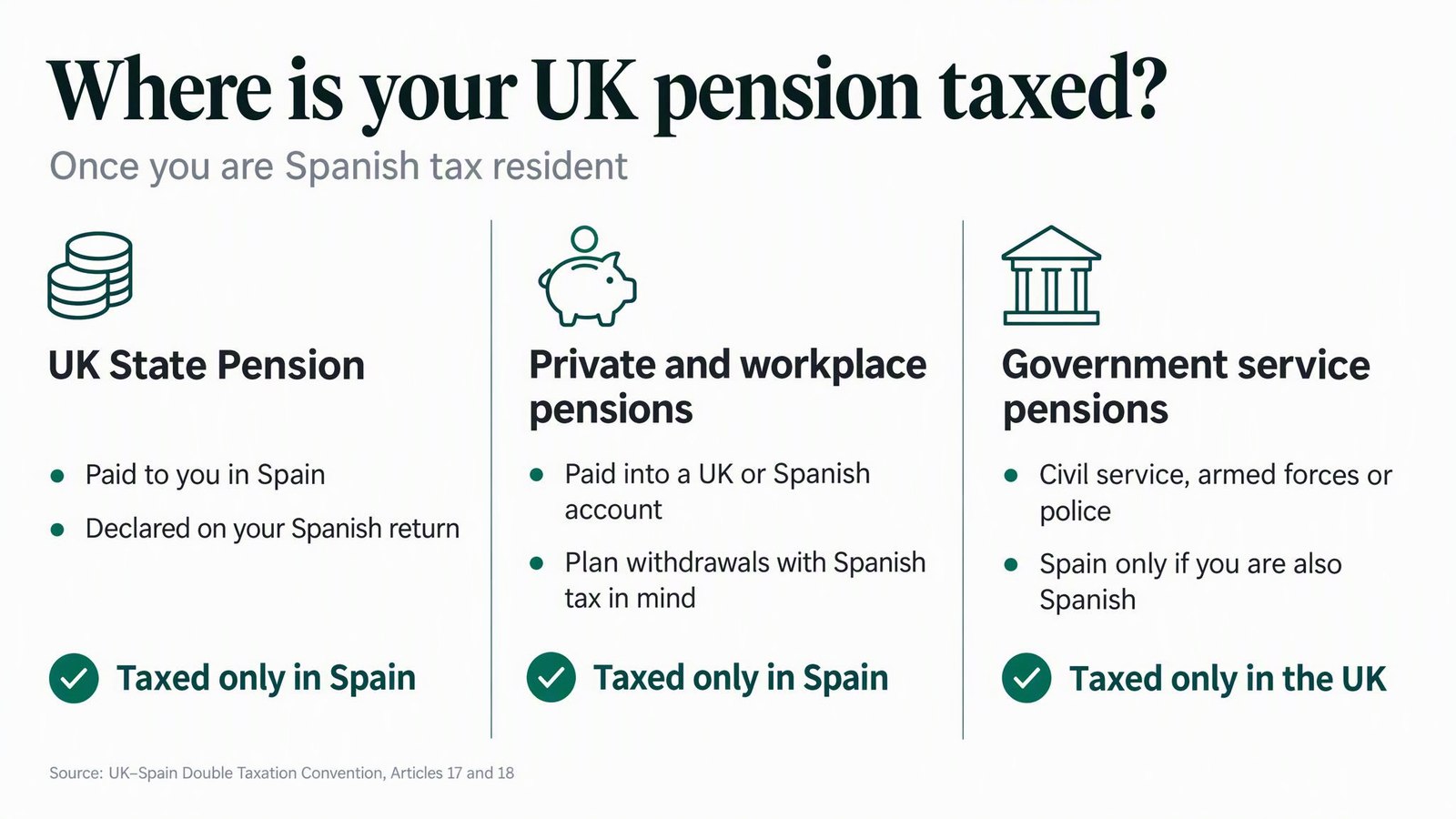
- The UK State Pension and private and workplace pensions are taxable only in Spain once you are resident there (Article 17).
- Government service pensions (for example, civil service, armed forces or police pensions) remain taxable only in the UK, unless you are both resident in Spain and a Spanish national (Article 18).
- UK rental income is usually taxable in both countries, but Spain gives a credit for UK tax paid.
- Dividends and interest may be taxed in both, but with credits to avoid double taxation.
However, the treaty does not mean you can choose where to pay tax. Your tax residence is decisive, and the treaty simply coordinates the two systems. A Spanish adviser familiar with UK rules, such as our legal support team for UK investors, is essential to apply the treaty correctly.
Income tax, wealth tax and other Spanish taxes affecting retirees
Once resident, you will be subject to several Spanish taxes. The main ones are:
- IRPF (Impuesto sobre la Renta de las Personas Físicas) – Personal income tax on pensions, rental income, investment income, etc.
- Wealth tax (Impuesto sobre el Patrimonio) – on your worldwide net assets above a regional allowance. In the Valencian Community, residents have a €2 million allowance from 2026 (Valencian Law 5/2026), and your main home is exempt up to €300,000. The state Solidarity Tax only applies to net wealth above €3 million.
- Inheritance and gift tax – potentially on worldwide assets if you or the beneficiary is resident in Spain. When Valencian rules apply, spouses, children and parents (Groups I and II) enjoy a 99% tax credit since 28 May 2023.
Spain also has specific rules and allowances for pension income, the sale of your main home and reinvestment, and for older taxpayers. A tailored analysis with a tax lawyer is crucial, especially if you hold significant UK property or investment portfolios.
Using the Beckham Law and other tax planning tools for new residents
For semi‑retired Britons who keep working, one of the most interesting tools is the so‑called Beckham Law (special expat tax regime), widely used by remote workers and directors moving to Spain.
What the Beckham Law is and who can use it
The Beckham Law is an optional regime that allows certain new residents to be taxed much like non‑residents for Spanish income tax purposes, for the year they become resident plus the following 5 years.
Key points:
- You must move to Spain for work reasons (employment, remote work or certain entrepreneurial and professional activities), not pure retirement.
- It is commonly used in combination with the Digital Nomad Visa or an employment contract with a Spanish entity.
- Your employment income is taxed at a flat 24% up to €600,000, while most foreign investment income stays outside Spanish tax.
For a semi‑retired consultant or director with high investment income abroad, this can be extremely advantageous compared with standard Spanish tax residency. However, it is technical, time‑limited and requires filing Form 149 within six months of starting your activity in Spain. Our guide to the Beckham Law, its requirements and how to apply explains the details.
Other key tax planning steps before moving
Before you become tax resident in Spain, it is wise to:
- Review how and where your pensions will be paid, and whether any restructuring (for example, annuities or drawdown strategies) is advisable.
- Consider whether to sell or retain UK property, and the timing of any sales to manage capital gains tax in both countries.
- Analyze your investment portfolio and whether Spanish‑compliant investment structures would be more efficient.
- Update or draft Spanish and UK wills to coordinate inheritance rules and avoid conflicts of law.
These decisions are very hard to undo once you are already resident in Spain, so it is important to speak to a lawyer and tax adviser before you trigger Spanish tax residence. Once you are settled, a legal tax management service can file your annual returns and foreign asset reports on time.
Healthcare for British pensioners retiring in Spain
Access to healthcare is a central concern for anyone retiring to Spain from UK after Brexit. Spanish immigration authorities will always check that you have comprehensive health coverage as a condition for granting a residence visa.
Using the S1 form for UK State Pensioners
If you receive a UK State Pension, you can usually apply for an S1 form from the UK authorities. This form confirms that the UK will cover the cost of your public healthcare in Spain.
In practice:
- You request the S1 from the NHS Overseas Healthcare Services before or shortly after moving.
- Once in Spain, you register the S1 with the Spanish Social Security institute (INSS), at a local office or online.
- After registration, you can access the Spanish public healthcare system on similar terms to Spanish pensioners.
For many British retirees, the S1 is the most cost‑effective and secure way to meet healthcare requirements, and it is usually accepted by Spanish consulates as proof of health coverage for visas (depending on the consulate’s practice at the time of application).
Private health insurance requirements for visas
If you are not yet of UK State Pension age, or do not qualify for an S1, you will need private health insurance from a Spanish‑authorized insurer to obtain most residence visas.
Key requirements usually include:
- Full coverage equivalent to the Spanish public system (no large deductibles or co‑payments).
- Valid for at least one year, matching the period of your permit.
- No waiting periods for major treatments, or at least clear documentation of them.
Premiums vary depending on age and medical history, so it is wise to obtain quotes early in your planning. In some cases, combining private insurance initially with later access to public healthcare (once eligible) offers the best long‑term balance.
Key practical rules: residence cards, driving, and time limits
Once your visa is granted and you have arrived in Spain, there are several important formalities that many retirees overlook but which are essential to stay compliant.
Registering as a resident and obtaining your TIE
All non‑EU citizens living in Spain long‑term must hold a TIE (Tarjeta de Identidad de Extranjero), the biometric residence card.
The process typically involves:
- Booking an appointment with the National Police (extranjería) in your province.
- Submitting form EX‑17, your visa, passport, proof of address, and paying a small fee.
- Providing fingerprints and later collecting the physical card.
You must also register on the local padrón municipal (municipal register) at your town hall. This is necessary for many services (healthcare registration, school enrollment for grandchildren, local voting rights in some cases, etc.).
Driving in Spain after Brexit for UK license holders
Driving rules for British residents in Spain are set by the UK‑Spain agreement in force since 16 March 2023:
- You can drive with your UK license for up to 6 months from the date you obtain residence.
- You can exchange your UK license for a Spanish license without taking a theory or practical test.
- After those 6 months your UK license is no longer valid for driving in Spain, although you can still exchange it.
Start the exchange as soon as you have your TIE, and check the latest guidance or ask a local lawyer or gestor when you arrive. Fines for driving without a valid license can be substantial.
Property, inheritance and estate planning for UK retirees in Spain
Many people retiring to Spain from UK after Brexit plan to buy a home in Spain, keep a property in the UK, and pass assets to children living in more than one country. That combination makes legal and tax planning more complex – but also more important.
Buying property safely as a non‑resident or new resident
Whether you buy before or after you move, you should treat a Spanish property purchase as a legal transaction, not just a lifestyle decision.
Key steps include:
- Conducting legal due diligence on the property (ownership, debts, planning permissions, licenses).
- Reviewing or negotiating the arras contract (reservation/deposit contract) to avoid losing large deposits.
- Ensuring your mortgage (if any) is suitable for non‑residents and correctly registered.
- Planning for property taxes (IBI, non‑resident income tax if you are not yet resident, plus purchase taxes or VAT).
Spanish property law and practice differ from England & Wales, so working with an independent Spanish lawyer who routinely advises foreign buyers is essential. Our legal guide to buying property in Spain as a foreigner walks through each step and the 2026 purchase taxes.
Cross‑border inheritance, wills and forced heirship
Spain has its own inheritance rules, including forced heirship (a reserved share for children, with regional variations), which can conflict with typical UK expectations (for example, leaving everything to a spouse). The EU Succession Regulation (No 650/2012) allows you to choose the law of your nationality (e.g. English law) to govern your estate, but this must be done correctly in a valid will.
For a British retiree with assets in both countries, it is generally advisable to:
- Have a Spanish will covering Spanish assets, coordinated with your UK will; an inheritance lawyer in Spain can make sure both wills fit together.
- Make a clear choice of law where appropriate (for example, choosing English law to govern your estate).
- Analyze potential Spanish inheritance tax exposure, which depends on the region, relationship to heirs, and value of assets (see the Valencian 99% credit mentioned above).
Proper planning can prevent disputes between heirs, avoid delays in accessing bank accounts or property, and reduce the overall tax burden on your family.
How much money you realistically need to retire in Spain after Brexit
Official visa thresholds are only a starting point. The actual amount you need to live comfortably depends on your lifestyle, whether you rent or own, and where in Spain you choose to live.
Visa thresholds vs. real‑life budgets
For the Non‑Lucrative Visa, the minimum income requirement is €2,400 per month for a single applicant and €3,000 for a couple. In practice:
- In many parts of Spain (including Valencia and much of the Costa Blanca), a couple who own their home can usually live comfortably but modestly within that threshold, excluding large travel or luxury spending.
- In prime coastal hotspots or the Balearic Islands, costs can be higher, especially for rent.
When planning, factor in:
- Housing (rent, community fees, IBI property tax, utilities)
- Health insurance (if no S1)
- Car running costs or public transport
- Travel back to the UK to see family
- Currency fluctuations between GBP and EUR
Many retirees choose to keep some savings in euros, or use specialist FX services, to reduce the impact of sterling volatility on their monthly budget.
Step‑by‑step roadmap for retiring to Spain from UK after Brexit
To bring all these elements together, here is a simplified roadmap that many of our British clients follow when planning their move.
Planning and application phase (6–12 months before moving)
- Decide whether you will fully retire (Non‑Lucrative Visa) or remain semi‑active (Digital Nomad Visa or other work‑based route).
- Gather evidence of income and savings and obtain preliminary confirmation that you meet visa thresholds.
- Review your tax situation with a Spanish/UK tax adviser: pensions, property, investments, potential use of the Beckham Law.
- Obtain quotes for private health insurance or apply for an S1 if you are a UK State Pensioner.
- Update or draft wills in the UK, and plan a Spanish will for later.
Visa application and arrival (3–6 months before and after the move)
- Submit your visa application at the appropriate Spanish Consulate in the UK, with all required documents correctly legalized and translated where necessary.
- Once approved, travel to Spain within the validity period of the visa.
- Apply for your TIE residence card and register on the padrón municipal.
- Complete healthcare registration (S1 or private insurance network registration).
- Start the process to exchange your UK driving license if you intend to drive.
Settling in and consolidating your new status (first 1–2 years)
- Monitor your days spent in Spain and abroad to understand when you become Spanish tax resident.
- File your first Spanish tax returns correctly, including the foreign asset report (Modelo 720) if your assets abroad exceed €50,000 in any category.
- Review your estate planning and sign a Spanish will aligned with your UK arrangements.
- Plan for visa renewals (Non‑Lucrative Visa renewals, Digital Nomad Visa extensions, etc.) within the two months before expiry, and keep proof that you spent more than 183 days a year in Spain.
Handled correctly, the process is structured and manageable. Handled casually, it can lead to visa refusals, unexpected tax bills or difficulties accessing healthcare. For that reason, many British retirees choose to work with a specialist Spanish legal and tax team from the outset.
Planning your retirement in Valencia? Our bilingual team can prepare your Non‑Lucrative Visa, plan your tax residence and draft your Spanish will. Book a free consultation.
Frequently Asked Questions
Can I split my time between the UK and Spain without becoming Spanish tax resident?
Yes, but you must carefully limit your time and ties in Spain. Staying 183 days or fewer in a calendar year is not always enough on its own; if your main home, spouse or dependent children are in Spain, you may still be treated as tax resident. Keep clear records of travel days, maintain strong ties in the UK (such as your main home and economic interests), and obtain tailored tax advice if you plan to “commute” between both countries.
Do I need to prove a specific level of savings as well as income to retire to Spain from the UK?
Not always, but having both helps. For most retirement‑type visas, you can usually qualify with either regular guaranteed income, sufficient savings to cover the required annual amount, or a combination of the two. Consulates often prefer predictable income (pensions, rental income) backed by bank statements and, where needed, lump‑sum savings to show long‑term sustainability of your move.
What happens to my UK State Pension and private pensions if I retire to Spain?
Your UK State Pension can still be paid to you in Spain and will continue to receive annual uprating under current rules. Private and workplace pensions can also be paid into a UK or Spanish bank account. However, once you are Spanish tax resident, your State Pension and private pensions are taxed only in Spain under the Double Taxation Convention (government service pensions stay taxable in the UK), so you must declare them in your Spanish tax return and plan withdrawals with Spanish tax in mind.
Is it better to rent first or buy a property immediately when retiring to Spain after Brexit?
Renting first is usually safer. It allows you to test different areas, understand year‑round costs, and confirm that your visa, healthcare and tax situation work as expected before committing capital. After 6–12 months, you will have a clearer idea of local prices, running costs and whether you prefer to settle permanently in that region, making a later purchase decision better informed and less risky.
Every case has its own details. Our English-speaking lawyers in Valencia can review your situation and advise you on the best way forward. Get in touch with us for tailored legal advice.
