


Sun, lifestyle, investment potential… there are many reasons why international buyers fall in love with Spain. But once you decide to move from dream to reality, you quickly discover that the legal and tax side of things can be confusing—especially if you are not familiar with Spanish law and you live abroad. The good news is that the process is clear and predictable if you know the steps, the documents you need, and the risks to avoid.
This guide explains everything you should know when buying a property in Spain as a foreigner: legal requirements, key stages of the transaction, taxes, financing options, and how property purchase connects (and does not connect) with residency and visas. It is written for non-lawyers, but with the depth and precision an international buyer actually needs.
Foreigners can buy property in Spain without restrictions
The first thing to understand is simple: yes, foreigners can buy property in Spain. Spanish law allows both EU and non‑EU citizens to purchase residential, commercial, and even land, whether they are tax residents or not. There is no general cap on the number of properties you can own and no special “foreign buyer tax”.
You can buy a home in your personal name, through a company, jointly with your partner, or via a family structure. However, each option has different tax and inheritance implications. For many expats, buying in their own name is the simplest, but higher‑net‑worth investors often consider Spanish or foreign companies and tailored estate planning to optimize wealth tax and succession rules.
Buying a property without residency rights
A frequent misunderstanding is to think that owning a home automatically grants you the right to live in Spain. It does not. Property rights and immigration rights are two separate legal systems:
- You can buy a property as a tourist and remain a non‑resident owner.
- You can be a legal resident in Spain and rent instead of buying.
Until 2 April 2025, investing at least €500,000 in Spanish real estate could give non‑EU buyers a residence permit (the so‑called Golden Visa). Organic Law 1/2025 abolished that route with effect from 3 April 2025, so buying a home no longer gives you residency on its own. Today, if you want to live in the property you buy for more than 90 days in any 180‑day period and you are non‑EU, you must separately qualify for a visa or residence permit (for example, Non‑Lucrative Visa, Digital Nomad Visa, work or family routes).
This is why many expats need a dual strategy: one legal plan for the property purchase, and another for immigration and tax residency. Coordinating both from the start avoids expensive mistakes, like buying a “retirement home” you cannot legally reside in year‑round.
Key legal requirements for buying a property in Spain as a foreigner
Although the law is open to foreign buyers, there are some non‑negotiable elements you must have in place before completing the purchase. Managing these early will save you delays and last‑minute stress at the notary.
Obtaining your NIE number (foreigner tax ID)
The essential document is the NIE (Número de Identificación de Extranjero). This is your tax identification number in Spain and it must appear on all key documents related to the purchase: contracts, mortgage deeds, tax forms, and the final title deed (escritura).
You can request a NIE:
- At a Spanish police station in Spain.
- At a Spanish consulate in your home country.
- Via a Spanish lawyer using a notarized and apostilled Power of Attorney.
Depending on location, appointments can take weeks or even months. If you are traveling to Spain only for viewings or the notary, it is wise to start the NIE process as early as possible (see our NIE service for property buyers) and often to delegate it to a local legal representative.
Opening a Spanish bank account
In theory, you can pay the purchase price from a foreign account. In practice, a Spanish bank account is almost essential if you want the process and your ongoing obligations to run smoothly. You will need it to:
- Pay purchase taxes, notary and Land Registry fees.
- Set up direct debits for community charges, utilities, and local taxes.
- Receive rental income if you let the property.
Spanish banks are strict with Know Your Customer and anti‑money‑laundering checks. Expect to provide proof of income, tax returns, and bank statements from your home country. For non‑EU clients or those with complex structures, having a lawyer who knows how to prepare documentation can avoid funds being blocked or accounts refused.
When you may need a military permit
Under Law 8/1975 on areas of interest for national defense, non‑EU buyers (UK nationals included since Brexit) need a prior military authorization to buy in restricted areas, such as municipalities on Spain’s land borders, Ceuta and Melilla, and other strategic zones. Notaries and Land Registrars must ask for it before the deed is signed or registered, and it can add several months to the timeline.
Signing a deposit contract with a tight completion date without factoring in this permit can put your deposit at risk. A due‑diligence‑oriented lawyer will check whether your chosen property is in a restricted area and adapt the contract accordingly.
The role of independent legal representation
In Spain, the notary is neutral. They verify the identity of the parties, read the deed, and ensure taxes and formalities are in order—but they do not investigate planning issues, community debts, or whether you are buying at the right price. The real estate agent is paid by the seller and focuses on closing the deal.
For a foreign buyer, this means that only your own lawyer is truly on your side. A specialist in real estate and international clients will:
- Check that the seller is the real owner and has capacity to sell.
- Confirm there are no hidden mortgages, seizures, or tax liens.
- Review planning legality and any building infractions.
- Adapt contracts so your deposit is protected if legal or financing issues arise.
In Spain, debts such as unpaid local taxes or community fees can “follow the property”. Without proper due diligence, you could inherit someone else’s problems on day one.
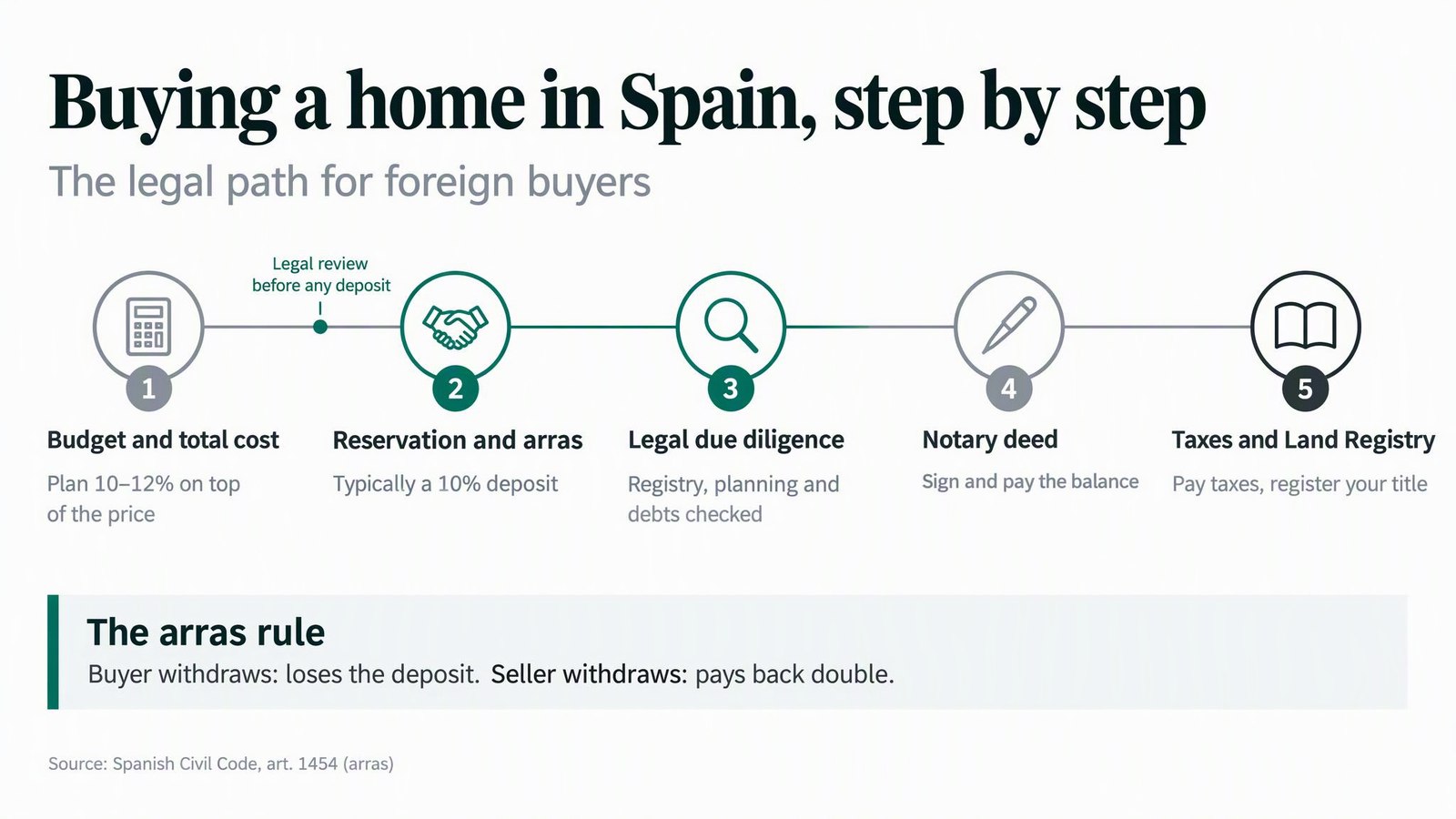
Step‑by‑step legal process for buying a home in Spain
While each transaction is unique, most purchases follow a similar legal path. Understanding the sequence helps you plan your visits, transfers of funds, and visa timing if you are relocating.
Step 1: Define your budget and total cost (purchase + taxes)
Listing prices in Spain do not include taxes and transaction costs. As a foreign buyer, you should plan for approximately 10–12% extra on top of the price, sometimes more if you are taking a mortgage. Typical extra costs include:
| Concept | Approximate range | Notes |
|---|---|---|
| Transfer tax (ITP) – resale | 6–10% of price | Varies by Autonomous Community (9% in the Valencian Community since June 2026) |
| VAT (IVA) – new build | 10% of price | Plus Stamp Duty (AJD) |
| Stamp Duty (AJD) | 0.75–1.5% | On new builds and some mortgage deeds |
| Notary & Land Registry | ~1–1.5% | Depends on price and number of pages |
| Legal fees | ~1% + VAT | Independent lawyer for due diligence |
For example, if you purchase a €300,000 resale apartment in Valencia (9% ITP), your total budget may be closer to €333,000–€336,000 once you add tax and costs. Clarifying this before you start visiting properties avoids falling in love with something that is just beyond your real budget.
Step 2: Property search and preliminary checks
Many foreigners start by browsing portals like Idealista or Fotocasa, or by visiting through local agents. At this stage, the focus is often on views, layout, and location—but it is wise to begin legal checks early, especially if you are making offers remotely.
Basic items your lawyer can verify before any deposit is paid include:
- Land Registry extract (nota simple): who owns the property, existing mortgages, seizures, or rights of way.
- Cadastral record: whether the surface area and description match what you are being shown.
- Urban planning situation: if there are illegal extensions, pools, or constructions subject to fines or demolition.
- Community and local debts: unpaid community fees or local property tax (IBI) that could become your responsibility.
For buyers living abroad, it is crucial never to transfer money purely on the basis of photos or an online advert. A short legal check at this stage can reveal scams, non‑existent properties, or sellers who are not actually the registered owners.
Step 3: Reservation and deposit contracts
Once you have found the right property and agreed a price, the next step is usually to reserve it and take it off the market. There are two common contracts:
- Reservation agreement: a small deposit (for example €3,000–€6,000) paid to secure the property for a short period while your lawyer performs initial checks.
- Deposit contract (contrato de arras): a more formal agreement, typically with a deposit of 10% of the price.
The arras contract is particularly important because of its legal consequences. In the standard form (arras penitenciales, Article 1454 of the Spanish Civil Code):
- If you, as buyer, withdraw without a valid contractual reason, you lose your 10% deposit.
- If the seller withdraws, they must return double the deposit to you.
For this reason, you should never sign an arras contract without independent legal review. Your lawyer can adapt it to include protective clauses, such as:
- Purchase being conditional on your mortgage being approved.
- Purchase being conditional on certain legal issues being resolved (for example, cancellation of a mortgage, regularization of minor planning issues).
- Extension mechanisms if extra time is needed for permits or banking formalities.
Step 4: Full legal due diligence
Between signing the deposit contract and completion, your lawyer will perform comprehensive due diligence. This is where the real value of legal representation appears, especially for foreign buyers who cannot easily access Spanish records or attend municipal offices.
Typical checks include:
- Ownership and charges at the Land Registry, ensuring there are no hidden mortgages, seizures, or rights that affect your use of the property.
- Urban planning with the Town Hall: building licenses, occupancy certificate (licencia de primera ocupación or cédula de habitabilidad), and any open planning infringement procedures.
- Community of owners: statutes, minutes of recent meetings, and a certificate confirming that the seller is up to date with payments.
- Utility status: whether electricity, water, and gas are properly contracted and if there are outstanding bills.
- Tax situation: confirmation that local property tax (IBI) and rubbish tax are paid up to date.
If problems are detected, your lawyer negotiates solutions with the seller before completion: cancellation of mortgages, rectification of registry descriptions, or price adjustments where appropriate.
Step 5: Signing the title deed at the notary
The purchase is formally completed when you sign the public deed of sale (escritura de compraventa) before a Spanish notary. At that moment:
- You or your representative (via Power of Attorney) sign the deed together with the seller.
- The remaining purchase price is paid, usually by bank check or certified transfer.
- The notary checks identification, property details, and attaches the Land Registry information.
As a foreigner, you have the right to request a translation or a bilingual deed so that you fully understand the content. Many expats prefer to have their lawyer attend and explain each clause, especially when a mortgage deed is also being signed.
Once signed, you receive the keys and become the owner in fact. To be fully protected against third parties, however, your ownership must still be registered, which is the next step.
Step 6: Registration at the Land Registry and post‑completion formalities
After the notary, several administrative steps must be completed within strict deadlines:
- Payment of purchase taxes (ITP or AJD), within a short statutory deadline (around one month, depending on the region).
- Filing of the deed at the Land Registry so your name is officially recorded as owner.
- Notification to the community of owners and change of direct debits for community fees.
- Transfer or activation of utilities (electricity, water, gas, internet).
For non‑resident buyers, it is common to grant a Power of Attorney to a lawyer so that all these steps are managed without you needing to be physically in Spain for each signature or appointment.
Taxes when buying a property in Spain: new build vs resale
Understanding the tax structure is essential when buying a property in Spain as a foreigner. The type of property (new or second‑hand) and the region where it is located determine which taxes apply.
Purchasing a resale (second‑hand) property
Most transactions in Spain involve resale properties. In this case, the main tax is the Property Transfer Tax (ITP – Impuesto sobre Transmisiones Patrimoniales). The rate varies by Autonomous Community:
- Madrid: generally 6%
- Valencian Community (Valencia, Alicante, Castellón): 9% since 1 June 2026 (10% before), and 11% for properties above €1 million
- Catalonia (Barcelona, Girona, etc.): generally 10%
- Andalusia (Málaga, Costa del Sol): standard 7% in many cases
Some regions offer reduced rates for large families, young buyers, or disabled purchasers. Your lawyer or tax adviser can confirm the exact rate for your situation and region.
Purchasing a new build property
If you buy directly from a developer and the property is being sold for the first time, you do not pay ITP. Instead, you pay:
- VAT (IVA): generally 10% of the purchase price for residential property.
- Stamp Duty (AJD – Actos Jurídicos Documentados): usually between 0.75% and 1.5%, depending on the region (1.4% in the Valencian Community since June 2026).
New builds may also involve additional costs for connecting utilities and setting up community services, which are often indicated in the developer’s documentation. Reviewing these carefully is important when comparing a new build with a resale property.
Financing your purchase: mortgages for non‑residents
Many foreigners finance part of their Spanish property with a local mortgage. Spanish banks are used to working with international clients, but the conditions differ from those offered to residents.
Typical mortgage conditions for foreign buyers
As a general rule:
- Non‑residents can usually borrow up to 60–70% of the property’s value or purchase price (whichever is lower).
- Residents may obtain up to 80%, subject to income and age.
In practice, this means that non‑resident buyers should plan to have around 40% of the price in cash to cover the down payment (30–40%) plus taxes and costs (10–12%). Banks will also look at:
- Your total debt‑to‑income ratio (usually not more than 30–35% of your net monthly income).
- Your age (many banks require that the mortgage ends by age 70–75).
- Proof of stable income, tax returns, and bank statements from your home country.
Most banks take the Spanish property itself as collateral and are reluctant to accept foreign security. Using a lawyer or mortgage broker familiar with non‑resident cases can help you compare offers and negotiate better conditions.
Coordinating mortgage approval with the legal process
Timing is critical. You should ideally have at least a pre‑approval before committing to a 10% deposit. Your arras contract should clearly state that if the bank does not grant the mortgage under reasonable conditions, you can recover your deposit.
Without this clause, if the bank later refuses to lend or offers unacceptable terms, you may either lose your deposit or be forced to complete in cash. Legal coordination between your bank, broker, and lawyer is therefore essential.
Ongoing taxes and obligations after the purchase
Once you own the property, your obligations do not end at the notary. Whether you are tax resident or not, there are annual taxes and practical matters you must manage to avoid fines or blocked accounts.
Local property tax (IBI) and other municipal charges
The main local tax is the IBI (Impuesto sobre Bienes Inmuebles), similar to council tax. It is calculated on the cadastral value of the property, which is usually lower than market value. The rate depends on the municipality.
In addition, some Town Halls charge a separate rubbish collection tax or other small municipal fees. These are usually paid annually or in installments and can be set up as direct debits from your Spanish bank account.
Non‑resident income tax and rental taxation
If you are not tax resident in Spain but own a property here, Spanish law assumes that the property could generate income, even if you do not rent it. As a result:
- You must file an annual Non‑Resident Income Tax return (Modelo 210) for the “imputed income” from the property.
- If you rent the property out, you must also declare that rental income. From 2026 income onward, rentals are reported in a single annual return filed between 1 and 20 April of the following year (Order HAC/623/2026); until 2025 the filing was quarterly.
The tax treatment differs according to your country of residence:
- Residents of EU/EEA countries generally pay 19% on net rental income and can deduct certain expenses (community fees, insurance, repairs, etc.).
- Non‑EU/EEA residents (for example, many UK, US, or Canadian citizens) usually pay 24% on gross rental income, without deducting expenses.
Failure to file these returns correctly is one of the most common reasons foreign owners receive fines. A tax adviser who understands double taxation treaties and the Beckham Law (for some expats who move their tax residence) is highly recommended if you intend to rent or relocate.
Short‑term rentals and tourist licenses
Many foreign buyers plan to rent their Spanish property on platforms like Airbnb or Booking.com when they are not using it. This can be attractive, but the legal framework is increasingly strict and highly local.
Tourist licenses and zoning rules
In many cities and coastal areas, short‑term holiday rentals require a specific tourist license. The rules vary by region and municipality:
- Some areas are open and grant licenses relatively easily.
- Others (for example, parts of Barcelona, Palma de Mallorca, or saturated coastal zones) have suspended new licenses or apply restrictive quotas.
Buying an apartment assuming you will obtain a tourist license later can be a serious mistake. Before signing any contract, your lawyer should check:
- Whether tourist rentals are allowed in that building and zone.
- If a license already exists and can be transferred.
- The current criteria and waiting times for new applications.
Two layers of rules now apply. Since 3 April 2025, in any building run by a community of owners you need the community’s express approval (three‑fifths of the owners, representing three‑fifths of the shares) to start a new tourist rental. On top of that, you need the regional tourist registration: the national Single Rental Registry number that Royal Decree 1312/2024 had made mandatory from July 2025 was annulled by the Supreme Court in May 2026 (Judgment 620/2026), so the regional register is once again the key requirement. In the Valencian Community, regional rules add their own requirements; see our guide to Decree‑Law 9/2024 on tourist rentals.
For long‑term rentals (more than 12 months), the rules are different and, in general, less restrictive, but still subject to national and regional tenancy law.
How property purchase relates to residency and visas
As noted earlier, owning a property in Spain does not automatically grant you residency. However, it can strengthen your case for certain visas and make your lifestyle in Spain more stable and predictable.
Typical residency routes for foreign property owners
Depending on your profile, some of the most common options include:
- Non‑Lucrative Visa (NLV): for retirees or people with sufficient passive income who do not plan to work in Spain. Owning a property can help demonstrate stable accommodation and reduce your monthly cost of living, which consulates consider.
- Digital Nomad Visa: for remote workers employed by foreign companies or self‑employed professionals with international clients. Many digital nomads choose cities like Valencia or Málaga and buy properties after trying the lifestyle.
- Family reunification or EU family member routes: where the property serves as proof of sufficient housing.
Each route has specific income thresholds, health insurance requirements, and documentation. Coordinating your property purchase with your immigration plan—rather than treating them as separate issues—helps avoid situations where you own a home but cannot stay as long as you wish.
Special considerations for different nationalities
While the core property law is the same for everyone, some practical aspects differ depending on your nationality and tax status.
EU/EEA citizens
Citizens of EU and EEA countries enjoy freedom of movement, so they can move to Spain more easily and later register as residents. For them, buying a property is often part of a broader relocation plan that also includes registering for healthcare, schools, and tax residency.
From a tax perspective, EU/EEA residents benefit from more favorable rules on rental income, as they can deduct expenses and pay a lower non‑resident rate.
UK citizens after Brexit
UK nationals can still buy freely, but are now treated as non‑EU for immigration and some tax rules. This means:
- Short stays are limited by the 90/180‑day Schengen rule unless a visa or residence permit is obtained.
- Rental income is usually taxed at 24% on gross amounts, without expense deductions (unless specific exceptions apply).
- They need the military authorization described above when buying in restricted areas.
For many British retirees and remote workers, combining a property purchase with an NLV or Digital Nomad Visa strategy—and careful tax residency planning—is essential. Our legal support for UK investors covers both sides.
US and other non‑EU citizens
Buyers from the US, Canada, Latin America, Asia, and other non‑EU countries face similar frameworks: full freedom to purchase, but separate immigration procedures and often higher withholding tax rates on rental income.
In restricted areas they are also subject to the military authorization requirement mentioned earlier. A lawyer familiar with these specificities will factor them into your timeline and contracts.
Why thorough legal and tax planning protects foreign buyers
Spanish property law offers solid protection to buyers who follow the correct steps. However, the system assumes that you, as buyer, will take responsibility for verifying the property’s situation. Unlike in some countries, there is no automatic state guarantee that the property is debt‑free or fully legal beyond what appears in the Land Registry.
For that reason, international buyers benefit from a holistic approach that combines:
- Specialized real estate legal advice for due diligence, contracts, and completion.
- Proactive tax and fiscal planning (non‑resident tax, potential tax residency, wealth tax, and inheritance implications).
- Coordinated immigration strategy if you intend to live in Spain more than a few months per year.
Done correctly, buying a property in Spain as a foreigner can be a secure, efficient, and rewarding process that supports your lifestyle, your family plans, and your long‑term investment goals. With the right legal structure and clear steps, your Spanish home can be a solid asset rather than a bureaucratic headache.
Buying in Valencia? Our bilingual team checks the property, reviews the reservation and arras contracts, and plans the taxes before you pay any deposit. Book a free consultation.
Frequently Asked Questions
Is it better to buy a Spanish property in my own name or through a company for tax and inheritance purposes?
For most buyers, purchasing in their own name is simpler and cheaper to manage. Using a company or structure only tends to make sense for higher‑value portfolios, complex family situations, or when you need specific inheritance or wealth‑tax planning. The “best” option depends on your total worldwide assets, marital regime, heirs, and where you are tax resident, so it should be decided with cross‑border tax and inheritance advice before you sign any contract.
How can I safely buy a property in Spain if I am not able to travel frequently?
You can grant a notarized and apostilled Power of Attorney so a trusted representative signs contracts, opens accounts, and completes at the notary for you. To stay safe, insist on independent legal representation, have all documents and deeds sent to you in advance for review and translation, use secure bank transfers (never cash), and avoid paying any deposit until your lawyer has checked ownership, debts, and the main legal risks.
What are the main risks foreign buyers overlook when purchasing property in Spain?
Commonly overlooked risks include: assuming tourist rentals will be allowed without checking licenses and zoning; underestimating ongoing taxes and community fees; ignoring planning or building irregularities because “everyone does it”; signing standard deposit contracts without financing or legal‑issue clauses; and not coordinating the purchase with visa and tax‑residency rules. Most of these can be avoided with early due diligence and written conditions in your contracts.
How do I plan my tax residency if I own a Spanish home but live between countries?
Tax residency is not decided by property ownership alone but by days spent in Spain, where your economic interests and family center are, and any double‑tax treaty rules. If you will split your time, track days carefully, analyze how becoming Spanish tax resident would affect your worldwide income, assets, and pensions, and coordinate with advisers in both countries. In some cases it is better to remain non‑resident; in others, formalizing Spanish tax residency brings more clarity and can reduce overall tax.
Every case has its own details. Our English-speaking lawyers in Valencia can review your situation and advise you on the best way forward. Get in touch with us for tailored legal advice.
