


Moving to Spain to study is already a big step. For many international students, the next question is obvious: “Can I work while I’m there, and how far can I go legally?” Spain’s immigration rules changed again in May 2025, and a lot of outdated information is still circulating online.
Below you’ll find a clear, updated guide on how work and student visas interact in Spain: who can work, how many hours are allowed, what kind of jobs are legal, and which options you have if you want to stay and work after graduation – with a special focus on life in cities like Valencia.
Understanding if you can work in Spain with a student visa
The starting point is simple: yes, you can work in Spain with a student visa, but only under certain conditions. The law considers that your main purpose in Spain is to study, so any work activity must be compatible with your studies and subject to limits.
Since 20 May 2025, student permits are governed by the new Immigration Regulation approved by Royal Decree 1155/2024. If you hold a long‑term study authorization for higher education (a bachelor’s, master’s, doctorate or other higher‑level program at a recognized institution), you are automatically allowed to work, as an employee or self‑employed, without applying for a separate work permit, as long as you respect the conditions explained below. Other study permits, such as upper‑secondary school, intermediate vocational training or Spanish language courses, do not include this automatic right: a work authorization must be requested first.
Maximum working hours and type of work allowed on a student visa
When people ask “Can I work in Spain with a student visa?” they usually mean: “How many hours can I work and what am I allowed to do?” Article 57 of the regulation sets clear limits to protect your status as a student.
With a higher‑education study authorization, you can:
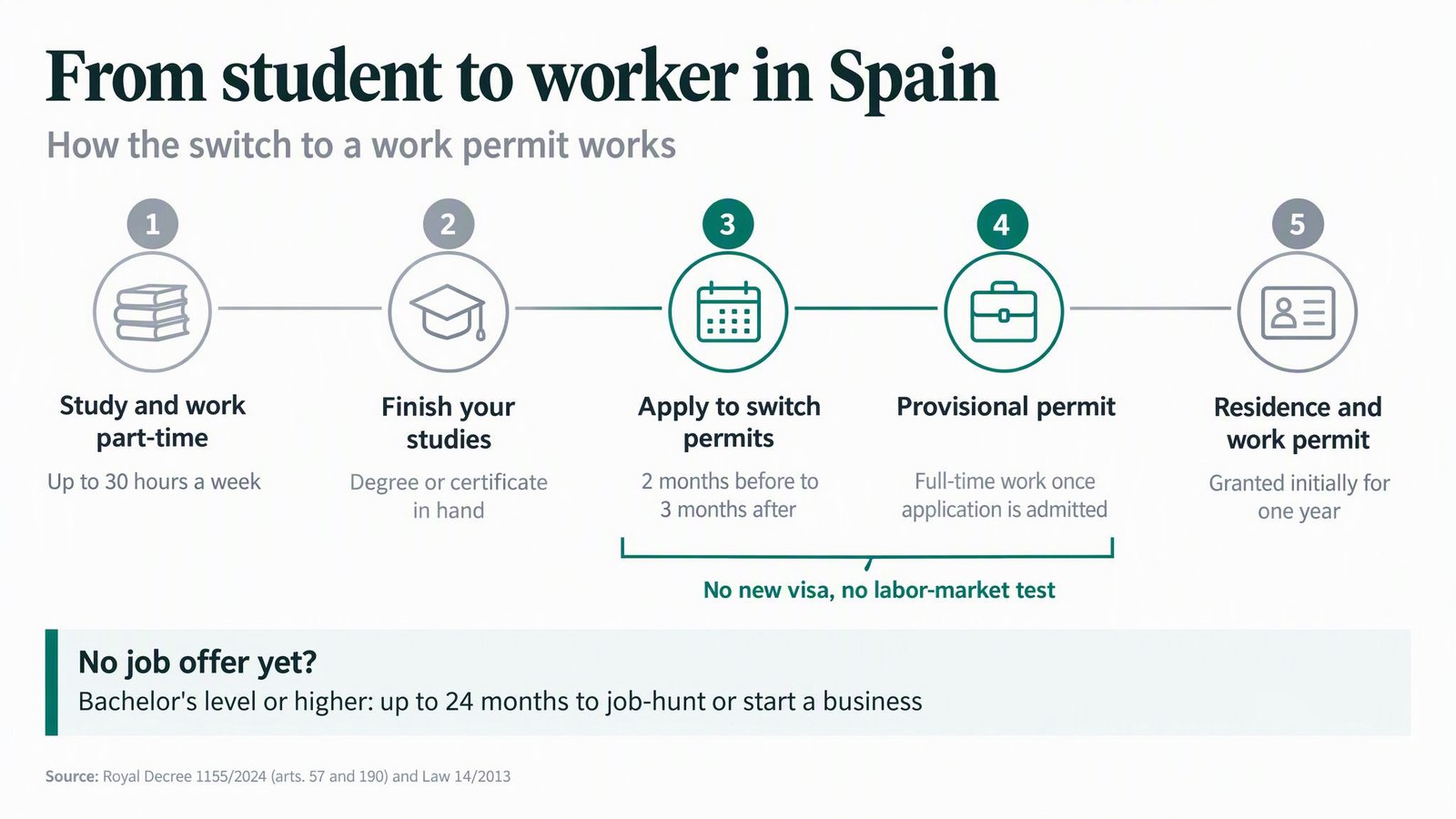
- Work up to 30 hours per week, as an employee or as a freelancer. The regulation does not include a full‑time exception for summer or other breaks, so plan on the 30‑hour cap all year round.
- Work in any sector (hospitality, retail, tech, etc.) – it does not need to be related to your degree.
- Do curricular internships that are part of your study plan without any additional authorization.
- Work in the region that issued your permit: the right to work is limited to that autonomous community (for example, the Valencian Community), plus neighboring towns just across its border.
The key rule is compatibility: your work schedule cannot overlap with your class schedule. If your lectures are in the mornings, your contract must be for afternoons, evenings or weekends. Going over 30 hours a week is a legal ground for terminating your study authorization, and the immigration office can ask you at any time to prove that you still meet the conditions of your permit.
What about proving funds? To obtain the permit you must show enough money to live on – 100% of IPREM (Spain’s public income benchmark) per month – plus health insurance. Under the new regulation, a valid employment contract or a firm job offer can count toward that amount when your permit allows you to work, alongside savings, family support or a scholarship. Even so, keep evidence of other funds, because a job capped at 30 hours may not cover the full amount on its own. Once you work and are registered with Social Security, that registration counts as your health coverage for permit purposes.
Differences between EU/EEA students and non‑EU students
Whether you are an EU/EEA/Swiss citizen or a non‑EU national changes the rules considerably. The following table summarizes the main differences.
| Aspect | EU/EEA/Swiss students | Non‑EU students |
|---|---|---|
| Right to work | Same as Spanish citizens (no visa or work permit) | Automatic with a higher‑education study permit; other study permits need a work authorization |
| Maximum hours during studies | No legal hour limit (only your own study schedule) | Up to 30 hours/week, all year round |
| Where you can work | Anywhere in Spain | The autonomous community that issued your permit (plus bordering towns) |
| Identification number | NIE (on the EU registration certificate) | NIE and TIE (student card) |
| Social Security registration | Mandatory before starting work | Mandatory before starting work |
| Post‑study options | Free access to the Spanish labor market | Must switch to another permit (job search, work permit, etc.) |
In practice, EU students have a smoother process: they register as EU residents, obtain a NIE, and can work without dealing with visas. Non‑EU students need to pay close attention to their permit type, card dates and extension deadlines, because their right to work depends entirely on keeping student status valid.
Requirements to work in Spain on a student visa
Beyond the visa itself, there are practical steps that every student must complete before starting a job. Employers in Spain are used to hiring students, but they will expect you to have your basic documents in order.
In general, you will need:
- Valid passport with your student visa (if you applied from abroad).
- NIE (Número de Identidad de Extranjero), your foreigner identification number.
- TIE (Tarjeta de Identidad de Extranjero) showing your study authorization, if you are a non‑EU national and your permit is valid for more than 6 months.
- Registration with Spanish Social Security (Número de la Seguridad Social), so your employer can pay contributions.
- A work contract that respects the 30‑hour weekly limit.
For most students in Valencia or elsewhere in Spain, the process is:
- Arrive in Spain and register your address (padrón) if required.
- Apply for your TIE in person at the police station within one month.
- Obtain a Social Security number (your employer or gestoría can help).
- Sign a contract and be registered in Social Security before your first working day.
If your study permit was granted under the previous regulation (before 20 May 2025), it keeps its validity until it expires, but new applications such as extensions fall under the new rules. If you are not in higher education, have changed programs or have gaps in your studies, it is wise to have a specialized immigration lawyer review your documents before you sign a contract.
Working through internships and university placements
Many international students prefer to gain experience through curricular or extracurricular internships, especially when studying at universities in Valencia, Madrid or Barcelona. These placements can be paid or unpaid, and they often count toward your degree.
Key points about internships on a student visa:
- Curricular internships are part of your official study plan, run under an agreement between your university and the company. The regulation expressly covers them under your study permit, with no extra authorization.
- Extracurricular internships are voluntary placements supervised by your university. Because they are not part of your study plan, it is safest to keep them, together with any job, within the 30‑hour weekly limit and outside class hours.
- If you want a traineeship after graduating, there is a separate internship residence permit for non‑employment placements.
These internships are particularly useful if you want to build a profile in Spain, for example in law, finance, technology or marketing, and they can be a bridge to a full employment contract after graduation. Employers in Valencia’s growing tech and startup ecosystem often recruit from their own interns.
Self‑employment and freelancing while you study
Another recurring question is whether you can work as a freelancer or run a small online business while holding a student visa. If you are in higher education, self‑employment (“autónomo”) is covered by the same automatic right to work, but the process is more delicate than a simple part‑time job.
If you want to invoice clients as a student in Spain, you generally must:
- Register as autónomo with Social Security and the Tax Agency (Hacienda) before you start.
- Respect the same compatibility and time limits as for employment (studies remain your main activity, and your total work should not exceed 30 hours a week).
- Pay monthly Social Security contributions (there is a reduced flat rate for new autónomos, but it is still a fixed cost).
Because becoming autónomo has tax and Social Security implications, it is strongly advisable to get individual legal and tax advice before registering; our guide to becoming autónomo in Spain walks through the registration steps. In many cases, a simple part‑time contract is more practical and less risky than self‑employment during your studies.
What happens if you work more than the legal limit?
Working more than the authorized hours, or working without being properly registered, can have serious consequences for your status in Spain.
Potential risks include:
- Termination of your study permit: the regulation expressly treats exceeding the 30‑hour weekly limit as a ground for ending the authorization.
- Sanctions for the employer for hiring you irregularly, which can also affect your future applications.
- Problems with future permits, including when you try to change from student status to a work permit.
Always make sure your contract clearly states your weekly hours, and keep copies of your class timetable and enrollment. If an employer pressures you to work “off the books” or over the legal limit, decline and, if needed, speak to an employment lawyer about your rights.
Tax obligations for students who work in Spain
Once you start earning income in Spain, you also enter the Spanish tax system. Even if you are “just a student”, you may have to file a tax return, depending on your income level and whether you are considered tax resident.
Key points to keep in mind:
- If you spend more than 183 days in Spain in a calendar year, you are typically treated as a tax resident, and Spain may tax your worldwide income (with relief under double tax treaties).
- If you stay less than that, you are usually taxed as a non‑resident on Spanish‑source income only, under the Non‑Resident Income Tax (IRNR).
- Your employer will normally withhold tax from your salary, but this does not always mean your obligations are fully covered.
Because student situations can be complex (scholarships, income from your home country, online work, etc.), it is sensible to have a brief tax residency analysis with a professional, especially if you plan to stay in Spain long term. Keep in mind that the Beckham Law (the special regime for inbound workers) requires that you were not tax resident in Spain in the five years before your move, so years spent here as a student can rule it out.
Staying in Spain to work after you finish your studies
Many students fall in love with Spain – and with Valencia in particular – and want to stay after graduation. When your program ends, your study permit also ends (it runs until 15 days after your studies finish), so you must plan early if you want to continue living and working in Spain legally.
The main options to stay and work after studying include:
- Job search or business residence permit – up to 24 months, non‑renewable, to find a job that matches your level of studies or to start a business, if you completed higher education at bachelor’s level or above.
- Modification to a work permit as an employee – if a Spanish company wants to hire you.
- Modification to a self‑employed work permit – if you plan to work on your own project or as a freelancer.
- Other specialized options, such as highly qualified professional permits, EU Blue Card, or entrepreneur permits, depending on your profile.
Each route has its own requirements and deadlines. The direct switch to a work permit is open to graduates of higher education, upper‑secondary or vocational programs (not language courses), once you hold your degree or certificate, and you can apply from two months before to three months after your study permit ends or you obtain your qualification. The job search permit must be requested in the 60 days before your study permit expires or the 90 days after. A careful strategy, designed a few months before graduation, can make the difference between a smooth transition and having to leave the country.
How the job search residence permit works
The job search permit is a popular bridge between student life and professional life in Spain. It allows you to stay in Spain legally while you look for a job that matches your level of studies or prepare to launch a business.
In broad terms, this permit (Additional Provision 17 of Law 14/2013):
- Is valid for up to 24 months, non‑renewable.
- Requires that you completed higher education at level 6 or above of the European Qualifications Framework (bachelor’s degree level or higher).
- Requires health insurance and sufficient funds, proven with a sworn statement detailing your means.
- Does not allow you to work: once you find a suitable job or launch your business, you must apply for the corresponding work or business permit.
The immigration office has 20 days to decide; if it does not answer in that time, the permit is deemed granted. This is often the most realistic route for students who do not yet have a signed employment contract at graduation time.
Changing from student visa to a work permit as an employee
If you already have an employer in Spain who wants to hire you when you finish your studies, you can modify your study permit into a residence and work permit as an employee (residencia y trabajo por cuenta ajena) under Article 190 of the regulation, without going back to your home country for a visa.
In this case:
- Either you or your employer can file the application, but the employer pays the government fee.
- The employer must provide a signed employment contract that follows the applicable collective agreement; if the job is part‑time, your annual pay must still reach the full‑time minimum wage.
- The labor‑market test does not apply: the employer does not have to prove it could not find a local candidate.
- You must have obtained your degree or certificate and have a clean criminal record.
Once the application is admitted for processing, your study permit becomes a provisional residence and work authorization that lets you work full time while the office decides, and the permit is initially granted for one year. Timing is still crucial, so coordinate the application with your graduation date and the expiry of your student TIE. A well‑prepared file, tailored to your specific profile (for example, a highly qualified position), significantly improves your chances of approval.
Changing from student visa to a self‑employed permit
For more entrepreneurial profiles – for example, tech freelancers or consultants – the alternative is to change from student status to a self‑employed work permit (residencia y trabajo por cuenta propia), within the same application window.
This route usually requires:
- A solid business plan showing that your activity in Spain is viable.
- The professional qualifications or experience your activity legally requires (and professional association membership, where applicable).
- Proof that the planned investment is sufficient to launch the project.
- Compliance with the licenses and rules any Spanish national would need to open the same business.
This is more complex than an employment permit, but for the right profile it can be an excellent way to remain in Spain while building an international career.
Alternative permits: Digital Nomad Visa and other expat options
Students who have finished their degrees sometimes discover that a different Spanish residence route fits their plans better than a classic work permit.
Depending on your situation, you may consider:
- The Digital Nomad Visa (international teleworking), if you work remotely for foreign companies or clients and want to base yourself in Spain.
- The Non‑Lucrative Visa, if you have sufficient passive income or savings and do not need to work in Spain.
- The entrepreneur residence permit, if you want to launch an innovative business. Note that the investor “Golden Visa” no longer exists: Organic Law 1/2025 abolished it with effect from 3 April 2025.
Each of these has specific tax and immigration consequences. For example, newcomers who move to Spain for remote work may qualify for the Beckham Law, but, as explained above, years spent in Spain as a tax‑resident student usually rule it out. Proper planning during the transition from student to professional life can save significant amounts in the long term.
Practical examples of working in Spain with a student visa
To make the rules easier to visualize, here are a few typical scenarios:
- Master’s student in Valencia: You attend classes every morning at a university in Valencia and hold a study permit for your one‑year master’s. You work legally as a waiter 20 hours per week in the evenings, with a formal contract and Social Security registration. This is compatible, because your work does not overlap with classes and stays under 30 hours/week.
- Spanish language student in Valencia: You attend an intensive Spanish course at a school accredited by the Instituto Cervantes. Your permit does not include an automatic right to work, so you cannot simply sign a part‑time contract: a work authorization must be requested first, and after the course you cannot switch directly to a work permit.
- Bachelor’s student in Madrid: A company offers you a 35‑hour‑per‑week job. This exceeds the 30‑hour cap and could cost you your study permit. You should negotiate 30 hours or fewer.
- Engineering graduate in Valencia: You finish your degree and want to stay. You apply for the job search permit within the deadline. Within six months you receive an offer from a local tech firm and apply for a work permit. Once it is approved, you can work full‑time.
In all these cases, the underlying logic is the same: keep your studies as the main activity during the student phase, then plan the right legal bridge to stay and work afterwards.
When to seek personalized legal advice
Immigration rules are national, but their practical application can vary by province and even by office. Valencia, for example, has its own immigration office practices and appointment systems, which can be confusing if you try to handle everything alone in a foreign language.
You should consider speaking with an English‑speaking immigration and tax lawyer in Spain if:
- You are unsure whether your particular study permit allows you to work (for example, if you are not in higher education).
- You plan to work close to the 30‑hour limit and want to avoid problems with your permit.
- You are thinking about freelancing or setting up a business while you study.
- You want to design a clear strategy to stay in Spain after graduation (job search permit, work permit, Digital Nomad Visa, etc.).
- You need to understand your tax residency and obligations once you start earning in Spain.
At Spain Legal Estate we assist international students, expats and foreign investors in Valencia and across Spain with immigration, tax and real estate matters. If you are asking yourself “Can I work in Spain with a student visa?” and you want a precise answer for your specific case, getting tailored advice before making decisions will help you study, work and stay in Spain with peace of mind.
Studying in Valencia and planning to work or stay after graduation? Our bilingual team checks what your permit allows and times your switch to a work or job search permit before the deadlines run out. Book a free consultation.
Frequently Asked Questions
Can I switch jobs or have more than one part‑time job while on a Spanish student visa?
Yes, you can change employers and even hold more than one part‑time job, as long as the total weekly hours from all contracts do not exceed 30, the jobs are in the region that issued your permit, and your work schedule remains compatible with your classes.
Do I need a minimum salary or specific contract type to work with a student visa in Spain?
There is no special minimum salary for students beyond standard labor rules (the national minimum wage and the applicable collective agreement), and you can work under typical Spanish contracts (e.g. part‑time, internship, fixed‑term). What matters is that the contract is formal, registered with Social Security, and respects the hourly limit.
Can I work remotely for a foreign company while I study in Spain on a student visa?
You can usually work remotely for a foreign employer if the activity respects the same compatibility and 30‑hour limits as local work. However, this may have tax and, in some cases, self‑employment implications, so it is important to check your specific situation.
What happens to my right to work if I extend or change my study program in Spain?
If you legally extend or modify your study permit to cover the new studies, your right to work continues under the same general conditions. Any gap, late extension request, or change that is not properly approved can interrupt your legal right to work.
Every case has its own details. Our English-speaking lawyers in Valencia can review your situation and advise you on the best way forward. Get in touch with us for tailored legal advice.
