


Launching a company in a new country is never just a business decision. It is about talent, tax, funding, lifestyle, and how easily you can execute your plans from day one. For founders eyeing Spain, there is one city that quietly checks all of these boxes at once – and it is not Madrid or Barcelona.
Below you will find a practical, founder‑friendly guide to why Valencia is increasingly the smart choice for relocating or setting up a startup in Spain, and how to structure that move legally, fiscally, and operationally.
Valencia offers a strategic base for startups expanding into Spain and Europe
Spain is the EU’s fourth‑largest economy and a natural bridge to Latin America and North Africa. Choosing the right city as your base will shape your access to markets, talent, and investors. Valencia combines EU single‑market access with a more agile, cost‑efficient environment than the country’s larger capitals.
Located on the Mediterranean coast, Valencia gives your team fast connections across Europe while keeping you close to key Spanish markets. High‑speed trains link you to Madrid in about 1 hour 40 minutes, Barcelona is roughly three hours away by train, and the city’s port and international airport make it easy to serve both B2B and B2C customers in multiple countries.
- EU access: Operate inside the EU single market with all the advantages of free movement of goods, services, capital, and people.
- Latin American bridge: Spanish language and strong historical ties make Valencia a natural staging point for expansion into LatAm.
- North Africa & Middle East: Direct air and sea connections support logistics‑heavy or industrial startups.
Cost structure in Valencia is founder‑friendly and investor‑attractive
When you are considering moving your startup to Spain, unit economics matter. Valencia stands out because you can significantly lower your burn rate without sacrificing infrastructure or talent quality.
Compared with Madrid, Barcelona, or other Western European hubs, Valencia offers more affordable housing, office space, and salaries. That translates directly into longer runway and more flexibility when experimenting with product–market fit.
| Cost item | Valencia (general picture) | Large EU hubs (typical) | Why it matters for startups |
|---|---|---|---|
| City‑center office / coworking | Lower monthly rates, flexible terms | Significantly higher, longer commitments | Reduces fixed costs; easier to scale up or down |
| Housing for founders & staff | Generally below Madrid/Barcelona | High, often a major part of salary expectations | Lets you hire competitively without inflating salaries |
| Everyday living (food, transport, leisure) | Generally lower than in Madrid, Barcelona or northern capitals | Much higher in capitals like London, Paris, Amsterdam | Improves perceived quality of compensation packages |
For investors, Valencia’s cost profile is equally attractive. The same capital injection typically buys more months of runway here than in Madrid, Barcelona, Berlin, or London, while the startup still benefits from Spain’s national incentives for innovative companies.
From a legal and tax perspective, structuring your company correctly from day one is essential to take full advantage of this cost efficiency. Setting up the right legal form (often a Spanish limited company, Sociedad Limitada – S.L.) and planning your tax strategy with local, English‑speaking startup lawyers will help you avoid surprises and keep your cost base predictable.
Valencia’s startup ecosystem is fast‑growing yet accessible
Valencia has quietly become one of Spain’s most dynamic startup ecosystems. It has fewer headlines than Barcelona, but for many founders that is an advantage: you get a serious tech and innovation community without the noise, competition, and cost of more saturated hubs.
Recent years have seen a surge in tech startups and scaleups across sectors such as fintech, AI, healthtech, mobility, and logistics. The Valencian Region Startup Observatory, promoted by the Startup Valencia association, counted 1,689 active startups in September 2025, 11.3% more than a year earlier, with artificial intelligence as the most common technology. Ecosistema Startup’s Regional Report on Tech and Innovative Companies 2025 ranks the Valencian Community third among Spain’s regions by number of tech and innovative companies.
- Critical mass without overwhelm: Well over a thousand startups, but still a community where you can actually know the key players.
- Sector diversity: From SaaS and marketplaces to deep tech, cleantech, and creative industries.
- International founders: A growing number of expat entrepreneurs and digital nomads choosing Valencia as a long‑term base.
The ecosystem is also well supported by local and regional institutions, and the city’s international profile helps: Valencia was World Design Capital 2022 (World Design Organization) and European Green Capital 2024 (European Commission). This public‑sector support complements the private accelerators and investors that are already active in the region.
For a founder relocating from abroad, this mix is ideal: you land in a city where startups are normal, where there are regular meetups and events, but where it is still realistic to get on the radar of key ecosystem players within a few months.
Founders benefit from a dense network of accelerators, incubators, and support programs
One of Valencia’s strongest assets is its dense network of accelerators, incubators, and public–private initiatives that help founders at every stage, from idea to internationalization. If you are considering moving your startup to Spain, this local support can dramatically shorten your learning curve.
In Valencia you will find programs focused on different verticals (water tech, fintech, industrial innovation, etc.), as well as generalist accelerators, such as Lanzadera at Marina de Empresas in the port area, and pre‑seed incubators. Many combine equity investment with mentoring, corporate partnerships, and access to international networks.
- Pre‑incubation & idea stage: Programs that match talent, help you validate ideas, and form founding teams.
- Acceleration: Programs lasting several months that offer investment, mentoring, and introductions to corporates and VCs.
- Sector‑specific hubs: Initiatives focused on areas like water, mobility, fintech, and deep tech.
- Community organizations: Startup associations, such as Startup Valencia, that lobby for founders’ interests and connect newcomers with local players.
On top of this, there is a growing ecosystem of business angels, family offices, and early‑stage funds that actively look at deals coming from Valencia. While many investors are based in Madrid or Barcelona, they increasingly see Valencia as a fertile hunting ground for quality startups with healthier cost structures.
From a legal standpoint, entering an accelerator or raising your first round in Spain involves key documents (term sheets, shareholder agreements, vesting schedules) that need to comply with Spanish corporate law. Having a corporate law team by your side that routinely advises startups and foreign investors in Valencia can ensure your cap table and governance are set up cleanly from the beginning.
Access to technical and creative talent is strong and cost‑effective
Talent is often the deciding factor when choosing where to base a startup. Valencia performs exceptionally well here thanks to its universities, vocational training centers, and creative heritage. For tech founders, the city offers a steady pipeline of engineers, developers, designers, and business profiles.
Two major public universities and several private institutions produce thousands of graduates each year, including a large number in STEM disciplines. Many of these graduates are eager to work in innovative environments, and salaries remain more competitive than in Madrid, Barcelona, or Northern Europe, which helps early‑stage companies scale their teams without breaking their budget.
- Engineering and IT: Strong computer science, telecoms, and industrial engineering programs feed the local tech scene.
- Design and UX/UI: Valencia’s long design tradition and its year as World Design Capital in 2022 attract creative professionals.
- International mindset: A large Erasmus and expat student population means many young professionals are comfortable working in English.
For startups in product, gaming, SaaS, or digital services, this combination of technical depth and creative flair is especially valuable. You can build cross‑functional teams that handle both the engineering and the user experience side of your product in‑house.
When hiring in Spain, it is crucial to understand local employment law, social security obligations, and the different ways to engage talent (employment contracts, freelancers, stock options, etc.). A labor law attorney familiar with employment law for employers in Spain can help you design contracts and incentive plans that are compliant and attractive to international talent.
Quality of life and work–life balance help attract and retain your team
Even the best business plan will struggle if your team burns out or refuses to relocate. One of Valencia’s biggest advantages is that it makes it genuinely easy to offer a high quality of life alongside an ambitious growth plan. This is a powerful tool for attracting top talent from around the world.
The city offers a rare mix: Mediterranean beaches, extensive parks, vibrant cultural life, and a compact, walkable center. Commutes are short, the climate is mild most of the year, and everyday costs (from groceries to childcare) are manageable compared to most Western European capitals.
- Short commutes: The compact city makes it realistic to get to work by bike, metro, or on foot.
- Outdoor lifestyle: Beaches, sailing, hiking, and cycling are all easily accessible.
- Cultural richness: Festivals, museums, music, and gastronomy provide ongoing inspiration and networking opportunities.
For remote‑first or hybrid startups, Valencia is particularly attractive. The city has excellent fibre‑optic internet coverage, modern coworking spaces, and a strong community of digital nomads and remote workers. This makes it easy to combine periodic in‑person collaboration with day‑to‑day remote work, whether your team is spread across Spain, Europe, or beyond.
When relocating employees or founders, immigration and tax status quickly become central issues. Structuring relocations under Spain’s Special Expats Regime (Beckham Law), or using the Digital Nomad Visa (available since 2023) where appropriate, can make a significant difference to your team’s net income and overall satisfaction.
Spain’s new startup law and expat tax regimes can benefit founders in Valencia
Spain has recently modernized its legal and fiscal framework for startups and international talent. If you are considering moving your startup to Spain, understanding these tools – and how they apply in Valencia – is essential to optimizing your structure.
Two pillars are especially relevant: the national Startup Law (Law 28/2022) and the Beckham Law (Special Expats Regime). Combined with Spain’s network of double taxation treaties, they can significantly improve your effective tax rate and that of your key employees.
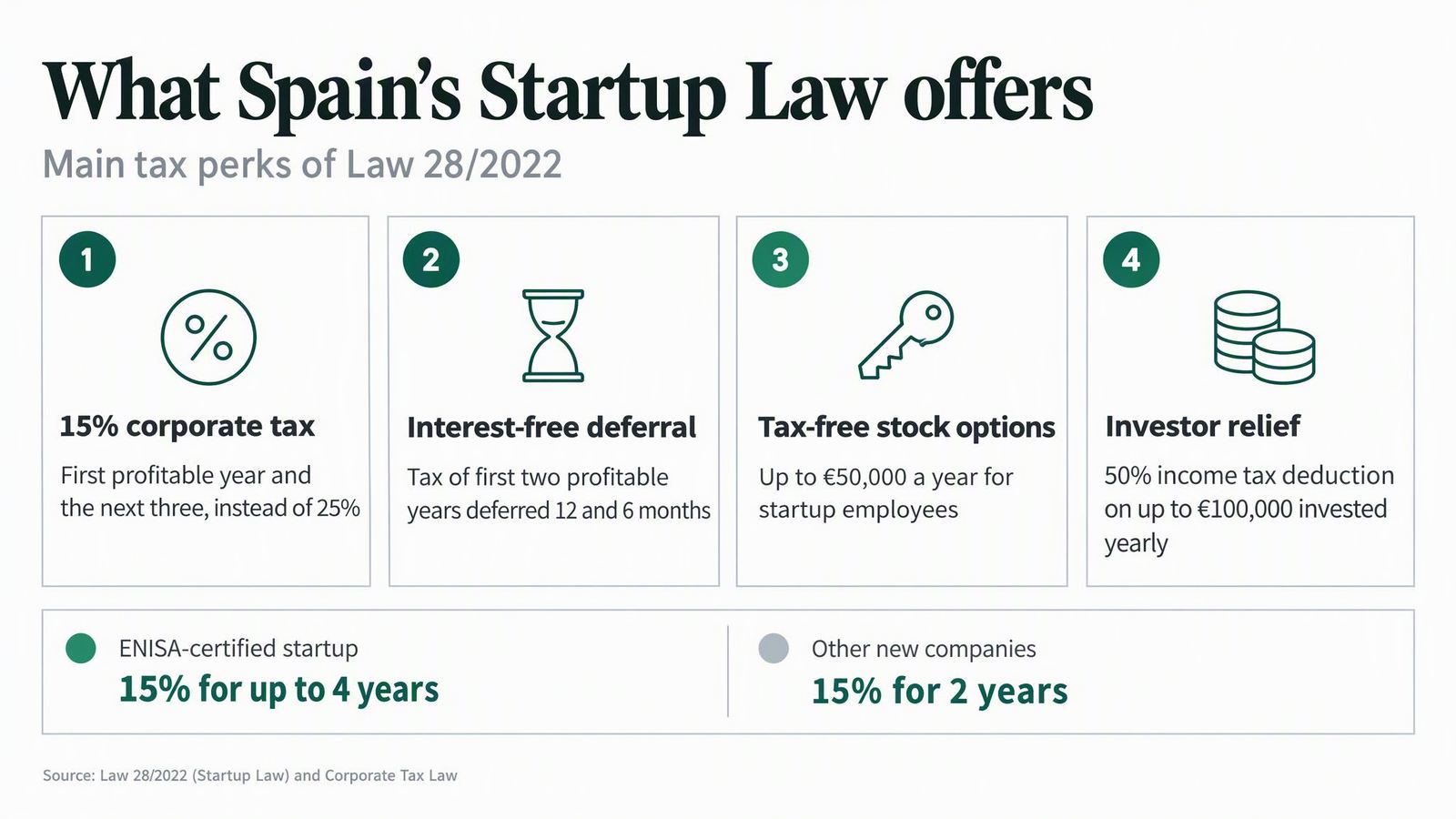
- Startup Law benefits: Companies certified as startups pay 15% corporate tax (instead of the general 25%) in their first profitable year and the next three, while other newly created companies get 15% for only two years under the Corporate Tax Law. Certified startups can also defer the corporate tax of their first two profitable years by 12 and 6 months without interest, and their employees can receive up to €50,000 a year in stock options tax‑free.
- Investor relief: Individual investors in young companies can deduct 50% of what they invest from their personal income tax, on up to €100,000 a year, subject to conditions.
- Beckham Law: Eligible people relocating to Spain pay a flat 24% on employment income up to €600,000 (47% above) in the year of arrival and the next five. Since 2023 it also covers certain entrepreneurs and highly qualified staff of startups, and only five prior years of non‑residence are required.
- Double Taxation Treaties: Spain has signed treaties with many countries to avoid being taxed twice on the same income and to clarify where you are considered tax resident.
To be certified by ENISA (the public agency that validates startups), a company generally must be no more than five years old (seven in biotech, energy, industrial and other strategic sectors), have its registered office or a permanent establishment in Spain with at least 60% of its employees there, run an innovative and scalable business model, not have distributed dividends, not be listed, and have annual turnover of no more than €10 million.
Applied correctly, these regimes can make Valencia highly competitive compared to other EU cities from a fiscal standpoint. However, the details matter: eligibility criteria, timing, and interaction with your home country’s tax rules must be analyzed case by case.
A boutique legal and tax firm experienced in Beckham Law, Non‑Resident Income Tax (IRNR), wealth tax optimization, and tax residency analysis can help you design a structure that supports both your personal situation and your company’s growth plan.
Immigration options for founders, remote workers, and startup teams in Valencia
For many non‑EU founders, the biggest practical question is: “How do I legally live and work in Spain while building my startup?” Valencia is particularly well‑positioned here because Spain offers several immigration routes tailored to entrepreneurs, remote workers, and investors.
The right path depends on whether you are a founder, an employee, a remote worker for a foreign company, or an investor. Each visa or residence permit has its own conditions, documentation requirements, and timelines.
- Digital Nomad Visa: Designed for remote workers and some founders whose income comes primarily from employers or clients outside Spain.
- Entrepreneur residence permit: For innovative projects of special economic interest for Spain, backed by a favorable report from ENISA; the residence authorization is granted for three years.
- Non‑Lucrative Visa (NLV): For those with sufficient passive income who do not plan to work in Spain.
- Golden Visa: No longer available. Organic Law 1/2025 abolished it, including the €500,000 real estate route, with effect from 3 April 2025.
- Standard work and residence permits: For employees hired by Spanish entities.
Regardless of the route, you will need to handle formalities such as obtaining your NIE (Foreigner Identification Number), registering your address, and, where applicable, applying for a TIE (residence card). These steps are manageable, but timing and documentation must be handled carefully to avoid delays.
Working with a legal team specialized in immigration and residency for expats, foreign investors, and digital nomads in Valencia can make the process significantly smoother. They can also coordinate immigration with your corporate setup, ensuring that your role in the company and your visa status are aligned from a legal perspective.
Setting up your company in Valencia: legal forms, tax, and compliance
Once you decide that Valencia is your base, you will need to choose how to structure your business in Spain. The decision affects liability, taxation, investor perception, and administrative obligations. For most startups, the typical choice is between operating as an individual entrepreneur (autónomo) or incorporating a company, usually a Sociedad Limitada (S.L.).
Many foreign founders also consider opening a Spanish branch of an existing foreign company, or creating a new Spanish subsidiary under a holding structure. Each option has pros and cons in terms of control, taxation, and cross‑border flows of dividends or IP.
- Autónomo (sole trader): Simple to register, suitable for freelancers or testing a concept, but with unlimited personal liability.
- Sociedad Limitada (S.L.): Limited liability company, separate legal personality, more credible for investors and partners, and usually the preferred form for startups.
- Branch vs. subsidiary: A branch keeps everything under the foreign parent; a subsidiary is a Spanish company with its own legal identity and potentially more local credibility.
Beyond incorporation, you must also address ongoing compliance: corporate tax filings, VAT (IVA), payroll and social security contributions, bookkeeping, and annual accounts. Spanish bureaucracy can be challenging if you are unfamiliar with the system, but with the right advisors it becomes a predictable routine rather than a distraction.
A law firm in Valencia specializing in company formation, commercial contracts, corporate restructuring, and ongoing tax and accounting support can act as your local back office. This frees you to focus on product, customers, and team, while staying fully compliant with Spanish and EU regulations.
Real estate and office space: from home offices to corporate headquarters
Whether you are a two‑person founding team or a scaleup moving dozens of employees, you will need to decide how and where your people will work. Valencia offers a broad range of options, from coworking spaces and flexible offices to long‑term leases and property purchases for those planning a permanent base.
For early‑stage startups, coworking spaces in central neighbourhoods provide desks, meeting rooms, community events, and often direct access to mentors and investors. As you grow, you may move to a dedicated office or even consider buying premises as a long‑term investment. Keep in mind that, since April 2025, buying property no longer gives you residency in Spain.
- Coworking & flexible offices: Ideal for small teams, hybrid work, and networking; available across the city.
- Traditional leases: Suitable for teams that need custom layouts, labs, or specific facilities.
- Property investment: Prices generally remain below Madrid or Barcelona; buying can give founders a stable base, but it does not grant residency on its own.
Commercial and residential property transactions in Spain involve specific legal checks: title verification, urban planning compliance, tax assessment, and often mortgage negotiation, particularly for non‑residents (see our guide to buying property in Spain as a foreigner). For founders relocating to Valencia with families, aligning real estate law, asset protection, and immigration strategy is key.
Engaging a legal partner experienced in property conveyancing, legal due diligence, and mortgage negotiation for non‑residents ensures that your office and housing decisions support, rather than complicate, your broader business and residency plans.
Planning for the future: estate, family, and cross‑border considerations
Founders relocating to Valencia rarely move alone. Partners, children, and sometimes elderly relatives are part of the picture – and that means thinking beyond the next funding round. Spain’s civil law system, inheritance rules, and matrimonial property regimes may differ significantly from what you are used to in common‑law jurisdictions.
For international entrepreneurs, it is important to align personal and family planning with your new life in Spain. That includes understanding how Spanish law treats marital property, what happens to your Spanish assets and company shares in the event of death or divorce, and how to coordinate wills and inheritance planning in different countries.
- Spanish wills and estate planning: Ensuring your Spanish assets, including real estate and company shares, pass according to your wishes.
- Cross‑border inheritance: Coordinating Spanish rules with those of your home country to avoid conflicts and unexpected taxes.
- Family law: Understanding how international divorce settlements, child custody, and support are handled when one or both spouses live in Spain.
For scaleup founders, wealth concentration in company equity and stock options also raises questions about asset protection and long‑term planning. Structuring holdings, trusts, or family companies correctly from the beginning can make future exits smoother and more tax‑efficient.
A boutique practice in Valencia that combines private client, family law, and corporate expertise can help you design a coherent strategy that protects both your business and your family across borders as your startup grows.
How a boutique legal and tax partner in Valencia can support your move
Relocating a startup is not just a question of choosing a city. It is a sequence of legal, tax, immigration, and practical decisions that must fit together. Valencia offers an exceptional environment for founders, but to fully benefit from it you will need specialized local guidance.
At spainlegalestate.com, our focus is precisely this intersection: boutique legal and tax services for expats, foreign investors, and digital nomads who want to build and scale businesses in Valencia and the wider Spanish market. We regularly assist founders and companies with:
- Choosing the right immigration route (Digital Nomad Visa, entrepreneur permits, highly qualified professional permits, Non‑Lucrative Visa, family reunification, and others).
- Analyzing tax residency and applying regimes such as the Beckham Law or the Startup Law where appropriate.
- Incorporating Spanish companies (S.L.), opening branches, or restructuring existing groups for optimal cross‑border efficiency.
- Drafting and negotiating commercial contracts, shareholder agreements, and employment documentation tailored to Spanish law.
- Handling real estate purchases, from founder housing to office or industrial space, including full legal due diligence.
- Advising on private client matters: Spanish wills, cross‑border inheritance, international divorce settlements, and asset protection.
- Supporting ongoing compliance: tax filings, accounting, corporate governance, and, where needed, dispute resolution or litigation.
Considering moving your startup to Spain? Our bilingual team in Valencia can line up your visa, company setup and, if you qualify, your ENISA startup certification in a single plan. Book a free consultation.
Frequently Asked Questions
What are the first practical steps to relocate my startup to Valencia?
Define your legal structure (autónomo, S.L., branch or subsidiary), check which immigration route fits you and your team, obtain NIEs, open a Spanish bank account, register for tax and social security, then secure a workspace and local accounting support. Doing this in this order avoids delays with incorporation and hiring.
How long does it typically take to set up a fully operational startup in Valencia?
If your immigration status is clear and documents are ready, you can usually incorporate, open a bank account, and obtain tax numbers in 3–8 weeks. Complex group structures, fundraising, or multiple foreign founders can extend this, so it is wise to plan for at least 2–3 months before being fully operational.
What hidden costs should founders budget for when moving to Valencia?
Beyond salaries and rent, plan for social security contributions, professional fees (legal, tax, accounting), incorporation and registry fees, health insurance if needed, relocation costs for staff, and periodic tax filings. These are manageable but should be built into your runway and fundraising plan from day one.
Can I keep my holding company abroad and only open an operating company in Valencia?
Yes, many founders use a foreign holding company and create a Spanish subsidiary as the local operating entity. This can help with investor familiarity and exit planning, but you must analyze tax residency, transfer pricing, IP ownership, and dividend flows to ensure the structure is efficient and compliant in both countries.
Every case has its own details. Our English-speaking lawyers in Valencia can review your situation and advise you on the best way forward. Get in touch with us for tailored legal advice.
