


Spain’s investor residence permit has changed a lot in recent years. New Golden Visa applications have been closed since 3 April 2025, but thousands of investors and their families still hold valid permits that must be renewed in 2026 and beyond. If you obtained your permit (or applied for it) before the cut‑off date, you can usually keep your residence, but only if you understand the renewal rules, deadlines and practical steps.
This guide from the Valencia‑based lawyers at Spain Legal Estate explains how to renew your Golden Visa in Spain in 2026, who can and cannot renew, and how to avoid the most common mistakes that lead to refusals or delays.
Key changes to the Spanish Golden Visa and who can still renew in 2026
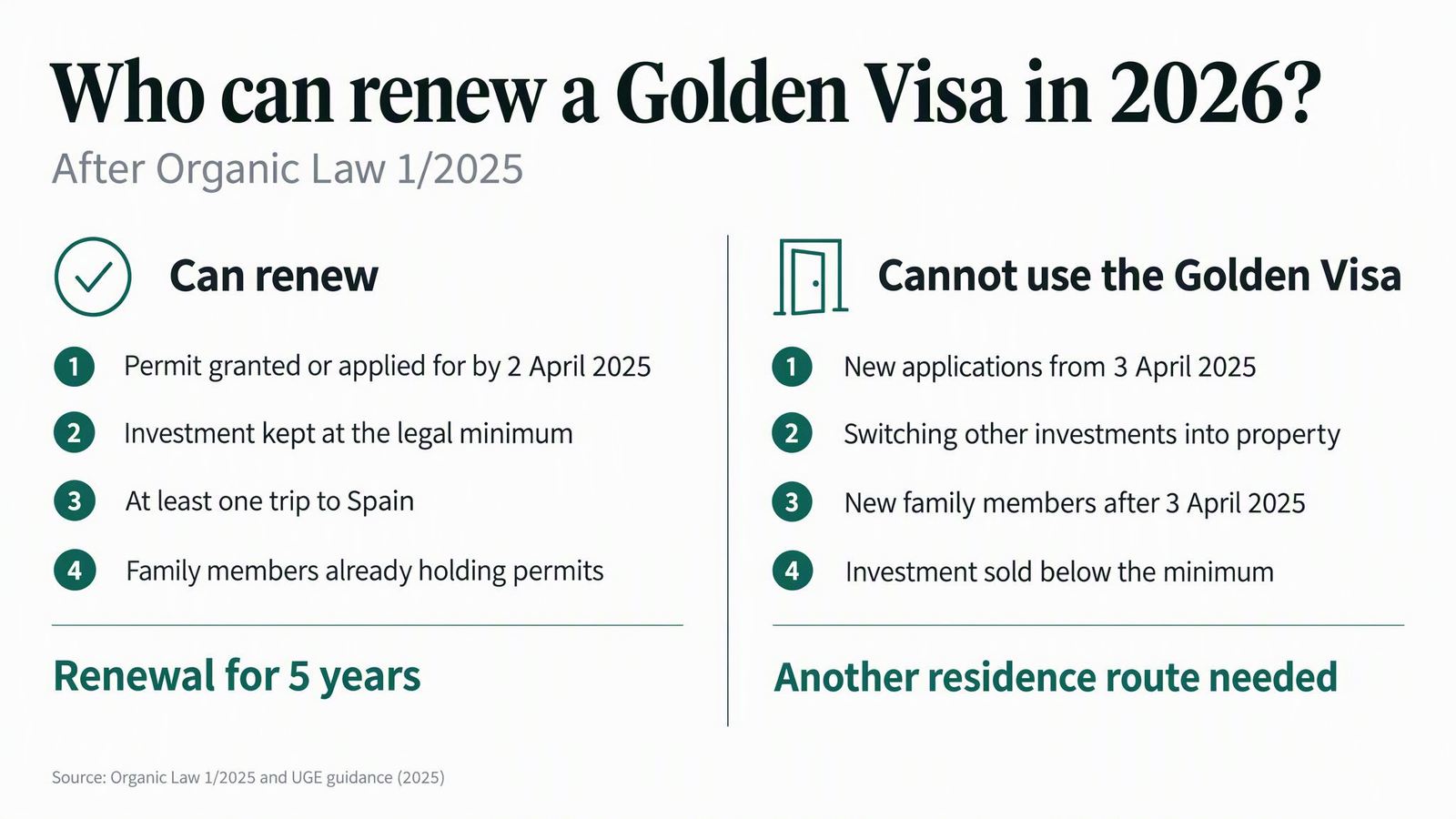
Organic Law 1/2025 of 2 January removed the investor residence rules (articles 63 to 67) from Law 14/2013 with effect from 3 April 2025. Its transitional rules distinguish clearly between:
- New applicants: no new Golden Visa can be requested from 3 April 2025, whatever the type of investment. Applications filed up to 2 April 2025 are still processed under the old rules.
- Existing holders: visas and residence permits already granted keep their validity, and renewals are decided under the rules that applied when the initial authorization was granted.
Can every type of investment still be renewed?
Yes. In guidance issued in 2025, the Large Companies and Strategic Groups Unit (UGE), the government office that handles these permits, confirmed that renewals are admitted for all investment types (real estate, public debt, shares and investment funds, bank deposits and business projects of general interest), provided the initial permit met the legal requirements. The nuances lie in changes to the investment:
- You may switch from real estate to another qualifying investment, or between non‑property investments, as long as you keep the minimum amounts.
- You may not switch from a financial or business investment into real estate.
- The residence right is personal: it cannot be transferred to a company, an heir or another family member.
A drop in value caused purely by market fluctuations does not count as a breach of the investment requirement. If you are unsure where you stand, our immigration lawyers can review your original resolution (resolución) and investment documentation before you file. If you no longer meet the conditions, see the alternatives section at the end of this guide.
Typical profile of investors who can still renew in 2026
Most people who will be able to renew successfully in 2026 share the following features:
- They are non‑EU nationals who obtained their Golden Visa, or applied for it, before 3 April 2025.
- Their residence is based on a qualifying investment they still hold, most often a real estate purchase of at least €500,000 free of charges and encumbrances.
- Property investors can prove ownership with an up‑to‑date Land Registry certificate.
- They have traveled to Spain at least once during the period of their permit.
- They have no criminal record and have maintained valid health insurance and sufficient economic means.
For these investors, renewing on time keeps their right to live and work in Spain and their path to long‑term residence and, eventually, citizenship.
Legal validity and duration of the Golden Visa after renewal
The Golden Visa was regulated by Law 14/2013 on support for entrepreneurs and their internationalization. Even though its investor articles were removed in 2025, those rules still govern the renewal of permits granted under them.
For renewals in 2026, the typical scenario is:
- Initial residence permit: two years under the original rules, and three years for permits granted after the reform introduced by the Startups Law (Law 28/2022).
- Renewals: five years each time, as long as the qualifying investment and the other conditions are maintained.
This long duration is one of the main advantages of the investor regime compared to other Spanish residence permits. A successful renewal in 2026 can therefore give you stability until 2031.
Remember that the residence card (TIE) is just the physical document. What really matters is the residence authorization behind it. You must renew the authorization first; then you apply for a new TIE at a National Police station in Spain.
Relationship with permanent residency and Spanish citizenship
Renewing your Golden Visa in 2026 also keeps your long‑term immigration plans alive. The time you spend as a Golden Visa holder can count towards:
- Long‑term residence (residencia de larga duración):
- Requires five years of continuous legal residence in Spain.
- To be considered “continuous”, you must not have been absent for more than six consecutive months or more than ten months in total during the five‑year period.
- Spanish citizenship by residence:
- General rule: ten years of legal and continuous residence.
- Reduced period of two years for nationals of Ibero‑American countries, Andorra, the Philippines, Equatorial Guinea or Portugal, and for people of Sephardic origin.
Many investors originally chose the Golden Visa because it did not force them to become tax residents or live more than 183 days per year in Spain. That advantage remains from an immigration perspective, but if your goal is long‑term residence or citizenship, you must plan your physical presence in Spain carefully and keep travel records.
Main requirements to renew your Golden Visa in 2026
To renew successfully, you must show that you still meet the same core conditions that allowed you to obtain the permit in the first place. The key points are:
- Maintain the qualifying investment.
- Have traveled to Spain at least once during the authorized period.
- Have no criminal record and pose no threat to public order.
- Show sufficient financial means for you and your family.
- Hold valid health insurance in Spain.
- Be up to date with Spanish tax and Social Security obligations.
- Apply within the legal deadlines and submit complete documentation.
Below, we look at each of these in detail, focusing on how they work in practice for renewals in 2026.
The investment must still be in place and properly documented
The main requirement to renew a Golden Visa in Spain is that your qualifying investment is still in place and meets the minimum amount required by the rules under which it was granted.
For real estate investors, this means:
- You still own qualifying property worth at least the legal minimum.
- The unencumbered portion (free of mortgages and charges) of your investment is at least €500,000.
- You can provide a Land Registry certificate of ownership and charges (certificación de dominio y cargas) dated within the 90 days before you file.
Holders of financial investments (public debt, shares, funds or bank deposits) must provide certificates from their bank, fund manager or notary showing that the investment has been maintained. If you have sold your original property, restructured your investments or moved assets into a company, it is crucial to check whether the new structure still qualifies. Remember that moving from a non‑property investment into property is not accepted.
Example: real estate investor renewing in 2026
Anna, a Canadian investor, purchased a flat in Valencia city in 2022 for €650,000, paying €500,000 from her own funds and financing the rest with a Spanish mortgage. She obtained the Golden Visa in 2023 and now wants to renew in 2026.
To renew, she must prove that:
- She still owns the flat.
- At least €500,000 of the investment remains free of charges.
- Her mortgage only affects the amount above €500,000.
Her lawyer obtains an updated Land Registry certificate and the bank documentation, confirming that she continues to meet the investment requirement and can safely proceed with the renewal.
Criminal record and public order requirements
Spain will check whether you present any risk to public order, public health or national security. The general rule for these permits is that you must have no criminal record in Spain or in the countries where you have lived during the last five years. The authorities check Spanish records directly; if you have lived elsewhere during your permit, you may be asked for foreign certificates.
Foreign criminal record certificates usually need to be:
- Legalized or apostilled (depending on your country).
- Officially translated into Spanish by a sworn translator.
- Recent (often no older than 90 days at the time of submission).
Minor infractions or very old convictions may not automatically block your renewal, but serious offenses can. If you have any doubts about your criminal record, seek legal advice before applying.
Financial means required to renew your Golden Visa in 2026
Even though the Golden Visa is designed for investors, you still have to prove that you have enough economic resources to support yourself and your dependants during your residence in Spain.
Law 14/2013 does not fix an exact amount; in practice, the reference is the IPREM (Indicador Público de Renta de Efectos Múltiples), a public income index. The usual benchmark is:
- 400% of IPREM for the main applicant.
- 100% of IPREM for each dependent family member.
In 2026 the IPREM remains at €600 per month (€7,200 a year on a 12‑payment basis), because no new State Budget has been approved since 2023. The figures are therefore:
| Applicant type | Percentage of IPREM | Monthly amount (2026) | Annual amount (2026) |
|---|---|---|---|
| Main applicant | 400% | €2,400 | €28,800 |
| Each family member | 100% | €600 | €7,200 |
Your lawyer should confirm the IPREM in force on the date you file and calculate the exact minimum for your family unit.
You can usually prove financial means through:
- Bank statements (Spanish or foreign).
- Certificates of deposits or investment portfolios.
- Proof of regular income (dividends, rental income, salaries outside Spain, etc.).
For practical reasons, many investors choose to keep the required amount in a Spanish bank account before renewal, as this simplifies the assessment by the authorities.
Health insurance coverage in Spain
Another non‑negotiable condition to renew your Golden Visa in Spain in 2026 is having public health coverage or private health insurance with a company authorized to operate in Spain. A private policy should:
- Offer full coverage comparable to the Spanish public health system (not just travel insurance).
- Ideally be without co‑payments (sin copago), as policies with co‑payments are often questioned.
- Cover all family members included in the renewal.
- Be in force for the period required by the authorities.
If you changed your insurer, forgot to renew your policy, or only hold travel insurance, your application may be rejected. Many investors ask their lawyer or broker to review the policy wording before filing.
Tax and Social Security compliance
The investor rules of Law 14/2013 require you to be up to date with your tax and Social Security obligations. In practice, this means:
- No outstanding debts with the Spanish Tax Agency (Agencia Tributaria), including the non‑resident tax returns on your property.
- No debts with Social Security if you employ staff or own a Spanish company.
If you have started to spend more than 183 days per year in Spain, or if you own rental properties or a company here, coordinate your planning with a tax lawyer who handles international cases before renewing.
Deadlines and timing to renew your Golden Visa in Spain in 2026
Missing the deadline is one of the most common and most frustrating reasons for problems with Golden Visa renewals. The rules offer a reasonable window, but you must still be organized.
When you can apply: the renewal window
In general, you can submit your application:
- From 60 days before the expiry date of your current authorization.
- Up to 90 days after the expiry date. Law 14/2013 still treats your permit as extended if you file within this period, but a late filing can lead to a fine.
Filing the renewal extends the validity of your current permit until the UGE decides, even if your card has technically expired. However, traveling outside Spain during this time can be complicated if you do not yet have a favorable resolution.
For peace of mind, many investors apply as early as the window allows, especially if they need time to collect foreign documents (criminal records, legalizations, translations).
Where and how to submit the renewal in 2026
Unlike visa applications, the Golden Visa renewal is processed in Spain, not at a consulate. Key points:
- The application is filed online with the UGE (Unidad de Grandes Empresas y Colectivos Estratégicos), usually by your lawyer or another authorized representative, so the file can be prepared and submitted while you are abroad.
- Once approved, you book an appointment at the National Police to provide fingerprints and obtain your new TIE card, which you must do in person in Spain.
Planning a short trip to Valencia or your usual Spanish base to coincide with the TIE appointment is therefore essential. That trip also helps you meet the requirement of having traveled to Spain during your permit.
Step‑by‑step process to renew your Golden Visa in Spain in 2026
Below is a simplified roadmap of the steps most investors follow when renewing their Golden Visa in 2026. Each case is different, but this gives you a clear overview of what to expect.
Step 1: Legal review of your situation and investment
Before collecting documents, it is wise to start with a legal review. At Spain Legal Estate, this usually includes:
- Checking the type and date of your original permit and any previous renewals.
- Confirming that your investment still qualifies, including any changes made since the initial grant.
- Analyzing your family situation (marital property regime, dependent children, new partners, etc.).
- Reviewing your travel history if you are also planning for long‑term residence or citizenship.
If any red flags appear (for example, you sold the property, changed ownership, or have long absences), your lawyer can propose corrective strategies or alternative residence paths before the deadline arrives.
Step 2: Collecting and preparing documentation
Next, you will need to gather the required documents. The exact list varies by case, but typically includes:
- Valid passport (with sufficient validity remaining).
- Current TIE card and the resolution of previous authorizations.
- Land Registry certificate (dated within the last 90 days) or the certificates proving your financial investment.
- Bank statements and financial certificates showing sufficient means.
- Health insurance policy and proof of payment.
- Criminal record certificates, if requested, duly legalized and translated.
- Marriage certificate and birth certificates of children (updated and legalized), if applicable.
- Tax and Social Security compliance certificates, if requested.
Foreign documents must usually be:
- Issued recently (often within the last 90 days).
- Legalized or apostilled according to international agreements.
- Translated into Spanish by a sworn translator (traductor jurado).
Because these steps can take several weeks, especially in countries with slower bureaucracy, it is smart to start preparing three to four months before your expiry date.
Step 3: Filing the renewal application online
Once your documentation is ready, your lawyer will usually:
- Complete the renewal application for your investor authorization under Law 14/2013.
- Pay the required administrative fees (tasas).
- Submit your application electronically to the UGE with all supporting documents.
The law gives the UGE 20 days to decide; if it does not answer in time, the application is deemed granted (positive administrative silence). In practice, requests for additional documents can extend the timeline, but investor renewals are generally faster than standard immigration procedures.
Throughout the process, it is important to monitor the file and respond quickly if the authorities request additional documents or clarifications.
Step 4: Resolution and new TIE card
If your renewal is approved, you will receive a favorable resolution (resolución favorable). With this in hand, you must:
- Book an appointment at the Comisaría de Policía (National Police station) in your area.
- Submit the required forms and pay the TIE issuance fee.
- Provide fingerprints and a passport‑size photograph.
- Collect your new residence card (TIE) after a few weeks.
Your renewed authorization will be valid for five years. During this period, you must continue to maintain your investment and other conditions if you plan to renew again or to move towards long‑term residence.
Family members: how spouses and children renew with you in 2026
One of the key benefits of the Golden Visa is the ability to include family members in your residence project. For renewals in 2026, family members who already hold a Golden Visa family permit can renew in parallel with you, under similar conditions.
Who can renew as a family member of a Golden Visa holder?
Usually, the following relatives are eligible:
- Spouse or partner (pareja de hecho), under the rules in force when your permit was granted.
- Minor children.
- Adult children who are financially dependent on you and have not formed their own family unit.
- Dependent ascendants (parents), subject to proof of dependence.
Each family member holds a residence permit linked to the main investor. When you renew in 2026, file all applications together so that your family’s permits remain aligned in duration.
An important change: according to the UGE, new family members can no longer be added to a Golden Visa after 3 April 2025. A relative who did not already have (or had not applied for) a family permit under Law 14/2013 must use the general family reunification route, which has stricter requirements.
Special rules about investment and marital property regime
In couples, the way you own the investment and your marital property regime can affect renewals:
- If a couple married under a community of property regime (gananciales) made an investment below double the legal threshold (for property, less than €1,000,000), the law treats one spouse as the investor and the other as a family member.
- For both spouses to be investors in their own right, each must hold a qualifying investment in their own name (for property, at least €500,000 each).
These details can be complex and have long‑term consequences, especially if you later divorce or want each spouse to have an independent route to residence. A careful review of your property deeds and marriage contracts is therefore essential before renewing.
Travel, absences and tax residency: practical implications in 2026
One of the classic advantages of the Golden Visa was the flexibility of physical presence: you did not need to live in Spain full‑time to keep your residence. For renewals in 2026, this general principle remains, but with some nuances.
Minimum presence required to renew the Golden Visa
Under the investor regime, you are not forced to stay more than 183 days per year in Spain to keep your residence. Instead, the key condition is that you:
- Travel to Spain at least once during each authorized period if you wish to renew.
In practice, this means that you can continue to live most of the year in another country, as long as you keep your investment and respect the other legal conditions. This is particularly attractive for international entrepreneurs and retirees who divide their time between several countries.
However, if your goal is to obtain long‑term residence or citizenship, you must meet stricter rules on continuous residence, as explained earlier. This is where many investors choose to change strategy after a few years of flexibility.
Tax residency and the Golden Visa in 2026
From a tax perspective, the Golden Visa does not in itself make you a tax resident in Spain. You generally become a Spanish tax resident if:
- You spend more than 183 days in Spain during a calendar year, or
- Your main center of economic interests is in Spain, or your spouse and minor children who depend on you live here.
Many Golden Visa holders spend less than 183 days in Spain to avoid becoming tax residents, while still enjoying residence rights and visa‑free travel within the Schengen Area. Others decide to relocate permanently and accept Spanish tax residency, sometimes using the Beckham Law special expat regime or careful planning with double tax treaties.
Before renewing your Golden Visa in 2026, it is wise to review:
- Where you actually spend your time.
- Where your main sources of income are located.
- Whether you might already be considered tax resident in Spain without realizing it.
A combined immigration and tax review can prevent unpleasant surprises later, such as unexpected wealth tax exposure or double taxation.
Common mistakes that can jeopardize your renewal in 2026
Even solid investors with strong cases sometimes face refusals or delays because of avoidable errors. When planning your Golden Visa renewal in 2026, pay special attention to the following risks:
- Selling or encumbering the property below the minimum threshold
- If you sell your original property or increase your mortgage so that the free‑of‑charge portion drops below €500,000, you may lose your eligibility.
- Switching the investment into property
- Moving money from shares, deposits or public debt into real estate during the permit is not accepted for renewal purposes.
- Letting documents expire
- Registry certificates, criminal records and civil status documents have strict validity periods. Submitting expired documents can lead to rejections or requests for new papers.
- Inadequate health insurance
- Travel policies or plans with high co‑payments are usually not accepted. Always verify that your policy is suitable for immigration purposes.
- Insufficient proof of financial means
- Relying on scattered foreign accounts without clear statements, or not meeting the IPREM‑based benchmark, can delay or block your renewal.
- Missing the renewal window
- Waiting until the last minute makes it harder to solve unexpected issues. Once the 90‑day grace period after expiry has passed, your permit is no longer extended and, since new Golden Visas are closed, you would most likely need a different residence permit.
- Ignoring tax and compliance issues
- Unpaid taxes, undeclared rental income, or Social Security debts can surface during the renewal and complicate your file.
Working with a specialized immigration and tax team in Spain, ideally based where your investment is located, such as Valencia, can greatly reduce these risks and make the process smoother.
Alternatives if you cannot renew your Golden Visa in 2026
Not every investor will be able to renew. Perhaps you sold the investment, your family situation changed, or you missed the renewal window. As new Golden Visas are no longer granted, you will need a different residence permit. Our guide to Golden Visa alternatives for property investors compares them in detail; the most common options are:
Non‑Lucrative Visa (NLV) for financially independent residents
The Non‑Lucrative Visa is designed for people who can support themselves without working in Spain. Key features:
- You must show stable passive income or sufficient savings, using the same 400% IPREM benchmark: €28,800 a year in 2026 for the main applicant, plus €7,200 per family member.
- You cannot work in Spain, either as an employee or self‑employed.
- Unlike the Golden Visa, you are expected to live in Spain for most of the year; the permit is granted for one year initially and then renewed.
Digital Nomad Visa for remote workers and entrepreneurs
The Digital Nomad Visa is designed for people who work remotely for foreign companies or run businesses with mainly international clients. It allows you to live in Spain while working remotely, requires an income of about €2,849 per month in 2026 (200% of the minimum wage), and may give access to the Beckham Law if you become tax resident.
Other options: family, entrepreneur and student permits
Depending on your profile, other residence paths may be relevant:
- Family member of a Spanish or EU citizen: since 20 May 2025, relatives of Spanish nationals apply for a specific five‑year residence permit, while relatives of other EU citizens obtain the EU family card.
- Entrepreneur residence: if you plan to start an innovative project with a favorable ENISA report, the entrepreneur permit under Law 14/2013 still exists.
- Student permit: if you or your children plan to study in Spain, this permit allows study and part‑time work.
Choosing the right alternative requires a careful analysis of your investment, income, family ties, and long‑term plans. Often, it is possible to design a transition strategy that avoids gaps in your legal residence status.
Practical tips for a smooth Golden Visa renewal in 2026
To finish, here are some concise, practical recommendations based on our experience assisting expats, foreign investors and digital nomads in Valencia and across Spain:
- Start early: begin reviewing your case at least four to six months before your authorization expires, especially if you need documents from abroad.
- Check your investment structure: ensure that property ownership, mortgages and any changes to the investment still meet the legal thresholds.
- Keep your Spanish bank account active: it is often easier to prove financial means with funds in Spain than with scattered international assets.
- Review your health insurance annually: confirm that your policy is still accepted for immigration purposes and covers all family members.
- Keep proof of your trips to Spain: boarding passes and passport stamps help show that you traveled to Spain during the permit.
- Coordinate immigration and tax planning: if you are close to 183 days in Spain, or if your wealth profile has changed, get integrated advice before renewing.
- Use a local specialist in your region: a firm based in Valencia, for example, will know the practices of local Police stations, registries and tax offices.
Renewing your Golden Visa in Spain in 2026 is not just about filling in a form; it is about protecting your investment, your residence rights, and your long‑term plans in Spain. A carefully prepared renewal file will help you continue enjoying life in Spain with security and peace of mind.
Is your renewal due in the coming months? Our bilingual team in Valencia checks your investment, your family’s permits and every document before anything is filed with the UGE. Book a free consultation.
Frequently Asked Questions
If I renew my Golden Visa in 2026, will my children who turn 18 later still be able to keep or renew their residence?
Adult children can usually continue as dependants if they remain financially dependent on you and do not form their own family unit. When they start working or become financially independent, they may need to switch to their own residence permit type, so it is important to plan their transition before their next renewal date.
Can I change the main investor in my family (for example, from one spouse to the other) when renewing the Golden Visa in 2026?
In general, no. The UGE treats the investor’s residence right as personal and non‑transferable, and new investor applications have been closed since 3 April 2025, so the other spouse cannot simply take over as main investor. If your family structure changes (for example, after a divorce), the spouse who depended on your permit will usually need another residence route, so plan it before the next renewal.
What happens to my Golden Visa renewal in 2026 if Spanish immigration rules change again before or during the process?
Organic Law 1/2025 already set the rule for the 2025 reform: renewals are decided under the rules that applied when your initial authorization was granted. Future reforms usually include transitional provisions too. Filing early within your renewal window reduces the risk of being affected by sudden changes in criteria or documentation requirements.
Can I work in Spain or run a local business after renewing my Golden Visa in 2026, or do I need an additional work permit?
The investor residence authorization already allows you to live and work in Spain, either as an employee or self‑employed, without needing a separate work permit. You must, however, comply with all labor, tax and Social Security obligations if you take a job, become self‑employed, or run a Spanish company.
Every case has its own details. Our English-speaking lawyers in Valencia can review your situation and advise you on the best way forward. Get in touch with us for tailored legal advice.
