


Owning or managing a short‑term rental in the Valencian Community has become a heavily regulated activity. Decree‑Law 9/2024 reshaped how tourist properties must be registered, equipped and operated, and introduced a strict limit on how long you can host the same guests. Since then, national reforms and new planning rules in the city of València have added further layers. Understanding how they fit together in 2026 is essential if you want to stay compliant, protect your investment and avoid very substantial fines.
Is Decree‑Law 9/2024 still in force in 2026?
Yes. Decree‑Law 9/2024 of 2 August, approved by the Valencian regional government (the Consell), came into force on 8 August 2024 and was validated by the Valencian Parliament (Les Corts) on 5 September 2024. It did not create a separate code: it amended the Valencian Tourism Law (Law 15/2018) and the regional tourist accommodation regulation (Decree 10/2021). When we talk about “the decree” in 2026, we mean those two texts as amended, which remain the core rules for tourist‑use homes (viviendas de uso turístico, VUT) in Valencia, Alicante and Castellón.
What has changed is the framework around it:
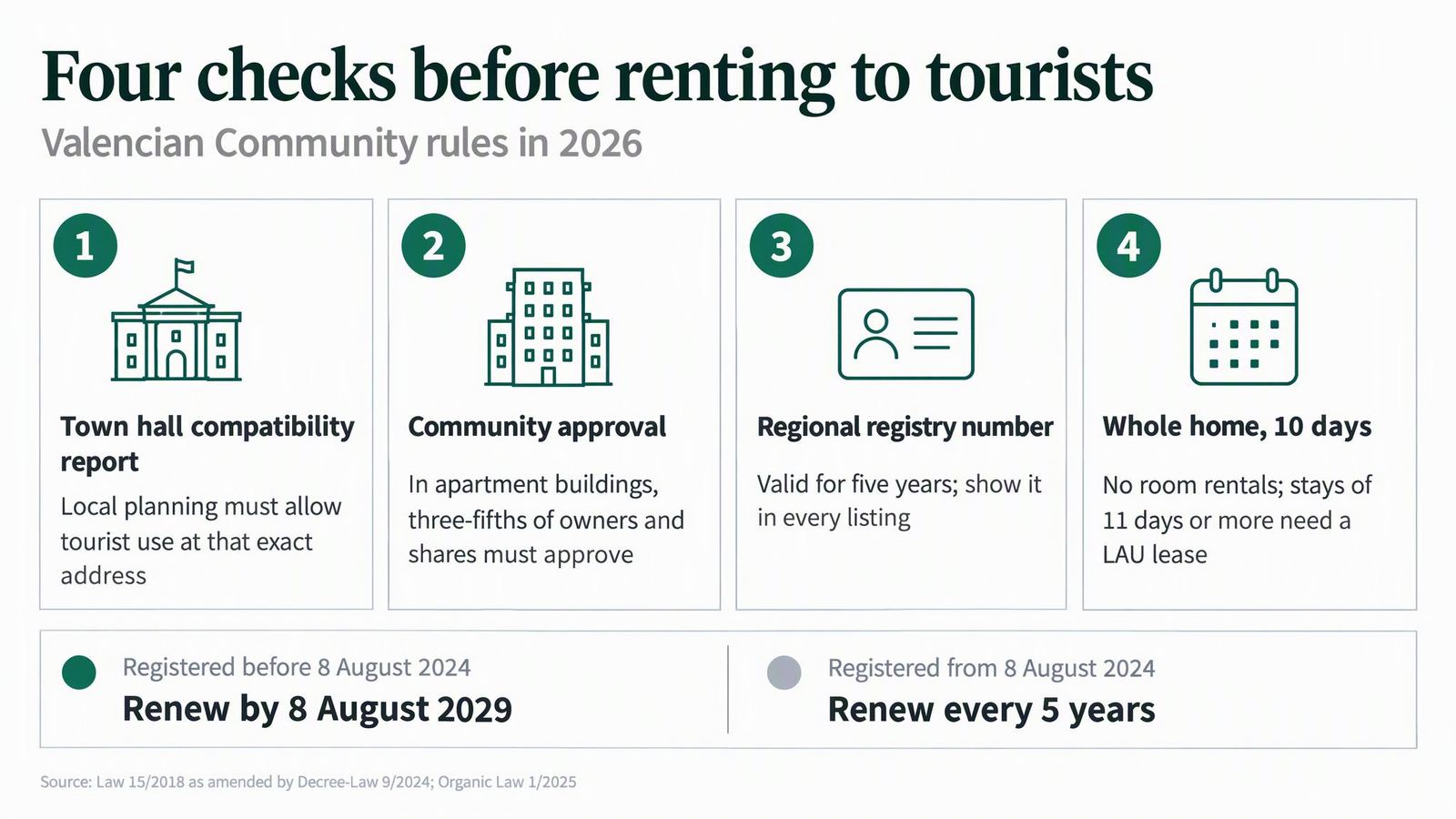
- Community approval (national law): since 3 April 2025, Organic Law 1/2025 requires the express approval of three‑fifths of the owners, representing three‑fifths of the shares, to start a new tourist rental in a building under horizontal property. Owners who were already operating legally before that date can continue.
- National registration number annulled: Royal Decree 1312/2024 required a national Single Rental Registry number to advertise short‑term rentals on platforms from 1 July 2025. In May 2026 the Supreme Court annulled that registration procedure (Judgment 620/2026) because it overlapped with the regional registries. The number that counts is now your Valencian Tourism Registry number, while the digital single window through which platforms share data with the authorities remains in place.
- València city limits: in March 2026 València City Council definitively approved new planning rules that replace the moratoria in place since 2024 with permanent caps per neighborhood (explained below).
- Stricter enforcement: the Generalitat removed more than 18,300 tourist homes from its Registry during 2025, mostly for missing cadastral references or tax IDs.
Why the Valencian Community has tightened rules on tourist rentals
Decree‑Law 9/2024 was a direct response to years of rapid growth in short‑term accommodation. Cities like Valencia, Dénia, Jávea or Alicante have seen a boom in holiday rentals, with clear side‑effects for residents and the housing market.
Regional authorities argue that uncontrolled tourist rentals have contributed to rising rents, gentrification of central neighborhoods and growing tension between visitors and local communities. There was also concern about unfair competition with hotels and regulated tourist apartments, and about the large number of unregistered or illegal listings on platforms such as Airbnb or Booking.
The reform aims to:
- Limit the intensity of tourist use in residential buildings and historic centers.
- Align tourist activity with urban planning, by requiring a favorable municipal compatibility report.
- Raise safety and quality standards in all tourist‑use homes.
- Give municipalities real control tools to cap the number of tourist homes per building, area or zone.
For foreign owners, digital nomads who invest in property and expats who rely on rental income, what was once a relatively flexible market is now a regulated activity with formal procedures and tight deadlines. If you are still at the buying stage, our legal guide to buying property in Spain as a foreigner explains the checks to make before paying any deposit.
How tourist‑use homes are defined under Decree‑Law 9/2024
The starting point is the legal definition of a tourist‑use home in the Valencian Community. Under article 65 of Law 15/2018, as amended, a property is a tourist‑use home when it meets all of the following:
- It is let for a price, ready for immediate occupancy, for tourist purposes.
- It is let to the same tenant for a maximum of 10 consecutive days.
- It is always let as a whole property – room‑by‑room tourist rental is prohibited.
- It has a favorable municipal urban compatibility report confirming that tourist use is allowed.
- It is registered in the Tourism Registry of the Valencian Community and identified by its unique cadastral reference.
The law also presumes tourist use when the home is offered through tourist marketing channels (including internet platforms) or by a tourist‑home management company. If your property fits this pattern, it will be treated as tourist accommodation regardless of whether you call it a “holiday home”, “Airbnb” or “short‑stay apartment”.
This definition draws a clear line between tourist rentals and other leases regulated by Spain’s national Urban Leases Act (Ley de Arrendamientos Urbanos, LAU). If you go beyond 10 days or change the purpose of the stay, you enter a different legal regime with different rules.
The 10‑day rule and new tenancy restrictions for tourist rentals
One of the most visible elements of Decree‑Law 9/2024 is the 10‑day maximum for tourist stays by the same tenant. It is designed to stop long‑term housing being disguised as tourist accommodation and to keep the tourist category separate from residential use.
Under the current regime:
- You may let a tourist‑use home to the same person or group for a maximum of 10 consecutive days.
- A stay of 11 days or more is not tourist use: it must be structured as a lease under the LAU and cannot be advertised as tourist accommodation.
- Splitting one long stay into several back‑to‑back bookings to stay under the limit is risky: inspectors look at the real length and purpose of the stay, not the labels on the booking.
For owners and managers, this means rethinking business models that relied on stays of several weeks under a tourist registration, and being careful with how you advertise and document longer stays.
How longer stays must now be structured
Decree‑Law 9/2024 does not forbid longer rentals; it channels them into the national lease framework. In practice, there are three broad categories:
| Type of stay | Duration | Legal regime | Key points |
|---|---|---|---|
| Tourist rental | Up to 10 days | Law 15/2018 as amended by Decree‑Law 9/2024 | Tourist Registry number, compatibility report and full compliance with tourist standards. |
| Seasonal lease | 11 days or more, for a temporary purpose | LAU – seasonal lease (arrendamiento de temporada) | The contract must state and justify the temporary purpose (work, studies, medical treatment); not advertised as tourist accommodation. |
| Residential lease | Tenant’s permanent home | LAU – main residence lease | Full tenant protection rules apply; not tourist use. |
For investors, this still allows some planning: you might combine short tourist stays in high season with seasonal contracts in low season. The responsible declaration states the periods in which the home is used for tourism, and a home let under the LAU during a declared tourist period can be removed from the Registry, so each type of stay must be documented and advertised according to its legal nature.
Registration in the Tourism Registry and 5‑year validity
Decree‑Law 9/2024 ended indefinite registrations. Registration of a tourist‑use home in the Tourism Registry of the Valencian Community is now valid for five years.
Key points of the regime:
- New registrations are valid for 5 years from the filing of the responsible declaration (declaración responsable).
- To keep operating, the owner must file a new responsible declaration within the month before the 5‑year period ends, with updated documentation.
- Registrations that are not renewed on time are removed from the Registry.
Existing registrations follow transitional rules:
- Homes registered before the decree came into force keep their registration until 8 August 2029, when they must renew under the rules then in force.
- Homes registered from 8 August 2024 must meet the new requirements from the start and follow the 5‑year cycle.
Each tourist‑use home must also be linked to a unique cadastral reference. Homes already registered had until 31 December 2024 to provide it; those that did not are being removed from the official Registry, which explains a large part of the 2025 clean‑up.
What happens when ownership of a tourist property changes
Another important change concerns sales, inheritances and other transfers. Under the amended regulation:
- The registration does not simply pass to the new owner.
- The new owner must file a new responsible declaration with a new municipal compatibility report.
- The property must meet the requirements in force at that time, not those that applied when it was first registered.
For buyers, especially foreign investors, this makes legal due diligence by a real estate lawyer even more important. Do not assume that a property advertised as having a “tourist license” will keep that status when you become the owner. Review the planning situation, community approvals and Registry status before signing anything.
Urban compatibility reports and municipal powers to limit tourist rentals
One of the central aims of Decree‑Law 9/2024 is to align tourist activity with local planning. It strengthens the role of Town Halls and requires a favorable municipal urban compatibility report (or, where the local plan allows it, an equivalent certificate from an authorized urban compliance entity) as a condition for operating any tourist‑use home.
This report must confirm that:
- The property is in a zone where tourist use is allowed under the municipal plan.
- The building and the specific unit comply with cadastral and planning requirements (for example, correct use class, no serious infringements).
- There is no local suspension or cap preventing new tourist homes in that area.
Beyond individual reports, the law allows municipalities, through their planning powers, to set proportionate limits on the maximum number of tourist homes per building, sector, area or zone, based on clear and objective criteria published in advance.
València city: the 2026 planning rules
València is the clearest example. After successive moratoria on new tourist apartments from May 2024, the City Council definitively approved a modification of its General Urban Plan on 31 March 2026, published in the provincial gazette in May 2026. For new tourist apartments:
- In buildings that also contain homes, they are only allowed on the ground or first floor, with independent access from the street.
- Tourist apartments may not exceed 2% of the housing stock of each neighborhood.
- Total tourist beds may not exceed 8% of registered residents in each neighborhood or district.
- Only up to 15% of existing ground‑floor premises can switch to tourist use.
In practice, an apartment on the third floor of a typical residential building in València can no longer become a new tourist rental, however good it is. Other municipalities can adopt their own limits under the same regional law, so location is now a legal factor, not just a commercial one. Before buying a property in Spain with tourist income in mind, check whether the Town Hall would issue a favorable report and whether any restrictions apply or are being prepared in that area.
New obligations and responsibilities for owners and managers
Decree‑Law 9/2024 significantly expanded the obligations of owners and management companies. The idea is to professionalize the sector and ensure tourist homes are run with the same seriousness as other regulated tourist establishments.
Among the key obligations are:
- Obtain and keep valid the municipal urban compatibility report.
- Register the property in the Tourism Registry and renew the registration every 5 years.
- Show the registration number and exact location in every advert, on any channel, including online platforms.
- Provide a 24‑hour phone line for guests.
- Give guests written house rules covering coexistence with neighbors, use of services and pet policies.
- Hold an occupancy license (first or second occupation) or equivalent document. We also recommend liability insurance that expressly covers tourist use.
Owners also have subsidiary liability for illegal offers or clandestine activity if, when asked by the authorities, they fail to identify the person or company actually running the tourist activity. Outsourcing the operation does not remove your exposure. If you delegate the day‑to‑day running, choose a property management service that works within these rules and keeps your documentation up to date.
Community of owners’ approval and house rules
In apartment buildings, the community of owners now plays a decisive role at two levels:
- Regional rule: to register a new tourist home, you must provide a certificate showing that the community statutes do not prohibit tourist or other non‑residential use.
- National rule: since 3 April 2025, starting a new tourist rental requires the community’s express approval by three‑fifths of the owners representing three‑fifths of the shares. The same majority can also limit or set conditions on tourist rentals in the building.
Many communities are reviewing their statutes to decide whether to allow tourist rentals, impose conditions or forbid them. For buyers, reviewing community documents and recent meeting minutes before committing to an investment based on tourist income is now essential.
Owners or managers must also set house rules for each tourist‑use home, covering:
- Basic coexistence rules (noise, respect for neighbors, use of common areas).
- Use of services such as pools, gyms or parking spaces.
- Pet policies and any restrictions on events or parties.
These rules should be easy for guests to find (for example, in a welcome folder in several languages) and consistent with the community’s own regulations, to reduce conflicts and complaints.
Quality, safety and minimum equipment requirements for tourist‑use homes
Beyond paperwork, the amended regulation sets quality and safety standards for all tourist‑use homes. The goal is a minimum level of comfort and risk prevention for guests, and fewer nuisances for neighbors.
Some of the main requirements include:
- Minimum habitability standards for residential use.
- A building evacuation plan on the door of the home or, failing that, emergency instructions in several languages.
- A list of emergency and useful phone numbers in a visible place.
- An elevator in buildings taller than ground floor plus four stories.
- A separate entrance for guests in homes located on the ground floor.
- 24‑hour telephone assistance for guests.
On the equipment side, tourist‑use homes must be fully furnished and include, at a minimum:
- An automatic washing machine, unless the building has a shared laundry.
- Kitchen facilities: at least two electric rings for homes of up to four guests, and three or more from five guests, plus a refrigerator and basic kitchenware.
- Internet connection (except in areas without coverage) and a television.
- Bed linen and towels for the maximum occupancy, and hot water.
- A first aid kit and information about the nearest medical center.
Regular cleaning between stays, proper maintenance and timely replacement of equipment are part of the professional standard expected by the authorities. Non‑compliance can be detected during inspections and lead to sanctions.
Accessibility and safety: practical examples
Consider two common scenarios:
- A fifth‑floor apartment in a 1970s building without an elevator. Buildings taller than ground floor plus four stories need an elevator for tourist use, so this unit is unlikely to qualify unless one is installed. In València city, it would also fall outside the floors where new tourist apartments are allowed.
- A ground‑floor apartment with its own street entrance. This is usually the most favorable layout, and in València it is one of the few configurations still open to new tourist apartments, subject to the neighborhood caps.
Before investing in refurbishment or furniture, get legal advice and, where needed, technical reports confirming that the property can realistically meet all the standards.
Explicit prohibitions: room rentals, key lockboxes and misuse of platforms
Decree‑Law 9/2024 also introduced clear prohibitions to close common loopholes. Ignoring them can quickly lead to serious fines.
The most notable prohibitions are:
- Renting individual rooms as tourist accommodation is prohibited. The entire home must be let as a single unit.
- Exceeding 10 days with the same tenant under a tourist contract is not allowed; longer stays must be re‑categorized and cannot be advertised as tourist accommodation.
- Handing over keys through lockboxes on the public street (for example, attached to railings, façades or public fixtures) is forbidden.
Authorities pay close attention to platforms. Advertising without the registration number and exact location is a serious infringement, while advertising room‑by‑room tourist rentals in a registered home is classed as very serious.
To remain compliant, owners and managers should:
- Ensure that every online listing includes the correct Tourism Registry number and exact location.
- Remove any offers for individual rooms or shared apartments aimed at tourists.
- Use a secure key handover system, such as in‑person check‑in, coded smart locks or key boxes inside the building.
Sanctions, fines and enforcement under the new regime
Enforcement relies on the sanctions regime of the Valencian Tourism Law (Law 15/2018, article 94). Fines depend on how the infringement is classified:
- Minor infringements: a warning or a fine of up to €10,000.
- Serious infringements: €10,001 to €100,000, and the activity can be closed for up to six months. Examples include not meeting the essential requirements to operate, advertising without the registration number and exact location, or failing to report a change of owner.
- Very serious infringements: €100,001 to €600,000, plus closure or cessation of the activity. Examples include operating or advertising a tourist rental without the required responsible declaration or requirements, and advertising room‑by‑room rentals in a registered tourist home.
These are not theoretical figures. València City Council, which received delegated sanctioning powers from the Generalitat in March 2025, reported in September 2026 that it had imposed 138 fines totaling more than €1.5 million in eighteen months, most of them classed as serious for not meeting the essential requirements. The court rulings issued so far on appeals have upheld the city’s fines.
Common triggers for sanctions include:
- Advertising a property as tourist accommodation without a valid registration number.
- Providing incorrect location or cadastral data in the Registry or on platforms.
- Failing to report a change of ownership or to file a new declaration after a sale or inheritance.
- Renting out rooms, or whole properties without urban compatibility or community approval.
Inspection and control mechanisms
To enforce these rules, the Generalitat and local Town Halls:
- Carry out inspections of registered and unregistered tourist homes.
- Monitor online platforms for unregistered or non‑compliant listings.
- Respond to neighbor complaints about noise, overcrowding or illegal rentals.
Given the level of scrutiny, keep complete documentation (registration, compatibility report, community approvals, occupancy license, insurance, contracts) and be ready to show that you have implemented every required measure.
Impact on investors, expats and digital nomads in the Valencian Community
For many foreign investors and expats, tourist rentals have been an attractive way to earn income from property in Valencia, Alicante, Castellón and popular coastal towns. Decree‑Law 9/2024 and the rules that followed clearly raise the entry barrier and the professional standard required to operate legally.
This does not necessarily make the region less attractive. The new framework favors:
- Owners who are willing to comply fully and run their rentals professionally.
- Investors who choose properties that already meet planning, safety, accessibility and community requirements.
- Business models that combine tourist stays with seasonal or long‑term rentals, set up correctly from both a legal and a tax perspective.
Stricter rules can also bring greater certainty. A clear, well‑enforced framework reduces unfair competition from illegal rentals and can help stabilize neighborhoods, making them more attractive in the long term.
The tourist rental rules also interact with other key areas of expat life in Spain:
- Tax residency and planning, including the Beckham Law and non‑resident tax on rental income, where a specialist tax lawyer can save you costly mistakes.
- Real estate due diligence when buying, including urban legality and community rules.
- Corporate structuring for those who manage several properties; see our comparison of buying through a company or as an individual.
In this context, specialized advice is often the difference between a profitable, compliant investment and a costly legal problem.
How Spain Legal Estate can help you comply with Decree‑Law 9/2024
Navigating the Valencian tourist rental rules is challenging, especially if you are not familiar with Spanish, regional and municipal regulations. Each property, municipality and ownership structure requires a tailored approach.
As a boutique firm in Valencia focused on real estate law, tax planning and expat services, Spain Legal Estate can assist you with:
- Pre‑investment analysis of properties you are considering, including urban compatibility, community rules and registration prospects, working alongside our real estate investment advisors in Valencia.
- Registration and renewal of tourist homes, preparation of responsible declarations and coordination with Town Halls.
- Review and drafting of contracts for tourist, seasonal and long‑term rentals, so that each stay is correctly structured.
- Tax planning for your rental income, including non‑resident tax, double taxation treaties and special expat regimes.
- Defense and representation in inspections, sanction proceedings or disputes with neighbors or authorities, with our litigation lawyers.
For expats, foreign investors and digital nomads who plan to invest in, or already own, tourist‑use homes in the Valencian Community, a proactive legal and tax strategy is now essential to protect both profitability and peace of mind.
Thinking of renting to tourists in Valencia? Our bilingual team checks the compatibility report, community approval and Registry status before you buy or list, so you know where you stand. Book a free consultation.
Frequently Asked Questions
How can I check if my current rental model is classified as tourist use or should be treated as a LAU (residential) contract under the new decree?
Review three elements: (1) how you advertise the property (tourist platforms vs. private agreements), (2) the real length and purpose of the stay (up to 10 days for tourism vs. work, studies, medical treatment, etc.), and (3) whether you offer hotel‑like services (cleaning, linen changes, reception). If you promote short stays to visitors through tourist channels, it will likely be treated as tourist use, even if the contract is labeled otherwise.
What practical steps should I take before investing in a property with the intention of using it for tourist rentals in the Valencian Community?
Before buying, you should: (1) verify with the Town Hall whether tourist use is allowed in that exact location and floor, and whether new registrations are capped, (2) review the building’s community statutes and recent meeting minutes, and confirm whether the three‑fifths approval for new tourist rentals can be obtained, (3) confirm that the property meets habitability, accessibility and safety standards, and (4) estimate profitability assuming strict enforcement and possible periods of seasonal or long‑term rental instead of continuous tourist use.
If I have bookings that exceed the 10‑day limit, what can I do to avoid problems?
Review all upcoming reservations and identify those longer than 10 days. Where the guest has a genuine temporary purpose (work, studies, medical treatment), restructure the stay as a LAU seasonal lease that states that purpose, and keep it off tourist platforms. Avoid artificially splitting one long stay into several tourist bookings, which inspectors can treat as a breach. Inform guests in advance and keep written evidence of the contractual changes.
How can I reduce the risk of inspections and fines under Decree‑Law 9/2024?
Keep your documentation updated and easily accessible (registration, compatibility report, community approvals, insurance, contracts), make sure all online listings exactly match Registry data, strictly respect capacity limits and coexistence rules, put your 5‑year renewal date in your calendar, and respond quickly to neighbor complaints or official notifications. Regular internal audits of your listings, contracts and on‑site equipment help detect issues before an inspection leads to a sanction.
Every case has its own details. Our English-speaking lawyers in Valencia can review your situation and advise you on the best way forward. Get in touch with us for tailored legal advice.
