


Spain’s sunshine, lifestyle and relatively low cost of living tempt many people to “try life in Spain first and sort the paperwork later.” But immigration and tax rules are strict, and the line between a harmless long stay and an expensive problem is thinner than most expats realize.
Understanding how long you can live in Spain without residency, how the 90/180-day rule works, and when you become a tax resident is essential if you want to avoid fines, entry bans or unexpected tax bills.
Understanding the basic rule for staying in Spain without residency
If you are not a Spanish resident, you are normally treated as a short‑term visitor (tourist or similar). For most non‑EU nationals this means you are bound by the Schengen 90/180‑day rule, set by Article 6 of the Schengen Borders Code.
This rule limits how long you can be in Spain (and the rest of the Schengen Area) without a residence permit. It also interacts with tax rules: if you stay too long, you may be considered a Spanish tax resident even if you never applied for residency.
How the 90/180‑day Schengen rule works in practice
For non‑EU/EEA/Swiss nationals, the standard position is:
- You can stay in Spain and the rest of the Schengen Area for up to 90 days in any rolling 180‑day period without a residence permit.
- Those 90 days can be continuous or split into several trips.
- Every day you spend in any Schengen country (Spain, France, Italy, Germany, etc.) counts toward the same 90‑day limit.
Example:
- You spend 60 days in Valencia (Spain) from 1 January to 1 March.
- In May, you spend 20 days in Italy.
- You have now used 80 of your 90 days in the relevant 180‑day window.
- You can only spend 10 more days in any Schengen country until the oldest days start “dropping off” the 180‑day window.
Key point: Owning property in Spain, having an NIE, or visiting frequently does not change the 90‑day immigration limit.
Who is exempt from the 90‑day visa requirement?
The 90‑day limit applies differently depending on your nationality:
- EU/EEA/Swiss citizens: Can enter Spain with an ID/passport and move freely. They do not need a visa for short stays, but if they intend to live in Spain for more than 3 months they must register as residents.
- Visa‑exempt non‑EU nationals (e.g. US, UK, Canada, Australia): Can enter without a visa, but are still limited to 90 days in 180 in the Schengen Area.
- Non‑EU nationals who need a Schengen visa: Their visa will specify the permitted stay, usually also within the 90/180 framework.
If you are still working out which documents you need at the border, see our guide on whether you need a visa to go to Spain.
How long can you live in Spain without residency and avoid penalties?
There are two different questions hidden inside “How long can you live in Spain without residency?”:
- Immigration side: How long can you stay without a residence permit before your stay becomes illegal?
- Tax side: How long can you stay before Spain considers you a tax resident and taxes your worldwide income?
To truly “avoid penalties”, you must respect both sets of rules.
Immigration: maximum legal stay without residency
From an immigration perspective:
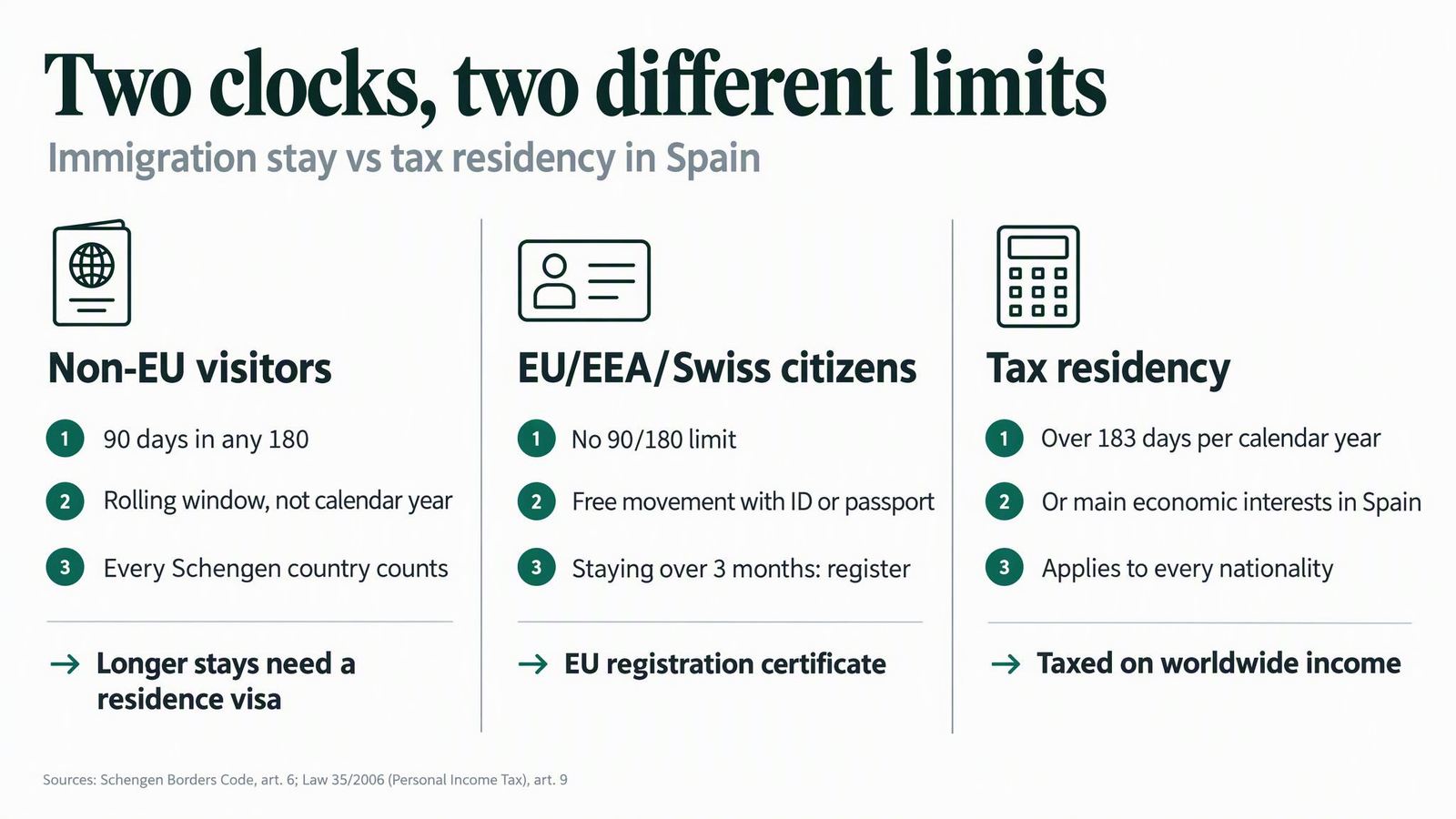
- As a non‑EU/EEA/Swiss national, you can stay up to 90 days in any 180‑day period in Spain without a residence permit.
- As an EU/EEA/Swiss national, you can be in Spain freely, but if you stay for more than three months, you must register as a resident within three months of arrival and obtain your EU registration certificate (Royal Decree 240/2007).
If you exceed the allowed period without the correct permit, you are technically overstaying and may face sanctions.
Tax: how long can you stay without becoming a Spanish tax resident?
Tax law uses a different clock. Under Article 9 of the Personal Income Tax Act (Law 35/2006), you become a Spanish tax resident if you:
- Spend more than 183 days in Spain in a calendar year (days do not need to be consecutive, and sporadic absences count as days in Spain unless you prove tax residence in another country), or
- Have the main base of your business or economic interests in Spain, even with fewer physical days.
The law also presumes that you are tax resident if your spouse (not legally separated) and your minor children habitually live in Spain.
So, you can usually stay in Spain up to 183 days per calendar year without becoming a tax resident, provided your economic and family ties remain clearly abroad. But remember, if you are non‑EU, immigration law limits you to 90 days in any 180‑day period unless you hold a residence visa.
Important distinction:
- Immigration residency = permission to live in Spain (visas, TIE card, EU registration).
- Tax residency = where you are considered resident for tax purposes (worldwide income, wealth tax, etc.).
You can have one without the other, and that is where many expats get into trouble.
What happens if you overstay in Spain as a non‑resident?
Overstaying can trigger immigration penalties and may also create tax exposure. Since 10 April 2026, the EU Entry/Exit System (EES) records every entry and exit of non‑EU short‑stay visitors electronically and counts the days automatically, so “invisible” overstays are no longer realistic.
Typical immigration penalties for overstaying the 90‑day rule
Staying in Spain without an extension of stay or a residence permit is a serious infringement under Article 53.1.a of Organic Law 4/2000 on the rights and freedoms of foreigners. The consequences may include:
- Fines – from €501 to €10,000 for serious infringements (Article 55.1.b), graded according to the circumstances of the case.
- Expulsion – instead of a fine, the authorities can order expulsion from Spain, applying the principle of proportionality (Article 57). A fine and an expulsion cannot be imposed together.
- Entry ban – an expulsion carries a ban on returning to Spain of up to five years, or up to ten where there is a serious threat to public order or security (Article 58). The ban is recorded in the Schengen Information System, so in practice it applies across the Schengen Area.
- Detention while the case is processed – in limited cases, a judge can order detention in an immigration detention center while an expulsion case is pending (Article 62), particularly where there is a risk of absconding.
Border police no longer rely on passport stamps: your entry and exit dates sit in the EES database, which flags overstays automatically. If you receive an expulsion order, an immigration appeal may be possible, but act quickly, as appeal deadlines run from notification.
Tax risks if you “quietly” stay too long
Even if immigration authorities do not immediately penalize you, staying long periods in Spain without formal residency can make you a de facto tax resident in the eyes of the Spanish Tax Agency (Agencia Tributaria).
Potential consequences include:
- Being assessed as a Spanish tax resident and taxed on your worldwide income.
- Exposure to Wealth Tax (and, for large fortunes, the Temporary Solidarity Tax on Large Fortunes).
- Fines and surcharges for late or missing tax returns.
- Complications with your home country’s tax authority if double taxation is not correctly managed.
If you are spending long periods in Spain, a tax lawyer can review your day count and ties before the Tax Agency does.
In short: overstaying can cost you both in immigration penalties and in unexpected tax bills.
How long can you stay in Spain if you own a property but no residency?
Many foreign buyers assume that owning a home in Spain gives them special immigration rights. It does not.
Property ownership allows you to enter and stay under the same rules as any other tourist of your nationality. That means:
- Non‑EU/EEA/Swiss owners are still limited to the 90/180‑day rule.
- EU/EEA/Swiss owners may stay freely, but should register as residents if they actually live in Spain for more than 3 months.
However, owning a property does have tax implications even if you are non‑resident.
Tax obligations for non‑resident property owners in Spain
If you own a property in Spain but are not a tax resident, you usually must:
- Pay annual IBI (Impuesto sobre Bienes Inmuebles) – the local municipal property tax.
- File Non‑Resident Income Tax (IRNR) returns, even if you do not rent the property (Spain imputes a notional rental income).
- Possibly pay Wealth Tax if your Spanish assets exceed the tax‑free allowance (rules differ by autonomous community).
Owning property no longer opens the door to residency either: the Golden Visa for buying €500,000 of Spanish real estate was abolished in April 2025 (see below).
Difference between short stay and residency in Spain
To understand your options, it helps to clearly separate short‑stay status from residency.
Short‑stay (tourist) status: what you can and cannot do
Short‑stay status (up to 90 days in 180) is intended for:
- Tourism and visiting family/friends.
- Short business trips, conferences, meetings.
- Short courses, research or volunteer projects.
Under this status, you generally cannot:
- Work for a Spanish employer or invoice Spanish clients.
- Register as self‑employed (autónomo) in Spain.
- Access most resident‑only benefits and rights.
Short‑stay status is simple and flexible, but it is not designed for living long‑term in Spain.
Residency: temporary and permanent
Residency is for those who want to live in Spain for more than 90 days. There are two main levels:
- Temporary residency – for stays of more than 90 days and less than 5 years (e.g. Digital Nomad Visa, Non‑Lucrative Visa, work permits, family reunification). Initial permits are often granted for one year; under the Immigration Regulation in force since May 2025 (Royal Decree 1155/2024), non‑lucrative renewals last two years and work‑based renewals four.
- Permanent residency – long‑term residency, generally available after 5 years of continuous legal residence; allows you to live and work indefinitely, with fewer renewal obligations.
Residency usually implies:
- A TIE card (Tarjeta de Identidad de Extranjero) for non‑EU citizens, or an EU registration certificate for EU/EEA/Swiss citizens.
- Stronger ties to Spain, often leading to tax residency if you spend more than 183 days per year here.
How long can you stay in Spain without becoming a resident?
Putting the pieces together:
- Immigration: Non‑EU visitors can stay up to 90 days in any 180‑day period without a residence permit. EU citizens can stay freely but must register if they stay more than 3 months.
- Tax: You can usually stay up to 183 days per calendar year without becoming a Spanish tax resident, provided your main economic and personal ties remain abroad.
This leads to a common misunderstanding: some people think they can spend 6 months in a row in Spain every year as tourists. For non‑EU nationals, that is not possible without a residence visa, because immigration law caps you at 90/180 days. The most the rule allows is roughly 90 days in and 90 days out (for example, January to March and then July to September), which adds up to about 180 days a year and brings you close to the 183‑day tax threshold.
In other words:
- Up to 90 days in 180 = no residency required, but no right to live or work long‑term.
- More than 90 days = you need some form of residency permit.
- More than 183 days in a year = you are very likely a Spanish tax resident.
Popular ways to stay longer than 90 days legally
If you want to spend more time in Spain than the 90‑day rule allows, you will need to apply for a residence visa that matches your situation and future plans.
Digital Nomad Visa: for remote workers and freelancers
The Spanish Digital Nomad Visa is designed for:
- Remote employees working for non‑Spanish companies, and
- Freelancers with mostly foreign clients.
Main advantages:
- Initial stay usually up to 1 year, extendable into multi‑year residency.
- Access to the Beckham Law (special expat tax regime) in many cases, allowing favorable taxation of foreign income.
This is often the best option for digital nomads and location‑independent professionals who want to base themselves in Spain (for example, in Valencia’s growing tech and remote‑work community) without working for Spanish clients full‑time.
Non‑Lucrative Visa: for retirees and financially independent people
The Non‑Lucrative Visa (NLV) allows you to live in Spain without working locally. It is ideal for:
- Retirees with pensions or savings.
- People with passive income (rents, dividends, investments).
Key features:
- Initial residence for 1 year, renewable for 2‑year periods.
- You must demonstrate sufficient financial means (at least 400% of the IPREM index per month for the main applicant) and private health insurance.
- Generally, you cannot work for Spanish employers or run a Spanish business while on this visa.
Because renewing the NLV requires you to have actually lived in Spain for more than 183 days in the calendar year (Article 64 of Royal Decree 1155/2024), holders almost always become tax residents and should plan their tax position in advance.
Work permits and business‑based residency
If you intend to work in Spain, you may consider:
- Employee work permit – based on a job offer from a Spanish company.
- Self‑employed / entrepreneur visa – for those creating a business or working as autónomo in Spain.
- Highly qualified professional permit – for senior or specialized roles with higher salaries.
These permits usually require more complex documentation (contracts, business plans, proof of qualifications) but can lead to long‑term residency and eventually permanent residency or citizenship.
Golden Visa: closed to new applicants
Until 2 April 2025, non‑EU investors could obtain residency by:
- Investing at least €500,000 in Spanish real estate, or
- Making other large capital investments (e.g. Spanish companies, government bonds, bank deposits).
Organic Law 1/2025 abolished this investor visa with effect from 3 April 2025, so it is no longer a way to stay in Spain beyond 90 days. Buying a home remains fully open to foreigners, but residency now has to come from another route; see our guide to Golden Visa alternatives for property investors.
EU family member routes and other options
Additional common routes include:
- Family member of an EU citizen – if your spouse or partner is an EU national living in Spain, you may obtain residency as their family member.
- Student visa – for long‑term studies (more than 90 days); can sometimes be a bridge to work‑based residency later.
- Family reunification – for relatives of non‑EU residents already legally living in Spain.
How to check your current residency status in Spain
If you are unsure whether you are considered a resident in Spain (immigration‑wise), you should check:
- Your TIE card (for non‑EU citizens) – it states your type of permit and its validity dates.
- Your EU registration certificate (for EU/EEA/Swiss citizens) – if you have one, you are registered as resident.
- Any resolutions from Spanish immigration authorities (Extranjería) approving your residence permit.
For tax residency, there is no single card, but indicators include:
- Where you file your annual tax return (IRPF in Spain or in your home country).
- Your days spent in Spain vs. other countries.
- Location of your main home, family and economic interests.
Because immigration and tax rules interact but are not identical, it is wise to obtain integrated legal and tax advice before extending your stays or moving to Spain semi‑permanently.
Practical examples of “how long can you live in Spain without residency?”
To make the rules clearer, here are some common scenarios:
Example 1: British couple with a holiday home in Valencia
They own an apartment in Valencia but live in the UK. They want to spend “half the year” in Spain.
- As non‑EU nationals post‑Brexit, they are limited to 90 days in any 180 in Spain and the Schengen Area.
- They cannot simply spend 6 consecutive months in Spain without a visa.
- If they want to stay longer, they must apply for a residence visa (e.g. Non‑Lucrative Visa or Digital Nomad Visa); the Golden Visa is no longer available.
- Our legal support for UK investors covers the visa, tax and property side of this plan together.
Example 2: US digital nomad trying out Valencia for 5 months
A US freelancer wants to live in Valencia for 5 months to see if they like it, working remotely for US clients.
- On a simple tourist stay, they can only be in Spain for 90 days.
- To stay 5 months legally, they should apply for the Digital Nomad Visa before arrival.
- If they stay more than 183 days in the calendar year, they will likely become tax residents and should plan for that (possibly using the Beckham Law).
Example 3: EU citizen working remotely for a foreign company
A German citizen wants to move to Valencia and work remotely for a US employer.
- As an EU citizen, they can enter Spain freely and are not limited by the 90/180 rule.
- If they stay more than 3 months, they must register as a resident (obtain the EU registration certificate).
- If they spend more than 183 days in Spain in a year, they will be considered tax residents and must declare their worldwide income in Spain, with double taxation relief where applicable.
How Spain Legal Estate in Valencia can help you
Navigating Spanish immigration and tax rules as an expat, foreign investor or digital nomad is rarely straightforward. The “How long can you live in Spain without residency?” question touches:
- Immigration law – visas, residency permits, family routes.
- Tax and fiscal planning – tax residency analysis, Beckham Law, Non‑Resident Income Tax.
- Real estate law – if you own or plan to buy property in Spain.
At Spain Legal Estate in Valencia, our boutique team focuses specifically on:
- Designing the right residency route for your situation with our immigration lawyers (Digital Nomad Visa, Non‑Lucrative Visa, work permits, EU family member, etc.).
- Analyzing your days in Spain and advising whether and when you may become a Spanish tax resident.
- Optimizing your position using tools like the Beckham Law and Double Taxation Treaties.
- Handling property conveyancing, NIE/TIE procedures, and ongoing compliance for non‑resident owners.
If you are unsure how long you can safely stay in Spain without residency, or you are planning a move to Valencia and want to avoid penalties, professional, coordinated immigration and tax advice is essential.
Close to the 90‑day or 183‑day line? Our bilingual team in Valencia can check your day count, your tax residency position and the residence route that fits your plans. Book a free consultation.
Frequently Asked Questions
How is the 90/180‑day rule actually calculated day by day?
You look back 180 days from each day you are in Spain (or any Schengen country) and count how many days you were present in that whole period. If the total is 90 or less, you are legal; if it exceeds 90, you are overstaying. The 180‑day window moves forward with each new day you are in Schengen.
Can I reset my 90 days in Spain by leaving the Schengen Area for a short trip?
No. There is no fixed “reset” date. Leaving and re‑entering does not give you a new block of 90 days. You must always respect the rolling 90 days in the previous 180 days, regardless of how often you exit and re‑enter.
What documents should I keep to prove I have not become a Spanish tax resident?
Keep evidence of where you actually live and work: travel tickets and boarding passes, rental or utility contracts in your main country, employment contracts and payslips, school enrollment for children, and tax returns filed elsewhere. These help show that your habitual residence and economic center are outside Spain if questioned.
What should I do if I realize I have already overstayed in Spain?
Do not ignore it. Collect proof of your circumstances (tickets, medical reports, family reasons), leave Spain as soon as practicable, and be prepared to explain the overstay at the border. Leaving voluntarily matters: under Article 58.2 of Organic Law 4/2000, in the cases set by regulation, no entry ban is imposed if you leave Spain while the sanction proceedings are underway, and a ban already imposed is revoked if you leave within the voluntary departure period. Seek legal advice before planning another trip.
Every case has its own details. Our English-speaking lawyers in Valencia can review your situation and advise you on the best way forward. Get in touch with us for tailored legal advice.
