


Spain is one of the most attractive countries in Europe for freelancers, consultants and remote professionals. But if you want to invoice clients legally, access public healthcare and avoid nasty fines, you must register as autónomo (self‑employed). For expats, digital nomads and foreign investors, the process combines immigration rules, tax registration and social security formalities that can be confusing if you are not used to Spanish bureaucracy.
This guide explains how to become self-employed (autónomo) in Spain from a legal and tax perspective. It covers who can register, the step‑by‑step process, the main taxes you will pay, how social security works in 2026, and common pitfalls for foreigners, with a special focus on expats living in or moving to Valencia.
Who can register as self-employed in Spain
In Spain, almost anyone who carries out an economic activity on a regular basis and for profit should register as an autónomo. This includes classic freelancers (designers, developers, teachers), small business owners, consultants, and even people selling online if it is more than a purely occasional activity.
The key legal idea is simple: if you issue invoices and get paid for your services or products on a continuous basis, Spanish law expects you to be registered in the tax office and social security as self-employed, even if your income is modest or part‑time. Failing to do so can lead to retroactive contributions, surcharges and penalties.
Differences between EU/EEA/Swiss and non‑EU citizens
Your nationality determines how you access the Spanish labor market, but the autónomo registration steps at the tax and social security offices are broadly the same for everyone.
- EU/EEA/Swiss citizens
- Can live and work in Spain without a work visa.
- Must still register as residents if staying long term, obtain an NIE, and then complete the tax and social security procedures.
- Often combine autónomo activity with remote work for foreign companies.
- Non‑EU citizens
- Need a residence permit that authorizes self‑employment (or at least work) before registering as autónomo.
- Common options include the self‑employed work visa, the Digital Nomad Visa (for people working mainly for foreign clients or employers), or modifying another residence permit. The Non‑Lucrative Visa does not allow any work in Spain.
- Once the right immigration status is in place, the tax and social security steps are similar to those of EU citizens.
At Spain Legal Estate we usually analyze both angles together: immigration + tax. This avoids the common mistake of registering as autónomo without having the correct residence/work authorization, which can cause serious problems later.
When you must register as autónomo
Many expats start with small side projects and are unsure when they legally need to register. Spanish law does not define a clear income threshold in the tax rules, which is why you will find conflicting information online.
In practice:
- If your activity is continuous (for example, you invoice every month), you should register as autónomo, even if the amounts are low.
- If you perform an activity only once or twice per year, clearly sporadic and not organized as a business, you may not need to register, but you will still need to declare any income in your annual tax return.
- Courts have sometimes used the Spanish minimum wage as a reference for “habitual” activity, but the tax office and Social Security tend to be stricter.
For expats and digital nomads, the safest approach is to register as soon as you start invoicing regularly. You will then be able to deduct business expenses and access the reduced flat rate for new autónomos.
Legal pathways for non‑EU expats who want to work as autónomo
If you are not an EU/EEA/Swiss citizen, you must first secure a residence status that allows you to work, either directly as self‑employed or with the option to become self‑employed later. The most common routes are:
Self-employed work visa (visado de trabajo por cuenta propia)
This is the “classic” route for non‑EU citizens who want to move to Spain primarily to run their own business or freelance activity. You apply in person at the Spanish consulate for your place of residence, and the initial permit is valid for one year, limited to one autonomous community and one sector of activity.
Authorities look at your professional qualifications or experience, whether the planned investment is sufficient and the viability of your project, usually backed by a business plan and a viability report. We explain the requirements, documents and deadlines in our step‑by‑step guide to the self‑employed visa. If your project is innovative and scalable, the entrepreneur visa may be a better fit.
Once the visa is granted, you enter Spain, register with Social Security within three months and then apply for your residence card (TIE). From that point, the autónomo steps below apply.
Digital Nomad Visa and remote workers
Spain’s Digital Nomad Visa is particularly attractive for expats who work mainly for foreign clients or companies but want to live in Spain.
Key features include:
- Possibility to work as an employee for a foreign company or as a freelancer.
- At least 80% of income from non‑Spanish sources (up to 20% can come from Spanish clients).
- Remote employees may be able to opt for the Beckham Law (Special Expats Regime); pure freelancers generally cannot (see below).
Depending on your set‑up, you may still need to register as autónomo in Spain to invoice Spanish clients or to formalize your freelance activity for tax and social security purposes. This must be coordinated carefully with your tax residency and international tax treaties.
Modifying an existing residence permit to self-employed status
If you already live in Spain under another permit (for example, as an employee, student, or family member), it is often possible to modify your residence authorization to allow self‑employment instead of (or in addition to) employment.
Typical situations:
- Employees who want to leave their job and start their own business.
- Students who finish their studies and want to freelance.
- Family members who wish to work independently.
The documentation is similar to the self‑employed visa (business plan, proof of investment, etc.), but the application is processed inside Spain. Timing and strategy are crucial so you do not fall into irregular status while your modification is being processed.
Step-by-step: How to become self-employed (autónomo) in Spain
Once your immigration situation allows you to work, the practical process to register as autónomo involves several Spanish authorities. Below is a simplified overview.
| Step | What you do | Main authority |
|---|---|---|
| 1 | Obtain NIE and, if applicable, TIE | Police / Immigration Office |
| 2 | Register with the Tax Agency (alta censal, Modelo 036) | Agencia Tributaria (AEAT) |
| 3 | Register with Social Security as autónomo (RETA) | Seguridad Social / Tesorería General |
| 4 | Set up bank account, invoicing and bookkeeping | Banks & private advisers |
Step 1. Get your NIE and (if non‑EU) your TIE
The NIE (Número de Identificación de Extranjero) is your foreigner identification number in Spain. It is essential for almost everything: taxes, social security, opening a bank account, buying property, etc.
Depending on your situation:
- Outside Spain: you can often apply for an NIE at the Spanish consulate alongside your visa application.
- Inside Spain: you request it at a National Police station that deals with foreign documentation, using form EX‑15 and paying a small fee.
If you hold a residence permit, you will also receive a TIE (Tarjeta de Identidad de Extranjero), your physical residence card. If you already live in Spain, your permit must authorize self‑employment before you register. If you arrive with a self‑employed visa, you do not wait for the card: you register with Social Security within three months of entry and then apply for the TIE within one month.
Step 2. Register with the Spanish Tax Agency (Agencia Tributaria)
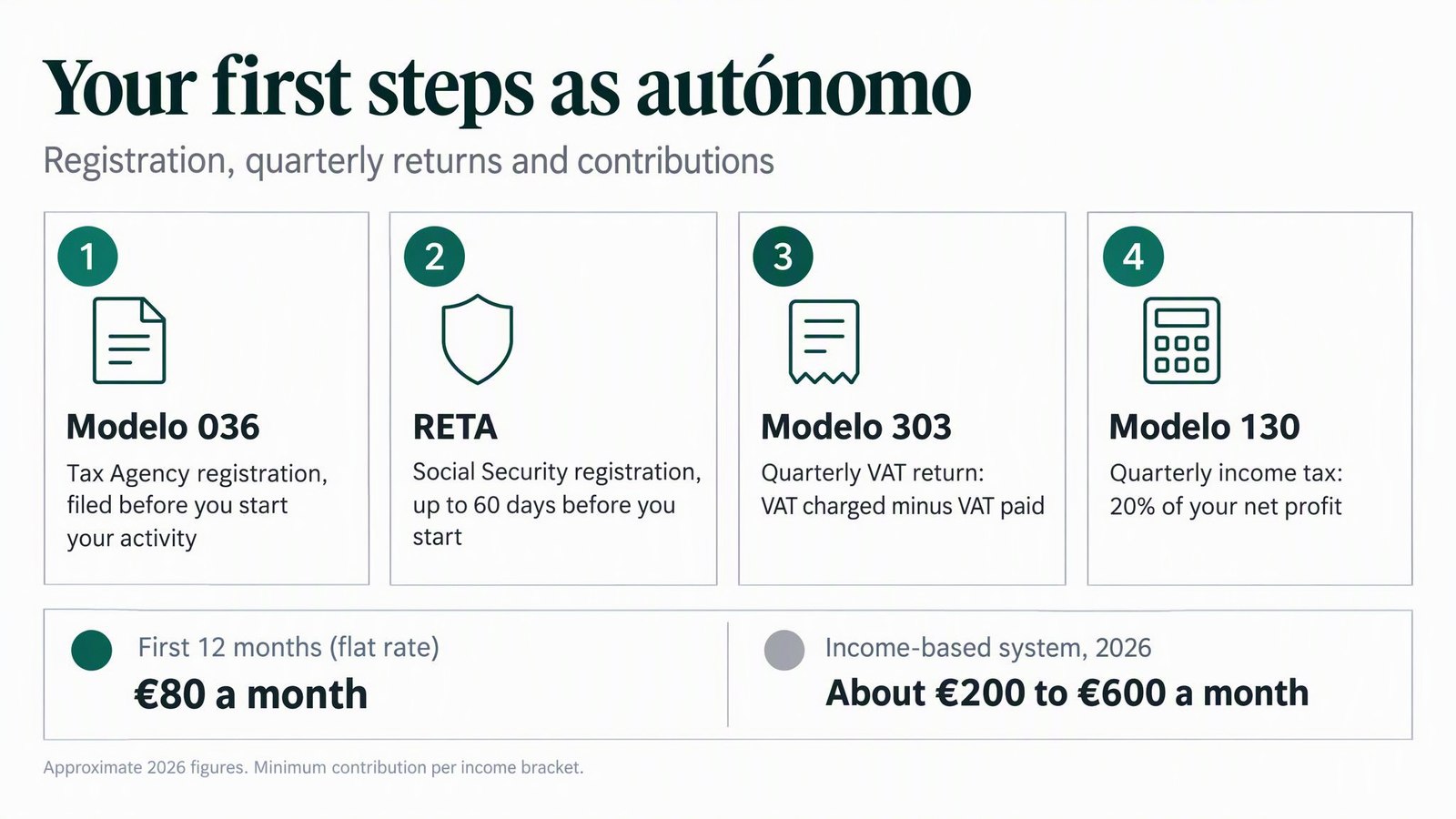
The second step is your tax registration, known as alta censal. This is where you inform the Spanish Tax Agency that you are starting a professional or business activity, and it must be done before you start.
You will need to:
- Choose your IAE activity code (Impuesto sobre Actividades Económicas) which describes what you do (e.g. translation, IT services, consulting, teaching, real estate intermediary).
- Indicate whether you are a professional autónomo (typically intellectual or liberal professions) or a business entrepreneur (empresario individual).
- State if you are subject to VAT (IVA) and whether you will apply standard rules or special regimes.
This is done by filing form Modelo 036. The simplified Modelo 037 no longer exists: it was abolished for filings from 3 February 2025 (Order HAC/1526/2024), and its simplified option is now built into Modelo 036. It can be submitted:
- Online, with a digital certificate or Cl@ve system; or
- In person at the local tax office, by appointment.
From the date you indicate on this form, you are considered to have started your activity for tax purposes, so you will be obliged to file quarterly and annual returns even if your income is initially low.
Step 3. Register with Social Security under RETA
You must also register as self‑employed with Social Security, under the special regime called RETA (Régimen Especial de Trabajadores Autónomos).
Key points:
- You must apply before you start your activity. Social Security lets you apply up to 60 days in advance, and registering late exposes you to surcharges and penalties.
- Since 2023, your contribution is based on your expected net income (cotización por ingresos reales), with 15 income brackets.
- New autónomos can pay a flat rate of €80 a month for the first 12 months, extendable for another 12 months if their income stays low.
To register, you usually need:
- NIE and passport.
- Social Security number (if you don’t have one, it can be assigned in the same process).
- A Spanish bank account for the monthly direct debit of contributions.
- Details of your activity and the same start date as in your tax registration.
Registration is done via the Social Security electronic office (Import@ss) or in person by appointment. From that moment, you will have access to the Spanish public healthcare system and you will start accruing years for your Spanish state pension, provided your contributions are paid correctly.
Step 4. Set up your bank account, invoicing and bookkeeping
Although Spanish law does not always require a separate business bank account, it is strongly recommended to open a dedicated account for your autónomo activity. This makes it easier to track income, expenses and social security payments, and is usually requested by accountants and banks when you apply for a mortgage or loan.
From a practical perspective, you must also:
- Design an invoice template that complies with Spanish rules (your full details, client data, date, invoice number, description, base amount, VAT, withholding tax if applicable, total, etc.).
- Decide how you will store and organize invoices and receipts (software, spreadsheet, or a professional system). These documents must be kept for several years for potential inspections.
- Consider hiring a gestor or tax lawyer to handle your quarterly and annual filings, especially if you are an expat dealing with foreign income, double taxation treaties or special regimes such as the Beckham Law.
Legal forms available for self-employed professionals
Many newcomers confuse the simple autónomo registration with setting up a company. In Spain you have several options, each with different legal and tax consequences.
Individual autónomo (empresario individual / profesional autónomo)
This is the most common structure for freelancers, digital nomads and small entrepreneurs. You and your business are legally the same person for most purposes.
Main characteristics:
- Quick and cheap to set up: no minimum share capital, no notary deed, no mercantile registry.
- All profits are taxed under your personal income tax (IRPF), using progressive rates.
- You are personally liable for business debts with all your present and future assets (unless you register as an emprendedor de responsabilidad limitada, which can protect your main home under certain conditions).
For most expats starting a one‑person activity (consulting, online services, teaching, design, etc.), this is usually the most efficient and flexible way to begin.
Limited company (Sociedad Limitada – SL)
A Sociedad Limitada (SL) is a separate legal entity, similar to a limited liability company. It may be interesting if:
- You expect significant profits (as a rule of thumb, often from around €60,000–€70,000 per year upwards).
- You want to limit your personal liability and separate business and personal assets.
- You plan to bring in partners or investors, or build a startup structure.
However, an SL involves:
- Share capital, which can be as low as €1 since Law 18/2022; companies with less than €3,000 must set aside at least 20% of profits as a legal reserve until they reach that figure.
- Notary deed, registration in the Registro Mercantil, and more complex bookkeeping.
- Corporate tax at a flat rate (25% general rate, with a reduced 15% rate for newly created companies in their first two profitable years).
Even as a director of your own SL, you will often still be registered as an autónomo societario for social security purposes, with different contribution rules. Choosing between pure autónomo and an SL requires individual tax planning; our guide on setting up a limited company in Spain as a foreigner covers the company route.
Taxes you pay as an autónomo in Spain
Once you are registered, you will be subject to several tax obligations. The exact combination depends on your activity, your clients (Spanish vs foreign, businesses vs individuals) and your personal situation.
Personal income tax (IRPF)
As a self‑employed individual, your profits are taxed under IRPF (Impuesto sobre la Renta de las Personas Físicas). You pay tax on your net income (income minus deductible expenses).
Obligations usually include:
- Quarterly payments on account (Modelo 130 for most activities), where you pay 20% of your net profit for the quarter, offset later in the annual return. Professionals are exempt from Modelo 130 if at least 70% of their income was subject to withholding in the previous year.
- Annual income tax return (Modelo 100), normally filed between April and June of the following year.
If you invoice Spanish companies or professionals, you must usually apply an IRPF withholding on your invoices: 15% as a general rule, or 7% in the year you start and the following two years. Your clients pay it to the tax office on your behalf, which reduces your quarterly payments.
VAT (IVA) for autónomos
Most self‑employed activities in Spain are subject to VAT (IVA – Impuesto sobre el Valor Añadido). The standard rate is 21%, with reduced rates for certain goods and services.
As an autónomo you will typically:
- Add IVA to your invoices to Spanish clients, unless your activity is exempt (e.g. many medical or educational services).
- File quarterly VAT returns (Modelo 303), declaring the VAT you charged (output VAT) and the VAT you paid on business expenses (input VAT).
- Pay the difference to the tax office or receive a refund if input VAT exceeds output VAT.
- File an annual VAT summary (Modelo 390) in January.
If you work with clients in other EU countries or outside the EU, special intra‑community VAT and export rules apply, and you may need to register for the ROI (Registro de Operadores Intracomunitarios). For digital nomads with global clients, this needs careful planning to avoid double taxation or missed obligations.
Social security contributions and benefits
How social security works for autónomos
All workers in Spain, including the self‑employed, must contribute to the Spanish social security system. For autónomos this is done through the RETA regime.
Your monthly contribution entitles you to:
- Access to the public healthcare system for you and, in many cases, your dependent family members.
- Accrual of rights towards a Spanish state pension.
- Coverage for temporary incapacity, birth and childcare leave and certain other benefits.
Unlike employees, who share contributions with their employer, autónomos pay the full amount themselves. Since 2023, the amount depends on your expected net monthly income, across 15 brackets. For 2026 the government kept the 2025 amounts, so the minimum monthly contribution runs from roughly €200 (net income up to €670 a month) to around €600 (net income above €6,000 a month).
You can change your bracket up to six times a year if your income changes. Once your tax return is processed, Social Security compares your declared bracket with your real income and either refunds the excess or claims the difference.
Flat rate and incentives for new autónomos
Spain offers a reduced “tarifa plana” for new self‑employed workers, including expats. In 2026 it works as follows:
- First 12 months: a single contribution of €80 per month, whatever your income.
- Next 12 months: you can keep paying €80 if your expected net income for the year is below the annual minimum wage (SMI). You must request this extension.
- Eligibility: you must not have been registered as autónomo in the previous two years (three years if you already used the flat rate before).
In the Valencia region, there may also be additional regional or municipal grants for new entrepreneurs, young people, or specific sectors. Calls change from year to year, so a local lawyer or tax adviser should check which programs are open in your case.
Ongoing obligations: invoicing, bookkeeping and filings
Becoming self‑employed in Spain is not just a one‑time registration. You must comply with ongoing administrative and tax obligations. Ignoring them can result in fines even if your income is low.
Invoicing and record‑keeping
As an autónomo you must:
- Issue proper invoices for every service or sale, with a consecutive numbering system.
- Include all legally required data: your name, NIE, address, client data, description, date, taxable base, VAT, IRPF withholding if applicable, and total.
- Keep separate records of issued invoices, received invoices (expenses) and investment goods.
- Store documentation for at least the four‑year tax limitation period, and longer if it may affect later years.
Many expats use cloud invoicing tools or work with a gestoría that provides digital platforms to upload invoices and receipts. This can be especially useful if you are often abroad or your Spanish is limited.
Quarterly and annual tax forms
Depending on your activity, you may need to file several forms. The most common for individual autónomos are:
- Modelo 130: quarterly IRPF advance payment (personal income tax on your profits).
- Modelo 303: quarterly VAT return.
- Modelo 111/115: if you withhold IRPF on payments to other professionals or on office rent.
- Modelo 100: annual personal income tax return.
- Modelo 390: annual VAT summary.
If you have cross‑border operations (EU clients, foreign suppliers, etc.), additional forms such as Modelo 349 may apply. A key part of our accounting and tax filing service is designing a compliance calendar for each client so nothing is missed.
Combining employment and self-employment (pluriactividad)
Some expats work as employees for a company (in Spain or abroad) and also develop a freelance activity on the side. In Spain this is called pluriactividad.
In these cases:
- You may have to contribute to social security both as an employee and as an autónomo, but there are mechanisms to avoid paying twice above certain limits.
- Some workers are entitled to partial refunds of excess contributions.
- Your income from both sources will be aggregated for personal income tax purposes.
This set‑up can be tax‑efficient if planned correctly, but it needs careful coordination between payroll, self‑employment contributions and annual tax filings.
Special considerations for expats, digital nomads and foreign investors
For foreigners, becoming self‑employed in Spain raises additional questions that locals do not usually face. Among the most frequent are tax residency, double taxation and the interaction with foreign companies or clients.
Tax residency and double taxation treaties
Before registering as autónomo, it is crucial to understand whether you will become a tax resident in Spain. Generally, you are considered tax resident if:
- You spend more than 183 days per calendar year in Spain; or
- Your main economic interests or family center are in Spain.
If you are tax resident, Spain can tax your worldwide income, although most countries have double taxation treaties with Spain that avoid paying tax twice on the same income. Correctly applying these treaties requires analyzing your specific situation, especially if you keep a company or property abroad.
Beckham Law (Special Expats Regime) and autónomos
Certain expats who move to Spain can opt for the Special Expats Regime, commonly known as the Beckham Law. Qualifying taxpayers are taxed under non‑resident rules: a flat 24% on employment income up to €600,000, while most foreign‑source investment income is not taxed in Spain. You must not have been Spanish tax resident in the previous five years.
Being autónomo is not enough on its own. Since the Startup Law (Law 28/2022), the regime covers people who move as employees (including remote workers), company directors, entrepreneurs with an innovative project approved by ENISA, and highly qualified professionals working for startups. Ordinary freelancers usually fall outside it. Our guide to how to apply for the Beckham Law explains who qualifies and the deadline to opt in.
Common mistakes foreigners make when becoming autónomo
From our experience advising expats and investors in Valencia and across Spain, there are recurring errors that can be avoided with proper guidance.
- Starting to invoice before registering with the tax office and social security.
- Choosing the wrong IAE code, which can affect VAT treatment and inspections.
- Ignoring quarterly filings because “I earned very little” – the obligation exists even with low income once you are registered.
- Not coordinating immigration and tax, for example registering as autónomo without having the right to work under your residence permit.
- Mixing personal and business expenses in the same bank account, making it difficult to justify deductions.
- Overlooking international tax issues (foreign companies, remote work, crypto assets, foreign pensions) when filing Spanish returns.
Working with a boutique firm used to expat cases, rather than a generic gestoría, usually pays for itself in avoided penalties and optimized tax structures.
How Spain Legal Estate can help you register as autónomo in Valencia
Becoming self‑employed in Spain opens the door to a flexible lifestyle and access to the European market, but it also means navigating multiple authorities, languages and legal systems. At Spain Legal Estate we specialize in guiding expats, foreign investors and digital nomads through the entire process in clear English.
Our services typically include:
- Analyzing your immigration options (self‑employment visa, Digital Nomad Visa, modifications, family permits).
- Obtaining your NIE/TIE and coordinating appointments in Valencia and other regions.
- Designing the optimal legal structure for your activity (individual autónomo, SL company, mixed structures).
- Handling your tax registration (Modelo 036) and social security registration (RETA).
- Setting up your ongoing tax compliance (quarterly and annual returns, VAT, IRPF, non‑resident taxes if applicable).
- Advising on international tax planning, double taxation treaties and, where possible, the Beckham Law.
If you are planning to start your activity or are already working informally and want to regularize your situation, it is usually best to get personalized advice before taking further steps. The right structure at the beginning can save you significant money and stress in the future.
Starting as autónomo in Valencia? Our bilingual team checks that your permit allows self‑employment, files your Modelo 036 and RETA registration and sets up your quarterly tax calendar. Book a free consultation.
Frequently Asked Questions
How long does it usually take to become fully registered as autónomo in Spain?
If your residence/work permit and NIE are already in place, completing tax registration, social security registration and basic setup typically takes from a few days to two weeks, depending on appointment availability and whether you file online or in person.
Do I need to speak Spanish to register and comply as autónomo?
Most official forms, online portals and tax notices are in Spanish only. You can register without speaking Spanish if you use a translator or adviser, but for ongoing compliance it is highly advisable to have at least basic Spanish or professional support.
Can I deduct expenses incurred before I officially register as autónomo?
It depends on the tax. For VAT, input VAT on purchases made before you start can be deducted if you can prove they were acquired for the activity (Article 111 of the VAT Act). For income tax, the Tax Agency’s general position is that only expenses incurred once the activity has started are deductible, so keep invoices in your name and time major purchases with your adviser.
What happens if I stop working as autónomo or leave Spain?
You must file the corresponding deregistration forms with both the tax agency and social security to stop future obligations. You will still need to submit any pending quarterly and annual returns, but no new contributions or filings accrue after the official deregistration date.
Every case has its own details. Our English-speaking lawyers in Valencia can review your situation and advise you on the best way forward. Get in touch with us for tailored legal advice.
