


Moving to Spain to run your own business or work as a freelancer is perfectly possible, even if you are not from the EU. Spain has a specific residence and work permit for people who want to be self-employed, commonly known as the autónomo visa. Understanding how it works, what documents you need, and how to prepare a solid application is essential if you want to avoid refusals and delays.
This step-by-step guide explains how to get a self-employed work visa in Spain under the immigration regulation in force since 20 May 2025 (Royal Decree 1155/2024), from the first idea of your project until you are fully registered as an autónomo and legally working in the country.
What the Spanish self-employed work visa actually allows you to do
The Spanish self-employed work visa is a residence and work permit that allows non-EU / non-EEA citizens to live in Spain and carry out an economic activity on their own account. In practice, this means you can invoice clients as a freelancer or run your own small business, instead of being hired as an employee.
This permit is often called:
- Self-employed visa (visado de trabajo por cuenta propia)
- Freelance visa
- Autónomo visa or autónomo work permit
With this visa you can:
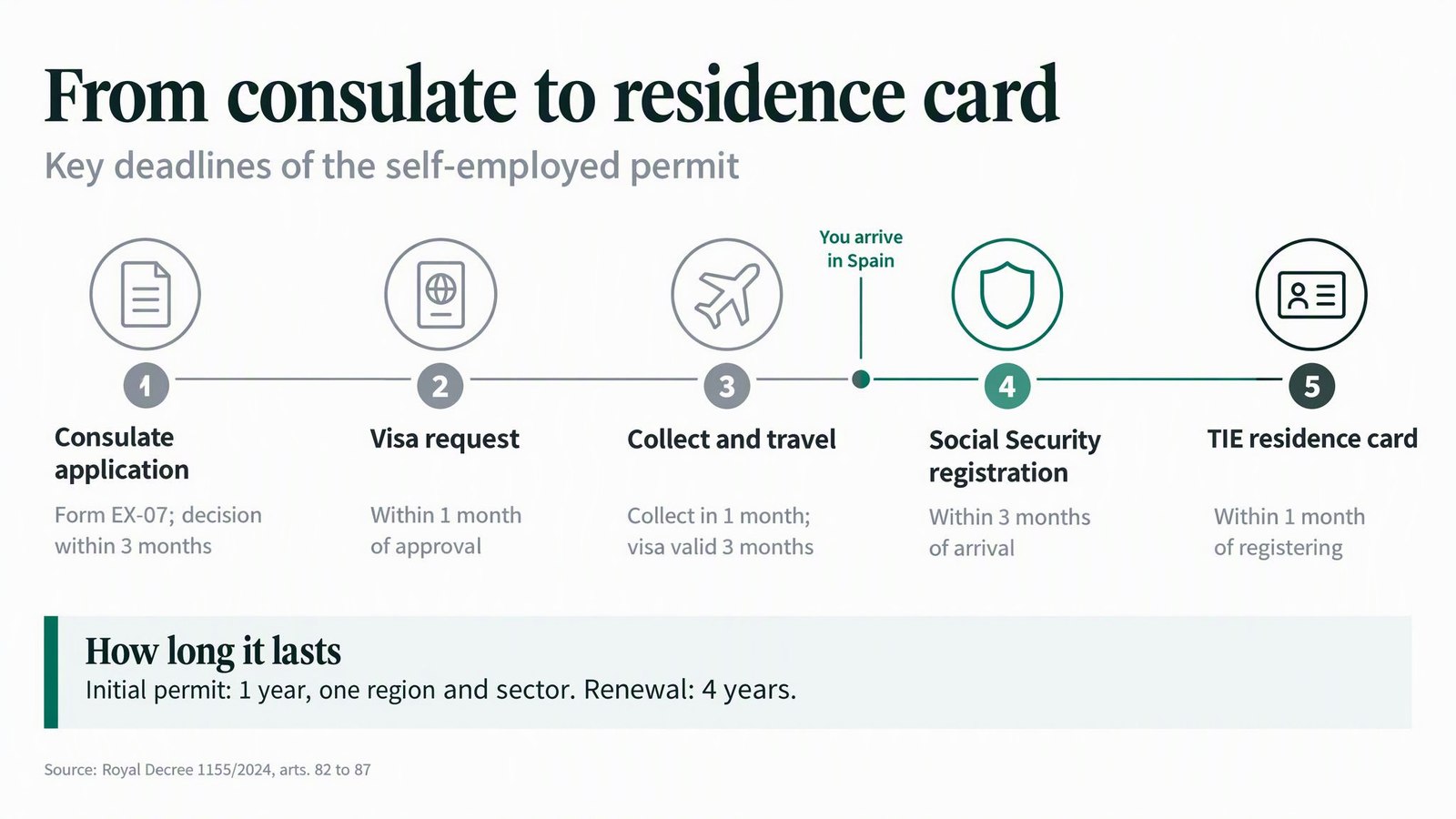
- Live and work legally in Spain. The initial permit lasts one year and is limited to one autonomous community and one sector of activity.
- Work for multiple clients or run your own business, online or offline.
- Issue invoices, register for Spanish tax and social security, and access the public healthcare system once registered.
- Renew for four years; the renewed permit lets you work as an employee or self-employed anywhere in Spain and in any sector.
- Accumulate years of residence that count towards long-term residence and, in many cases, Spanish citizenship.
However, this visa is not the same as the Digital Nomad Visa or the Entrepreneur Visa. It has its own requirements, especially around the business plan, the investment and where you submit the application.
Who can apply for a self-employed work visa in Spain
Not everyone needs this permit to work independently in Spain. It is designed for third-country nationals (non-EU/EEA/Swiss) who want to live and work in Spain as self-employed professionals. If you are an EU/EEA or Swiss citizen, you have freedom of movement and can register directly in Spain without a visa.
You may be a good candidate for this visa if you:
- Are a freelancer (e.g. designer, developer, consultant, translator, coach).
- Want to open a small business (e.g. café, shop, yoga studio, beauty salon).
- Are a professional (e.g. lawyer, architect, therapist) who will work independently.
- Plan to work with Spanish clients or operate a business physically located in Spain.
On the other hand, if your project is innovative, scalable and of special economic interest for Spain, the Entrepreneur Visa under Law 14/2013 (as amended by the 2022 Startup Law) may be more appropriate. If you will mainly work remotely for foreign employers or clients, the Spanish Digital Nomad Visa could be easier. Our self-employment visa lawyers can help you compare these options for your specific case.
Basic legal requirements you must meet
Articles 82 to 85 of the immigration regulation (Royal Decree 1155/2024) set out the requirements. You must:
- Not be a citizen of the EU, EEA or Switzerland (or a family member covered by EU free-movement rules).
- Not be in Spain irregularly.
- Have no criminal record in Spain or in the countries where you have lived during the last 5 years.
- Not be listed as inadmissible in countries with which Spain has an agreement to that effect, nor be within a no-return period after a voluntary return program.
- Not represent a threat to public order, security or public health (a medical certificate is required at the visa stage).
- Meet the requirements that Spanish law imposes on nationals to open and run the planned activity (licenses, permits, registrations).
- Have the professional qualifications or proven experience required for the activity and, for regulated professions, recognition of your degree and professional registration.
- Show that the planned investment is sufficient and, where relevant, its impact on job creation (your own self-employment counts).
- Pay the administrative fees.
In addition, your activity must be compatible with the Spanish Social Security scheme for self-employed workers and comply with all local rules (licenses, health and safety regulations, etc.) in the place where you will operate.
How to get a self-employed work visa in Spain: overview of the process
The process has two main stages, the residence and work authorization and then the visa, and it starts at the Spanish consulate in your country of residence, not in Spain. Understanding this structure helps you plan your timing correctly.
In simple terms, you must:
- Prepare your business plan, proof of investment and supporting documents.
- File the residence and self-employment authorization (form EX-07) in person at the Spanish consulate.
- Once it is approved, apply for the visa within one month.
- Collect the visa and travel to Spain within its three-month validity.
- Register as an autónomo with Social Security within three months of arrival, then apply for your TIE (residence card) within one month.
Below you will find a detailed step-by-step guide for each part of the process, including what to do once you arrive in Spain.
Step 1: Choose the right region and define your project clearly
Immigration rules are national, but the initial self-employed permit is limited to one autonomous community and one sector of activity, and licensing rules for premises vary by region and municipality. For example, Valencia, Catalonia, Andalusia or Madrid may have different local requirements for opening a bar, a consultancy office, or a wellness studio.
Before you start gathering documents, you should:
- Decide in which city or region you want to live and work (e.g. Valencia, Barcelona, Madrid, Alicante).
- Define whether you will:
- Work as a freelancer under your own name (autónomo persona física), or
- Create a company (e.g. a Spanish S.L.); see our guide to creating a limited company in Spain as a foreigner.
- Clarify your main activity (e.g. digital marketing consultant, web designer, bar owner, yoga teacher).
These decisions affect the type of licenses you need, the investment required and the way you present your business plan. A local lawyer in the region (for example, in Valencia) can check the specific municipal requirements before you commit to a certain activity.
Step 2: Prepare a solid business plan for your Spanish self-employment
The business plan is one of the most important documents in your application. It is not just a formality: immigration officers will use it to decide whether your project is viable and whether it will generate enough income for you to live in Spain.
A strong business plan for a self-employed visa in Spain should be clear, realistic and detailed. It should be understandable even for someone who is not an expert in your sector, and it should show that you understand the Spanish market, your costs and your expected income.
Key sections to include in your business plan
While there is no single official template, a complete plan usually includes:
- Executive summary
- Who you are (short profile and background).
- What your business or freelance activity will be.
- Where you will operate in Spain (city/region).
- Your main objectives for the first 1–3 years.
- Description of services or products
- What exactly you will sell: design services, IT consulting, language classes, coffee and food, etc.
- How your offer is positioned (low-cost, premium, niche, local, online, etc.).
- Market analysis
- Who your target clients are (locals, expats, tourists, companies).
- Demand for your service in the chosen area.
- Main competitors and what makes you different.
- Marketing and sales strategy
- How you will find and retain clients (website, social media, networking, partnerships, local advertising).
- Pricing strategy (hourly rates, packages, menu prices, etc.).
- Operational plan
- Whether you need premises (office, shop, studio) or can work from home / co-working.
- Suppliers, tools, software, staff (if any).
- Licenses and permits required (opening license, health permits, etc.).
- Financial plan
- Initial investment (equipment, deposits, renovations, legal fees).
- Monthly fixed costs (rent, utilities, social security, insurance, software).
- Projected income for at least 1 year (better if 2–3 years).
- Cash-flow forecast showing that you can cover expenses and your own living costs.
- Job creation and economic impact (if applicable)
- Whether you plan to hire local employees in the future.
- How your project benefits the local economy (services to locals, attracting foreign clients, etc.).
The viability report
The Ministry’s guidance allows you to prove your qualifications, the sufficiency of the investment and the impact on employment with a viability report (informe de valoración) issued by one of these self-employed workers’ organizations: ATA, UPTA, CIAE, OPA or UATAE. It is not the only admissible evidence, but it is the most common way to support your business plan, so build it into your timeline.
In many cases, it is also very helpful to attach letters of intent from potential Spanish clients or partners confirming that they plan to work with you once you are in Spain. This strengthens the credibility of your income projections.
Example: freelance web designer in Valencia
Imagine you are a non-EU web designer planning to move to Valencia. Your business plan could show:
- That you already work remotely with several international clients and some Spanish businesses.
- Letters of intent from 2–3 Spanish companies in Valencia who are ready to sign contracts once you arrive.
- A clear pricing structure (e.g. €1,200–€2,000 per website, hourly rate for maintenance).
- Projected monthly income, which comfortably covers:
- Your rent and living expenses in Valencia, and
- Your social security contributions and taxes.
This type of concrete, well-documented plan is far more convincing than a vague idea without numbers or real contacts.
Step 3: Calculate and document the required investment and funds
Another core element of your application is proving that you have enough money to launch your activity. There is no single fixed amount for every case, because the needs of a coffee bar are very different from those of an online consultant.
In practice, the authorities will look at two aspects:
- Initial investment for your project (equipment, premises, licenses, stock, website, etc.), which the regulation requires to be sufficient.
- Your ability to support yourself while the business grows: a plan that cannot cover your own living costs will hardly look viable.
Typical types of proof of funds
You can usually use a combination of:
- Recent bank statements in your name.
- Term deposits or savings accounts.
- Loan agreements or investment contracts (if a third party is financing part of the project).
- Proof of assets that can reasonably be used to support the business (with clear documentation).
All foreign documents must be translated into Spanish (or the co-official language of the region) by a sworn translator, and public documents must be legalized or apostilled, depending on the country of origin.
Illustrative comparison of investment needs
| Type of activity | Main costs | Typical investment profile |
|---|---|---|
| Online consultant / digital freelancer | Laptop, software, website, marketing, co-working desk | Lower initial investment, but must show stable income and living funds |
| Coffee bar / small restaurant | Premises, renovation, equipment, licenses, staff, stock | Higher initial investment; authorities expect detailed cost breakdown |
| Yoga / fitness studio | Studio rental, equipment, insurance, marketing | Medium investment; strong local demand and client base are key |
Because the exact amount depends on your project and region, it is wise to have a professional review your financial plan before you submit it.
Step 4: Gather all required documents for the self-employed visa
Once your project and financial plan are clear, you can start collecting the documents that will accompany your application. Consulates may ask for slightly different formats, so always check the specific requirements of the Spanish consulate where you will apply.
In general, you will need:
Personal and identification documents
- Valid passport (a complete copy); by the visa stage it must be valid for at least one year.
- Passport-sized photos following the consulate’s specifications.
- Completed application form EX-07 (residence and self-employment authorization), plus the national visa form used by the consulate when you later apply for the visa.
Professional and project documents
- Your business plan and, ideally, the viability report described above.
- Professional and academic certificates proving that you are qualified for the activity (degrees, diplomas, professional licenses, portfolio, CV), with recognition and professional registration for regulated professions.
- Any pre-contracts, letters of intent or collaboration agreements with Spanish clients or partners.
- Draft lease agreement or proof of negotiations for business premises, if relevant.
- Licenses and permits: for retail and certain services in premises of up to 750 m², a responsible declaration (declaración responsable) or prior notice; for other activities, a list of the licenses required and the status of each application.
Financial and legal documents
- Proof of funds to cover the investment and support you (bank statements, deposits, loan agreements).
- Criminal record certificate (police clearance) from each country where you have lived in the last 5 years, properly legalized/apostilled and translated into Spanish by a sworn translator.
- Medical certificate, required when you apply for the visa itself.
- Fee forms Modelo 790, code 052 (residence and work authorization) and code 062 (work authorization), which must be paid within ten working days of filing.
All foreign documents must usually be presented with:
- The original and a copy.
- A sworn translation into Spanish if they are in another language.
- Legalization or Apostille of The Hague, depending on the issuing country.
Step 5: Submit your application at the Spanish consulate in your country
Unlike some other permits, the self-employed work authorization is requested from outside Spain, in person, at the Spanish consulate for your place of residence. You cannot simply arrive as a tourist and then switch to this status.
The typical procedure is:
- Book an appointment at the Spanish embassy or consulate that has jurisdiction over your place of residence.
- Check their website for the exact process, required forms and fees.
- Confirm which documents must be translated, legalized and how to pay the fees.
- Prepare and organize all documents in the order indicated by the consulate, with originals and copies.
- Attend the appointment in person and submit your file with form EX-07.
- The residence and work fees (Modelo 790, codes 052 and 062) are paid within ten working days; the visa fee comes later, when you apply for the visa itself.
- The consulate may ask you additional questions about your project.
- The consulate will forward your application to the competent Immigration Office in the province of Spain where you plan to work (for example, Valencia if your project is in Valencia).
From this point, you must wait for the Spanish authorities to study your project, your background and your financial situation.
Processing time and possible additional requests
The administration has three months to decide on your application. If no decision is notified within that period, the application is deemed refused (negative administrative silence), so it is important to follow up.
During this period:
- The Immigration Office may request additional documents or clarifications, especially regarding your business plan or financial capacity.
- It is essential to respond quickly and clearly to avoid delays or negative decisions.
If your application is approved, the consulate notifies you. You then have one month to apply in person for the visa, bringing a passport valid for at least one year, a criminal record certificate and a medical certificate. The consulate decides on the visa within one month.
Step 6: Collect your visa and travel to Spain
Once the visa has been granted, the consulate will ask you to come in person to collect your passport with the visa sticker.
Keep in mind that:
- You have one month from notification to collect the visa; otherwise, you are deemed to have withdrawn and the file is closed.
- The visa is valid for three months, and you must enter Spain within that period. It covers your stay until you register with Social Security.
When you arrive in Spain, your work and residence authorization will be linked to the region and activity described in your application. You must then complete several registrations to be fully legal as an autónomo.
Step 7: Register as an autónomo within three months of arrival
From the date you enter Spain, you have three months to register with Social Security and start contributing. To work legally as self-employed, you also need to register with the Tax Agency (Agencia Tributaria). Our guide on how to become autónomo in Spain explains contributions, taxes and forms in detail; here is the short version.
1. Register your address (empadronamiento)
Register your address in the municipal register (padrón) at your local town hall. You will need proof of address (rental contract, property deed, or authorization from the person who hosts you). The padrón certificate is useful for the bank and required later for your TIE.
2. Open a Spanish bank account
Social security contributions are collected by direct debit, so you will generally need a Spanish bank account and IBAN before registering.
To open an account, banks often request:
- Your NIE (or at least the NIE number).
- Your passport with the visa.
- Proof of address in Spain.
- Sometimes proof of your activity or employment status.
3. Register with the Spanish Tax Agency as self-employed
Next, you must register with the Agencia Tributaria as an autónomo using form Modelo 036 (the simplified Modelo 037 was abolished in February 2025), where you indicate:
- Your personal data and NIE.
- The economic activity code (epígrafe IAE) that best matches your work.
- Where you will carry out the activity (home office, rented premises, etc.).
- Whether you will charge VAT (IVA) and how your income tax (IRPF) will be calculated.
Choosing the correct IAE code and tax regime is important, as it affects your obligations (invoicing, quarterly tax returns, etc.). Many foreigners use a gestor or tax advisor to avoid mistakes.
4. Register with the Social Security system (RETA)
You must then join the Régimen Especial de Trabajadores Autónomos (RETA), the social security regime for self-employed workers. The registration must be filed before you start your activity (it can be requested up to 60 days in advance) and, for visa holders, within the three-month window after entry.
When registering, you will:
- Choose your contribution bracket based on your expected net income (which determines the amount you pay and your future benefits).
- Provide your bank details for direct debit of monthly contributions.
- Gain access to the public health system and other social benefits (sick leave, birth and childcare leave, pension contributions, etc.).
New autónomos can usually pay a reduced tarifa plana of €80 per month during the first 12 months, extendable for another 12 months if net income stays below the minimum wage. Check the conditions at the time of registration.
Step 8: Apply for your TIE (residence card)
Within one month of your Social Security registration, you must apply in person for your TIE (Tarjeta de Identidad de Extranjero) at the police station of the province where your authorization was processed. This card is your physical proof of legal residence and shows your NIE, the type of permit and its validity dates.
The main steps are:
- Appointment for fingerprints (toma de huella):
- Book an appointment online with the National Police in your province.
- Bring form EX-17, your passport and visa, the padrón certificate, photos, and proof of payment of the card fee.
- Your fingerprints will be taken, and you will receive a receipt.
- Collection: after a few weeks, you can collect your TIE at the same police station. Until then, keep the receipt carefully, as it proves that your residence card is in process.
Step 9: Comply with ongoing tax and legal obligations
After you are fully registered as an autónomo, you can start invoicing clients and running your business. However, you must comply with a number of ongoing obligations to keep your permit in good standing and to renew it in the future.
Among others, you will need to:
- Issue invoices that meet Spanish requirements (including your NIE, client data, VAT if applicable, and IRPF withholding when needed).
- File quarterly tax returns for:
- VAT (IVA), if your activity is subject to it.
- Personal income tax (IRPF) installments.
- Submit annual tax summaries and keep proper accounting records.
- Pay your monthly social security contributions on time.
- Maintain any licenses and permits required for your premises or activity (for example, renewals of opening licenses, safety inspections, etc.).
Failing to comply with these obligations can create problems when you try to renew your self-employed permit, as the authorities will check whether your activity is real and whether you are up to date with tax and social security.
Validity and renewal of the Spanish self-employed work visa
The initial residence and work authorization for self-employment is granted for one year. If you want to stay longer, you must apply for renewal online during the two months before it expires. You can still apply within the three months after expiry, but you risk a fine. Filing on time extends your current permit until a decision is made.
For renewal, you typically have to show that:
- You continue the activity that gave rise to your permit, and
- You have complied with your tax and social security obligations.
- Alternatively, the regulation also accepts other situations, such as receiving self-employed unemployment protection (cese de actividad) or having a family member who meets the requirements to sponsor you.
- You have no criminal record and, if you have children of compulsory school age, you can show they are enrolled in school.
The renewal is granted for four years (articles 86 and 87 of Royal Decree 1155/2024) and allows you to work as an employee or self-employed anywhere in Spain and in any sector. Once you have completed five years of legal and continuous residence in Spain, you may be eligible for long-term residence.
Self-employed visa versus other ways to work independently in Spain
Many foreigners are unsure whether the self-employed work visa is the best route for them, especially if they are digital professionals or investors. It is helpful to compare it briefly with other common options:
| Permit type | Main target | Key feature |
|---|---|---|
| Self-employed work visa (autónomo) | Freelancers and small business owners working mainly in Spain | Requires business plan, sufficient investment and registration as autónomo |
| Digital Nomad Visa | Remote workers and freelancers working mainly for foreign clients | At least 80% of income from outside Spain; remote employees may qualify for the Beckham Law |
| Entrepreneur / Startup Visa | Innovative, high-impact business projects | Requires a favorable report from ENISA on the business project |
| Non-Lucrative Visa | People who want to live in Spain without working | No work allowed; must prove passive income or savings |
Choosing the correct route from the beginning saves time and reduces the risk of refusal. For example, a UK citizen who wants to move to Spain as a freelancer after Brexit may choose between the self-employed visa, the Digital Nomad Visa or even a company-based route, depending on where their clients are and how they are taxed.
Common mistakes when applying for a Spanish self-employed visa
Many refusals of self-employed visas in Spain are not due to bad business ideas, but to avoidable mistakes in the application. Being aware of these issues can help you prepare a stronger file.
Some frequent problems include:
- Weak or vague business plan
- Lack of concrete figures, market research or realistic income projections.
- No clear explanation of how you will attract clients in Spain.
- Insufficient proof of funds
- Bank statements that do not clearly show ownership or available balance.
- Underestimating the real cost of living and business expenses in Spain.
- Missing or incorrectly legalized documents
- Criminal record certificates without apostille or sworn translation.
- Medical certificates that do not follow the required wording or are too old.
- Choosing the wrong activity or region
- Planning an activity that requires licenses you cannot realistically obtain.
- Not considering local regulations in the chosen autonomous community.
- Not respecting deadlines
- Missing the one-month windows to apply for and collect the visa.
- Not registering with Social Security within three months of arrival, or applying too late for renewal.
To avoid these issues, many applicants prefer to work with a law firm experienced in immigration and business set-up for foreigners, especially in the region where they plan to live (for example, Valencia for those moving to the Valencian Community).
Practical example: moving to Valencia with a self-employed work visa
To illustrate how the process works in real life, imagine the case of a non-EU marketing consultant who wants to relocate to Valencia and work mainly with local businesses and international clients based in Spain.
The steps would typically be:
- Define a clear service offer (digital marketing for small hotels and restaurants in Valencia).
- Prepare a detailed business plan with:
- Market analysis for tourism-related businesses in Valencia.
- Projected income from Spanish and international clients.
- List of tools and monthly expenses (software, co-working, transport).
- Gather letters of intent from several Valencia-based hotels and cafés and obtain a viability report.
- Collect all personal, financial and legal documents, and obtain sworn translations.
- Submit the application at the Spanish consulate in the country of residence, indicating Valencia as the place of activity.
- After approval, apply for and collect the visa, travel to Valencia, register in the padrón, open a Spanish bank account, register as autónomo with the Tax Agency and Social Security, and then apply for the TIE.
Once all registrations are completed, the consultant can legally invoice clients in Spain, pay taxes and social security, and enjoy life in Valencia while building a long-term residence history in Spain.
Planning to freelance or open a business in Valencia? Our bilingual immigration team reviews your business plan, prepares your consulate file and handles your autónomo registration once you arrive. Book a free consultation.
Frequently Asked Questions
Can I include my spouse and children in my Spanish self‑employed work visa application?
No. Family members cannot be added to your own application. They usually join you through family reunification, which you can generally request once you have lived legally in Spain for one year and have applied to renew your permit for at least another year (some exceptions apply). You must prove sufficient income and suitable housing, and a reunified spouse, partner or child can work in Spain.
How much Spanish do I need to speak to get a self‑employed work visa in Spain?
There is no formal language test for this visa, but you should have enough Spanish to handle basic bureaucracy and, in many cases, to deal with clients and suppliers. For client‑facing businesses, low Spanish skills can weaken your business plan because it may affect your ability to attract and retain local clients.
Can I change my activity or work in another region of Spain after getting the self‑employed visa?
Your initial authorization is limited to one autonomous community and one sector of activity. Moving your business to another region or changing sector during the first year requires going back to the immigration authorities, so plan it with a lawyer. After the first renewal, the permit lets you work as an employee or self-employed anywhere in Spain and in any sector.
What happens if my Spanish self‑employed visa application is denied?
If your application is refused, the decision letter will state the reasons and the appeals available, with their deadlines. Remember that silence after three months also counts as a refusal. You can file an administrative or court appeal, or in some cases submit a new application correcting the issues (for example, strengthening your business plan or financial evidence). Our immigration appeals team can assess which option makes more sense. During this time you must respect the immigration rules of your current country of residence.
Every case has its own details. Our English-speaking lawyers in Valencia can review your situation and advise you on the best way forward. Get in touch with us for tailored legal advice.
