


Getting your Spanish digital nomad visa approved is a milestone, but it is only the start. Once you land in Spain, a new set of questions appears: which card you need and when, whether you keep paying UK National Insurance, how you access healthcare, when Spain starts taxing your income and whether the Beckham Law applies to you.
This plain‑English guide covers living in Spain on a digital nomad visa from the perspective of British citizens and UK residents: your first registrations, social security and the A1 certificate, healthcare and the S1, tax residency, the Beckham Law, your ongoing obligations and renewals. If you have not applied yet, start with our step‑by‑step guide to the digital nomad visa for UK citizens, which covers the requirements, 2026 income thresholds and documents.
Visa, residence permit and TIE: understanding your status
The digital nomad route (officially, residence for international teleworking under Law 14/2013, as amended by the Startup Law 28/2022) works in stages, and the document you hold depends on where you applied:
| Stage | Document | Validity |
|---|---|---|
| Applied at a Spanish consulate in the UK | Teleworking visa (your residence title in Spain; no TIE needed that year) | Up to 1 year |
| Applied from inside Spain, or after the visa year | Residence authorization from the UGE-CE, plus your TIE card | Up to 3 years |
| Renewal | Renewed authorization and new TIE | 2 years each time |
| After 5 years of continuous legal residence | Long-term residence | Long-term (card renewed every 5 years) |
If you arrived with a consular visa, mark the date on your calendar: within the 60 days before it expires, you must apply online to the Unit for Large Companies and Strategic Groups (UGE-CE) for the residence authorization, and only then request your TIE. Missing this window can leave you without status. Our digital nomad visa lawyers handle these conversions and later renewals.
Time on the permit counts toward long-term residence after five years, and British nationals can apply for Spanish citizenship after ten years of legal residence, subject to language and culture tests.
First registrations after you arrive in Spain
Once you are in Spain with your visa or your approved resolution, complete these formalities early:
- Empadronamiento: register your address at the local town hall (ayuntamiento). You will need the certificate for healthcare, schools and many other procedures.
- NIE and TIE: your NIE (foreigner identification number) is printed on your TIE (residence card). Book a fingerprint appointment with the police and bring your passport, photos, visa or resolution and the fee receipt; you collect the card a few weeks later.
- Bank account: a Spanish account makes paying rent, utilities and local taxes much simpler.
- Self-employed set-up: if you invoice clients yourself and are not covered by a UK certificate of coverage, you will need to register as self-employed (autónomo) with the Tax Agency and Social Security. Our guide to becoming autónomo in Spain explains the steps.
Some British nomads later set up a Spanish limited company (SL) if they plan to hire staff or grow locally. That choice has its own tax and compliance consequences, so it is worth deciding it with advice rather than by default.
Social security: UK certificate of coverage or Spanish contributions
One of the most technical, but important, aspects for British residents is social security. Your permit file must show one of two things: that you are registered with Spanish Social Security, or that you remain insured in the UK under a certificate of coverage. Since 1 January 2021, the UK–EU Trade and Cooperation Agreement coordinates social security between the UK and Spain, so you should not have to pay contributions twice.
The A1 certificate for UK employees
If you are employed by a UK company and work temporarily from Spain, you or your employer can ask HMRC for a certificate of coverage, commonly called an A1 (form CA3822; self-employed people use form CA3837). Under the “detached worker” rule, it normally covers periods of up to 24 months.
Key points:
- The certificate confirms that you pay UK National Insurance, not Spanish social security, for the period stated.
- Like other UK documents, it may need an apostille and a sworn Spanish translation for your permit file.
- It helps you avoid double contributions and keep building your UK National Insurance record for your future UK State Pension.
Plan ahead for when the certificate ends: at renewal you will need either a new certificate, if HMRC grants one, or registration with Spanish Social Security.
If you are self-employed or your employer registers in Spain
Freelancers and company directors who are not covered by a UK certificate usually contribute in Spain: freelancers through the self-employed scheme (RETA) and employees through their employer’s registration with Spanish Social Security. Contributing in Spain also gives you access to the Spanish public system, including healthcare. This is an area where tailored advice is strongly recommended, because the right answer depends on how your contract and your UK company are set up.
Healthcare: private insurance, the S1 and the public system
Healthcare is often the first practical question for British families after the move. How you are covered depends on your social security position:
- For the application: you need public or private health insurance with an insurer authorized to operate in Spain, covering you and any dependants. UK travel insurance does not count.
- If you stay in UK National Insurance: the HMRC certificate can come with an S1 healthcare certificate issued by the NHS Business Services Authority. You register the S1 with Spain’s National Social Security Institute (INSS) to access public healthcare on the same terms as local residents.
- If you contribute in Spain: as an employee or autónomo, you access the public health system through your local health center; in the Valencian Community, you receive the regional health card (SIP).
- GHIC: the UK Global Health Insurance Card is designed for temporary stays, not for people who live in Spain.
Many British nomads keep their private policy even once they have public cover, for shorter waiting times and English‑speaking doctors.
When you become tax resident in Spain
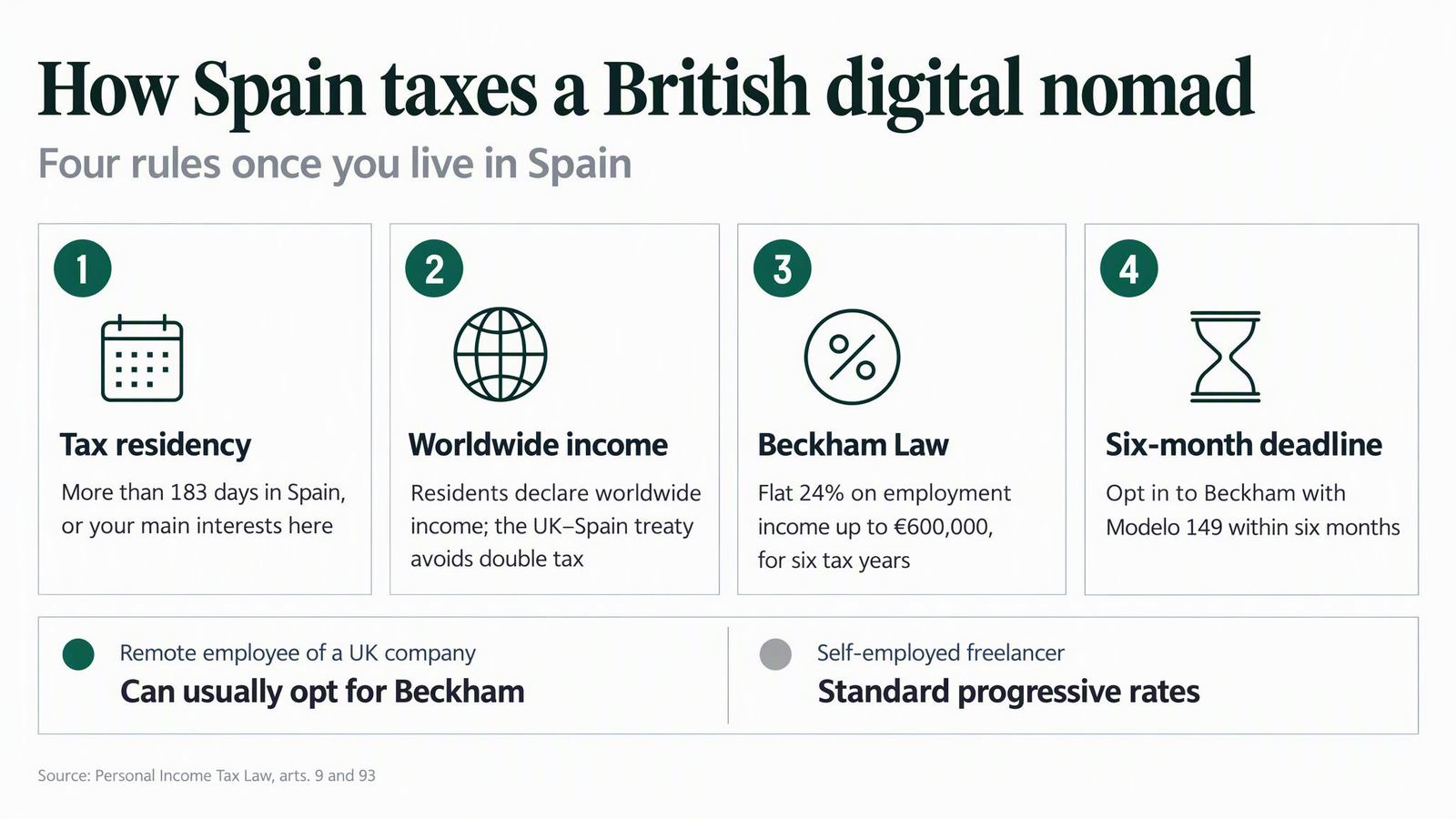
Immigration and tax are separate systems, but they interact. Moving to Spain with a digital nomad visa does not make you tax resident from day one, but under Article 9 of the Personal Income Tax Law you are generally treated as a Spanish tax resident if:
- You spend more than 183 days in Spain in a calendar year, or
- Spain is the main center of your economic activities or interests, or
- Your spouse (if not legally separated) and dependent minor children live in Spain, unless you prove otherwise.
As a tax resident, you are normally taxed on your worldwide income at progressive rates. Spain’s double taxation treaty with the UK helps ensure you do not pay tax twice on the same income, but it does not exempt you from filing in both countries where required. Keeping UK bank accounts or a UK home does not stop you from becoming Spanish tax resident; it only affects how you declare and coordinate taxes in both countries.
Residents with assets abroad worth more than €50,000 in any category (bank accounts, securities or real estate) must also file an information return, Modelo 720. For Britons with UK savings, investments or a home in the UK, this is one of the easiest obligations to miss.
The Beckham Law for British digital nomads: who qualifies
Since the Startup Law, Article 93 of the Personal Income Tax Law, the special regime for workers who move to Spain known as the Beckham Law, also covers people who work remotely from Spain using exclusively digital means. If you qualify, you are taxed under non‑resident rules while remaining a Spanish taxpayer:
- Flat 24% rate on employment income up to €600,000 a year (47% above that).
- Six tax years: the year you become resident and the following five.
- Foreign income: most non-employment income from outside Spain, such as UK interest or dividends, is generally not taxed in Spain, and you do not file Modelo 720.
- Condition: you must not have been tax resident in Spain in the previous five tax years.
- Deadline: you opt in by filing Modelo 149 within six months of starting your activity in Spain.
The key limit for British nomads is how you work. The regime is designed for employees: a remote worker employed by a UK company can usually opt in, but self-employed freelancers generally cannot, unless their activity qualifies as an innovative entrepreneurial activity or they are highly qualified professionals working for startups. For a full walkthrough of the requirements and the application, see our guide to the Beckham Law.
Why tailored tax advice is essential
Because your situation may involve UK PAYE or self‑assessment, Spanish income tax, social security coordination and the Beckham Law at the same time, it is crucial to:
- Analyze whether and when you become Spanish tax resident.
- Decide if and how to apply for the Beckham regime before the six-month deadline.
- Coordinate UK and Spanish filings to avoid double taxation.
For many British digital nomads, a one‑time consultation with a tax lawyer before or just after moving saves significantly more than it costs.
Your legal rights and responsibilities as a digital nomad in Spain
Once your permit is granted, you gain a clear set of rights, but also obligations, under Spanish law.
What you are allowed to do
- Live in Spain for the validity of your visa or authorization, and renew it while you keep meeting the conditions.
- Work remotely for foreign employers or clients as described in your application.
- Work for Spanish clients, if you are self-employed, for up to 20% of your professional activity. Employees may only work for companies based outside Spain.
- Bring close family members (spouse or partner, children and dependent parents), who can live, study and work in Spain.
- Travel within the Schengen Area for up to 90 days in any 180‑day period in other member states.
Your main ongoing obligations
To keep your status safe, you must:
- Maintain the conditions under which your permit was granted:
- Keep your income above the required threshold.
- Keep your employer or main clients outside Spain.
- Continue in a remote‑work arrangement similar to the one described in your application.
- Stay compliant with tax and social security rules in both Spain and the UK.
- Renew on time: apply before your authorization expires, with updated evidence of income, work, insurance and social security.
- Notify authorities of major changes where required, such as a new employer, family situation or address.
What happens if you don’t comply
Non‑compliance can lead to refusal of your renewal, revocation of your residence authorization or administrative fines. If your situation changes, for example because you accept a job with a Spanish company, you may need to modify your residence and work permit rather than simply renew it.
If your renewal is refused or your permit is revoked, Spanish law allows for administrative appeals. These are technical and time‑sensitive, so it is highly advisable to work with immigration appeals lawyers if you need to challenge a decision.
Practical examples for British residents living in Spain
Example 1 – UK employee working fully remotely
Sarah is a British citizen living in Manchester, employed full‑time by a London marketing agency that has agreed she can work fully remotely.
- She earns £60,000 a year, well above the income threshold.
- She applies at the Spanish Consulate General in Manchester, is granted a 1‑year visa and moves to Valencia.
- Her employer obtains an HMRC certificate of coverage, so she keeps paying UK National Insurance and registers her S1 with the INSS for public healthcare.
- Within six months of starting work in Spain, she files Modelo 149 to opt for the Beckham Law and pays a flat 24% on her salary.
- Before her visa expires, she applies to the UGE-CE for a 3‑year residence authorization and gets her TIE.
Example 2 – British freelancer with mostly US and UK clients
Tom is a UK national from London, working as a freelance graphic designer for US and UK clients.
- He invoices around €4,000 a month, mainly to non‑Spanish clients, above the €2,849 monthly threshold for a single applicant in 2026.
- He travels to Spain as a visitor, falls in love with Valencia and, within his 90‑day stay, files his application online with the UGE-CE, obtaining a 3‑year authorization.
- He registers as autónomo, which gives him access to the public health system.
- After spending more than 183 days in Spain, he becomes tax resident. As a freelancer, he cannot use the Beckham Law, so he declares his worldwide income at progressive rates, with credit for any UK tax under the treaty.
- He keeps work for Spanish clients below 20% of his activity.
Why many British digital nomads choose Valencia
The permit allows you to live anywhere in Spain, but Valencia has become one of the most popular choices for UK remote workers and their families:
- Lower cost of living than London or many other UK cities, with good housing, food and services.
- Excellent connectivity, with fast internet, co‑working spaces and direct transport links to the rest of Spain, Europe and the UK.
- A strong expat community, including many English‑speaking professionals and international schools.
- Good healthcare and a family‑friendly urban environment, with beaches, parks and cultural events.
Many nomads rent first and buy once they are sure they want to stay. If that is your plan, our guide to buying a property in Spain as a foreigner explains the legal steps and taxes.
Already approved, or moving to Valencia soon? Our bilingual team coordinates your TIE, social security, Beckham Law application and renewals, so that immigration and tax stay aligned from day one. Book a free consultation.
Frequently Asked Questions
Can I switch to another Spanish residence permit or to permanent residence after holding the digital nomad visa?
Yes. Time spent in Spain on the digital nomad residence counts toward the 5 years needed for long‑term residence, provided you keep your status continuous and legal. Before your digital nomad permit expires, you can either renew it (for two-year periods, as long as you still meet the conditions) or apply to change to another residence type if you meet that category’s requirements. Long‑term residence and, later, citizenship each have their own additional conditions on stay, integration and clean records.
What happens if I change employer, lose a big client, or my income drops while I am in Spain?
You must still meet the core conditions: mainly non‑Spanish income and earnings above the required threshold. If you change employer or lose a key client, you should quickly secure a new contract and keep paperwork proving continuity of remote work and sufficient income. Major changes should be reported when renewing your permit or sooner if they affect the basis on which it was granted. Long‑term failure to meet the conditions can lead to non‑renewal or, in serious cases, revocation.
Can my partner or children work or study in Spain as my dependants on the digital nomad visa?
Yes. Family members who hold linked permits can live and study in Spain, and adult family members can work, either as employees or as self-employed, although they must register with the tax and social security systems in their own right. Children can attend Spanish public or private schools like other resident minors. Each family member’s card sets out their status, so check the details when you collect the TIEs.
If I keep my UK bank accounts and property, where do I pay tax as a digital nomad in Spain?
Where you pay tax depends mainly on tax residence rules and double‑taxation agreements, not on where your bank account or property is located. If you become Spanish tax resident (for example, by spending over 183 days a year in Spain), Spain can tax your worldwide income, with relief for tax already paid in the UK under the UK–Spain treaty. Keeping UK assets does not stop you becoming Spanish tax resident; instead, it affects how you declare and coordinate taxes in both countries.
Every case has its own details. Our English-speaking lawyers in Valencia can review your situation and advise you on the best way forward. Get in touch with us for tailored legal advice.
