


Spain has closed its classic “residence by real estate investment” route, but it has not closed its doors to international investors. If you are a non‑EU property buyer planning a move in 2026, you now need two coordinated plans: a residency strategy (to live legally in Spain) and an investment strategy (to keep buying, renting or developing property). With careful planning, you can still build a Spanish portfolio, protect your assets and obtain a residence permit for you and your family.
The end of the real estate Golden Visa and what it means for investors
Organic Law 1/2025 of 2 January removed the investor residence rules from Law 14/2013. The Golden Visa (residence for investing at least €500,000 in Spanish property, or making certain financial or business investments) stopped accepting new applications on 3 April 2025. From that date:
- No new Golden Visa applications are accepted, whatever the type of investment. Applications filed up to 2 April 2025 are still processed under the old rules.
- Existing holders can keep renewing their Golden Visa as long as they maintain the qualifying investment and the other original conditions.
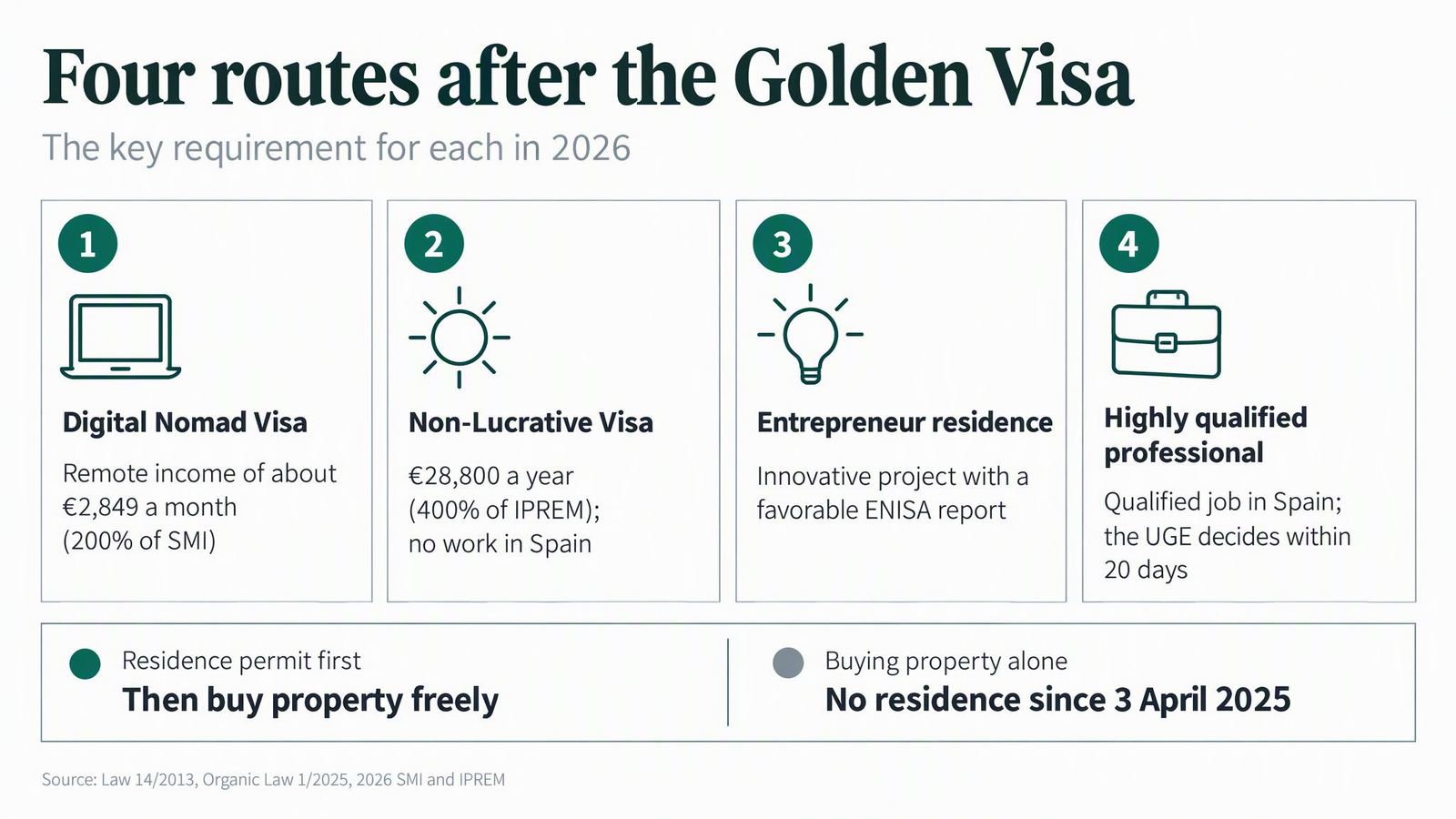
- Buying property alone no longer gives new applicants any route to residency.
For non‑EU property investors in 2026, this creates a new reality:
- You can still freely buy, sell or develop real estate in Spain as a non‑resident.
- To live in Spain for more than 90 days in any 180‑day period you need another residence permit. These are the real Golden Visa alternatives.
- Your property strategy should be coordinated with immigration, tax and asset‑protection planning from day one.
At Spain Legal Estate in Valencia, our immigration lawyers work precisely at this intersection, together with our tax and real estate team, for expats, foreign investors and digital nomads.
Overview of the best Golden Visa alternatives in Spain for 2026
For 2026, the most effective alternatives to the abolished Golden Visa, especially if you own or plan to own Spanish property, are:
- Digital Nomad Visa (remote workers and online business owners)
- Non‑Lucrative Visa (NLV) (retirees and financially independent investors)
- Entrepreneur residence (innovative business projects)
- Highly qualified professional permits and standard work permits (employed or self‑employed)
- EU family routes and family reunification (if you have close relatives with Spanish, EU or legal resident status)
Each option has its own profile, income thresholds, tax consequences and flexibility for travel and work. The “best” alternative depends on:
- Your country of tax residence and the applicable double tax treaty
- Whether you want to live full‑time in Spain or just spend part of the year
- Your income structure (pensions, rentals, dividends, remote salary, business profits, crypto, etc.)
- Your family situation (spouse, dependent children, dependent parents)
- Your investment strategy (buy‑to‑let, flip, long‑term holding, development, company vs personal ownership)
Below you will find a practical comparison of the main routes, with a focus on how they work for property investors.
The Digital Nomad Visa is now a key route for globally mobile investors
The Spanish Digital Nomad Visa (officially, residence for international teleworking under Law 14/2013) has become one of the strongest replacements for the Golden Visa for investors who:
- Work remotely for foreign companies or clients, or
- Own an online business or location‑independent consultancy.
How the Digital Nomad Visa works in practice
This permit allows you to live in Spain while working remotely for companies or clients based outside Spain. You can still invest in Spanish property, but your main income must come from abroad. Key features:
- If you apply at a Spanish consulate, you receive a visa valid for up to one year; if you apply from within Spain, the residence permit is granted for up to three years and can be renewed for two‑year periods.
- Self‑employed holders can also work for Spanish clients, as long as that work does not exceed 20% of their total professional activity.
- You can bring family members (spouse or partner, children and, in some cases, dependent parents).
- If you become Spanish tax resident, you may be able to opt for the Beckham Law special expat tax regime, provided you meet its conditions.
For a property investor who already has a remote income, this visa can be more flexible than the old Golden Visa, and often more tax‑efficient.
Digital Nomad Visa requirements for investors
The main conditions in 2026 are:
- Non‑EU/EEA/Swiss nationality.
- A genuine remote work relationship:
- An employment contract with a foreign company, or
- Self‑employment or a company invoicing mainly to foreign clients.
- That relationship must have existed for at least three months before you apply.
- A university degree or recognized professional training, or at least three years of professional experience.
- Minimum income of 200% of the Spanish minimum wage (SMI): about €2,849 per month in 2026, based on the SMI of €17,094 a year set by Royal Decree 126/2026, plus 75% of the SMI for the first family member and 25% for each additional one.
- Health insurance with an insurer authorized to operate in Spain (or public coverage).
- No criminal record in Spain or in the countries where you have lived during the last five years.
Property ownership is not required, but buying a home in Valencia or elsewhere in Spain can strengthen your relocation project and give you a stable base. Our Digital Nomad Visa team can prepare the application and the tax analysis together.
Why digital nomad status is attractive after the Golden Visa
For many former Golden Visa candidates (especially entrepreneurs and professionals), this has become the preferred path because:
- You can work legally from Spain, unlike with the Non‑Lucrative Visa.
- It can open the door to the Beckham Law, which limits Spanish tax on most foreign income for the year you move and the following five years.
- You can still freely invest in real estate, either personally or via a Spanish or foreign company.
Example: A US software consultant buys two rental apartments in Valencia through a Spanish SL company. Her main income is a US‑based consultancy contract. She applies for the Digital Nomad Visa, checks whether she qualifies for the Beckham regime, and spends most of the year in Spain while expanding her Spanish property portfolio.
The Non‑Lucrative Visa remains a solid choice for retired and passive investors
The Non‑Lucrative Visa (NLV) is another strong Golden Visa alternative in Spain in 2026, particularly for:
- Retirees with pensions from abroad
- Investors with substantial passive income (dividends, interest, rental income)
- People who do not need to work in Spain
Key features of the Non‑Lucrative Visa
The NLV allows you to reside in Spain without working (no employment or professional activity in Spain). You may:
- Live in Spain on a long‑term basis. Unlike the Golden Visa, you are expected to spend most of the year in the country, and renewals check your actual presence.
- Buy and manage property as a passive investment (rental income is allowed, but you cannot personally run a Spanish business without changing your status).
- Apply for long‑term residence after five years, and eventually for Spanish citizenship (subject to the standard residence and integration rules).
Non‑Lucrative Visa requirements
Typical requirements include:
- Proven sufficient financial means to live in Spain without working: 400% of the IPREM for the main applicant, which means €28,800 a year (€2,400 a month) in 2026, as the IPREM remains at €600 a month, plus 100% of the IPREM (€7,200 a year) for each dependent family member.
- Funds can come from:
- Foreign pensions
- Dividends and interest
- Rental income
- Capital and savings
- Private health insurance with full coverage in Spain, from an insurer authorized to operate in Spain.
- No criminal record and no irregular stays in Spain.
Owning property in Spain is not mandatory, but it can help demonstrate your intention to reside and may make your application more coherent, especially if you are relocating as a family.
How property investors use the Non‑Lucrative Visa
Many former Golden Visa candidates now follow a two‑step strategy:
- Enter and reside in Spain via the Non‑Lucrative Visa.
- Use their capital to build a rental portfolio in cities like Valencia, Alicante or Malaga, while keeping their main income abroad.
Example: A British couple sells their UK home, buys a beachfront apartment near Valencia and a small city flat as a rental. Their UK pensions and investments meet the NLV income requirement. They live in Spain most of the year, pay Spanish tax as residents, and grow their local property holdings slowly without needing to work.
Entrepreneur residence as a strategic alternative
Another alternative is the entrepreneur residence permit under Law 14/2013. The investor articles of that law were removed in 2025, but its entrepreneur provisions remain in force. This route is designed for business projects that are innovative and of special economic interest for Spain, and it requires a favorable report from ENISA, the public company that assesses these projects.
What counts as an entrepreneur project in 2026?
The assessment gives priority to job creation in Spain and also looks at:
- Your professional profile, training and personal involvement in the project
- The business plan: activity, location, expected jobs, market analysis and financing
- The added value for the Spanish economy, innovation and investment opportunities
For property investors, this route is only realistic if you move beyond passive buy‑to‑let and build a genuinely innovative business, for example:
- A technology‑driven platform for managing rental or co‑living properties, with local staff
- A new model for energy‑efficient refurbishment of older buildings in Valencia
- A scalable property services business with a clear innovation component
A conventional rental portfolio or a standard development company will rarely pass the innovation test on its own.
Advantages and challenges for property investors
Advantages:
- Gives you a work‑enabled residence permit linked to your Spanish business.
- Can legitimize a more active property strategy (development, management, services).
- Applications from Spain are handled by the Large Companies and Strategic Groups Unit (UGE), which has a legal deadline of 20 days to decide.
Challenges:
- The project must obtain a favorable ENISA report on its innovative character and economic interest.
- More complex than the old “buy €500,000 of property” rule; legal and tax structuring is critical.
- Ongoing compliance and reporting obligations.
With a well‑designed business plan and support from an entrepreneur visa lawyer, this can be a powerful alternative for serious real estate entrepreneurs in 2026.
Highly qualified, employed and self‑employed permits for active professionals
For some investors, the most realistic path is a work‑based residence permit, either as an employee or as a self‑employed professional (autónomo) or company director.
Highly qualified professionals and employed work permits
If a company in Spain hires you for a senior or specialized role, it can apply for a highly qualified professional permit (or an EU Blue Card) through the UGE, also with a 20‑day legal deadline. For other jobs, the employer applies for a standard residence and work permit. For property investors this may be relevant if:
- You become an executive or key employee of a Spanish real estate company.
- You are transferred to a Spanish branch of your existing employer (intra‑company transfer).
These routes are not “investment visas”, but once you hold a residence card you are free to buy and manage property like any resident.
Self‑employed and business owner permits
You may also apply as a self‑employed worker or director of a Spanish SL (limited company), typically by:
- Registering as autónomo in Spain, or
- Forming a Spanish company that carries out genuine economic activity.
For property investors this is particularly useful when you:
- Run a property management business (holiday lets, co‑living, student housing).
- Operate as a developer or refurbishment specialist.
- Combine consultancy or professional services with real estate investment.
These routes require detailed business plans, financial projections and proof that the activity is viable and will generate sufficient income. They also have important tax and Social Security implications that must be assessed before you apply.
Family routes and EU connections as indirect alternatives
Some investors do not need a dedicated Golden Visa alternative because they can rely on family or EU rights instead. This is common for families where:
- One spouse or partner holds a Spanish, EU/EEA or Swiss passport.
- A close family member already has legal residence in Spain.
Examples of family‑based pathways
- EU family member card if your spouse or partner is a citizen of another EU/EEA country or Switzerland living in Spain.
- Residence for family members of Spanish citizens: since 20 May 2025, under the new Immigration Regulation (Royal Decree 1155/2024), spouses, partners and certain relatives of Spanish nationals apply for a specific five‑year permit that also allows them to work.
- Family reunification if a close relative is already a legal resident in Spain.
- Spanish citizenship by descent, only in specific cases. Note that the application window of the “Grandchildren Law” (Democratic Memory Law) closed on 22 October 2025.
Once you hold the corresponding residence card, you are free to buy and manage property in Spain. In these cases, the immigration route is not tied to your investment level, but your property decisions must still be aligned with your tax and inheritance planning.
How property investment works now that the Golden Visa is gone
Even without a Golden Visa, Spain remains one of Europe’s most attractive real estate markets. For 2026, non‑resident investors should take into account:
- No minimum investment is required to buy property: you can purchase for €100,000 or €10 million; the law does not discriminate.
- You will still need an NIE (Número de Identificación de Extranjero) to buy, sell or hold property and to pay Spanish taxes.
- You can buy:
- In your own name
- Through a Spanish company (SL)
- Through a foreign company or holding structure (with careful tax analysis)
However, the immigration benefits that used to come with a €500,000 purchase no longer exist for new investors. Residency must be obtained through one of the permits described above. For the purchase itself, see our step‑by‑step guide to buying property in Spain as a foreigner.
Tax and residency interaction for investors
Whether you are on a Digital Nomad Visa, NLV or work permit, you should analyze:
- Tax residency: if you spend more than 183 days per year in Spain, you will normally become a Spanish tax resident.
- Non‑Resident Income Tax (IRNR): if you remain non‑resident but own property, your Spanish rental income and the imputed income from property you do not rent out are taxed under IRNR.
- Wealth Tax and the temporary Solidarity Tax on Large Fortunes, whose impact depends on the region and on how your assets are held.
- Potential access to the Beckham Law for certain newcomers, limiting taxation on foreign‑source income for a fixed period.
Strategic use of companies, double taxation treaties and regional tax rules can significantly improve your after‑tax returns while staying fully compliant.
Comparing the main Golden Visa alternatives in Spain
| Route | Work allowed? | Typical profile | Link with property investment |
|---|---|---|---|
| Digital Nomad Visa | Yes (remote; up to 20% Spanish clients if self‑employed) | Remote workers, online entrepreneurs | Ideal for investors with foreign income who want to live in Spain and build a portfolio |
| Non‑Lucrative Visa | No (no Spanish work) | Retirees, financially independent | Good for passive investors who can show sufficient income and spend most of the year in Spain |
| Entrepreneur residence | Yes | Innovative projects with a favorable ENISA report | Suitable for innovative property management or services businesses with clear economic impact |
| Highly qualified / work permits (employed or self‑employed) | Yes | Professionals, company directors | Once resident, free to invest; useful when you actively run a property‑related business |
| Family / EU routes | Usually yes | Relatives of Spanish or EU citizens, or of legal residents | Immigration is based on family ties; property investment is then a separate strategic choice |
Choosing the right alternative for your situation
Choosing among the Golden Visa alternatives is not just a legal question; it is a strategic planning exercise. A few practical guidelines:
- If you are still working remotely and earn mainly abroad, the Digital Nomad Visa is often the best starting point.
- If you are retired or financially independent, and can show stable income, the Non‑Lucrative Visa is usually simpler.
- If you want to actively develop or manage property projects with a real innovation component, an entrepreneur route may be viable.
- If you have or can obtain Spanish or EU family links, explore those paths first; they may be faster and more flexible.
In all cases, aligning your residency choice, tax planning and real estate strategy from the beginning will protect your investment and maximize your freedom of movement.
How Spain Legal Estate supports foreign investors in Valencia and across Spain
Our boutique practice in Valencia is dedicated to expats, foreign investors and digital nomads. Typical services we provide for clients looking for Golden Visa alternatives include:
- Immigration strategy: analysis of your profile and recommendation of the most suitable route (digital nomad, NLV, entrepreneur, work permit, family, etc.).
- Tax and fiscal planning: tax residency analysis, Beckham Law applications, IRNR and Wealth Tax planning, use of double taxation treaties.
- Real estate law and conveyancing: legal due diligence, contract negotiation, mortgage review for non‑residents, and real estate investment advice in Valencia.
- Corporate and business structuring: Spanish SL formation, shareholder agreements, cross‑border holding structures.
- Private client and estate planning: Spanish wills, inheritance planning and cross‑border family arrangements for your property assets.
Planning to invest in Spanish property in 2026? Our bilingual team in Valencia reviews your income, family and investment plans and tells you which residence permit fits before you sign a reservation contract or transfer any funds. Book a free consultation.
Frequently Asked Questions
Can I still get Spanish permanent residency or citizenship if I use one of the Golden Visa alternatives instead of investing €500,000 in property?
Yes. Most long‑stay residence permits (digital nomad, non‑lucrative, work, entrepreneur, family) count towards the five years needed for long‑term residence and, in many cases, towards the ten‑year period for citizenship. The key is maintaining legal residence continuously and meeting physical‑presence and integration requirements, not the size of your property investment.
If I already hold a property‑based Golden Visa, should I switch to a different residence permit now that the program is closed?
Not necessarily. Existing Golden Visa holders can keep renewing as long as they maintain the qualifying investment and meet the renewal conditions. Switching only makes sense if another permit would clearly improve your tax position, work flexibility, or family options. Any change should be timed carefully to avoid gaps in legal residence.
Does buying more or higher‑value property improve my chances of being approved for a digital nomad, non‑lucrative, or work visa?
No. These visas are decided mainly on income, job or business viability, health insurance, and background checks. Property ownership can support your relocation narrative (showing ties and stability) but is not a formal approval criterion, and there is no minimum purchase price that guarantees a positive decision.
What is the biggest mistake non‑EU property investors make when choosing a Golden Visa alternative in Spain?
The most common mistake is choosing a visa type without first analyzing tax residency and income structure. Many investors focus only on getting a card and later discover higher‑than‑expected income, wealth, or inheritance taxes. The right approach is to decide first where you want to be tax‑resident, then select the residence permit and ownership structure that best supports that goal.
Every case has its own details. Our English-speaking lawyers in Valencia can review your situation and advise you on the best way forward. Get in touch with us for tailored legal advice.
