

For many expat couples, the apartment in Valencia or the villa on the Costa Blanca is the biggest thing they own together. When the marriage ends, the questions arrive quickly: who owns the home, can one of us keep it, what happens with the mortgage and how much tax will the split cost?
The answers about Spanish property after divorce depend less on the divorce itself than on the matrimonial property regime that governs your marriage. For international couples that regime is often not Spanish, and in the Valencian Community it can even depend on the year of the wedding.
Which property regime governs your marriage
The law that ends your marriage and the law that divides your assets are two separate questions. For the property side, the decisive fact is the wedding date, and it is the first thing a family lawyer used to cross-border divorces will ask you.
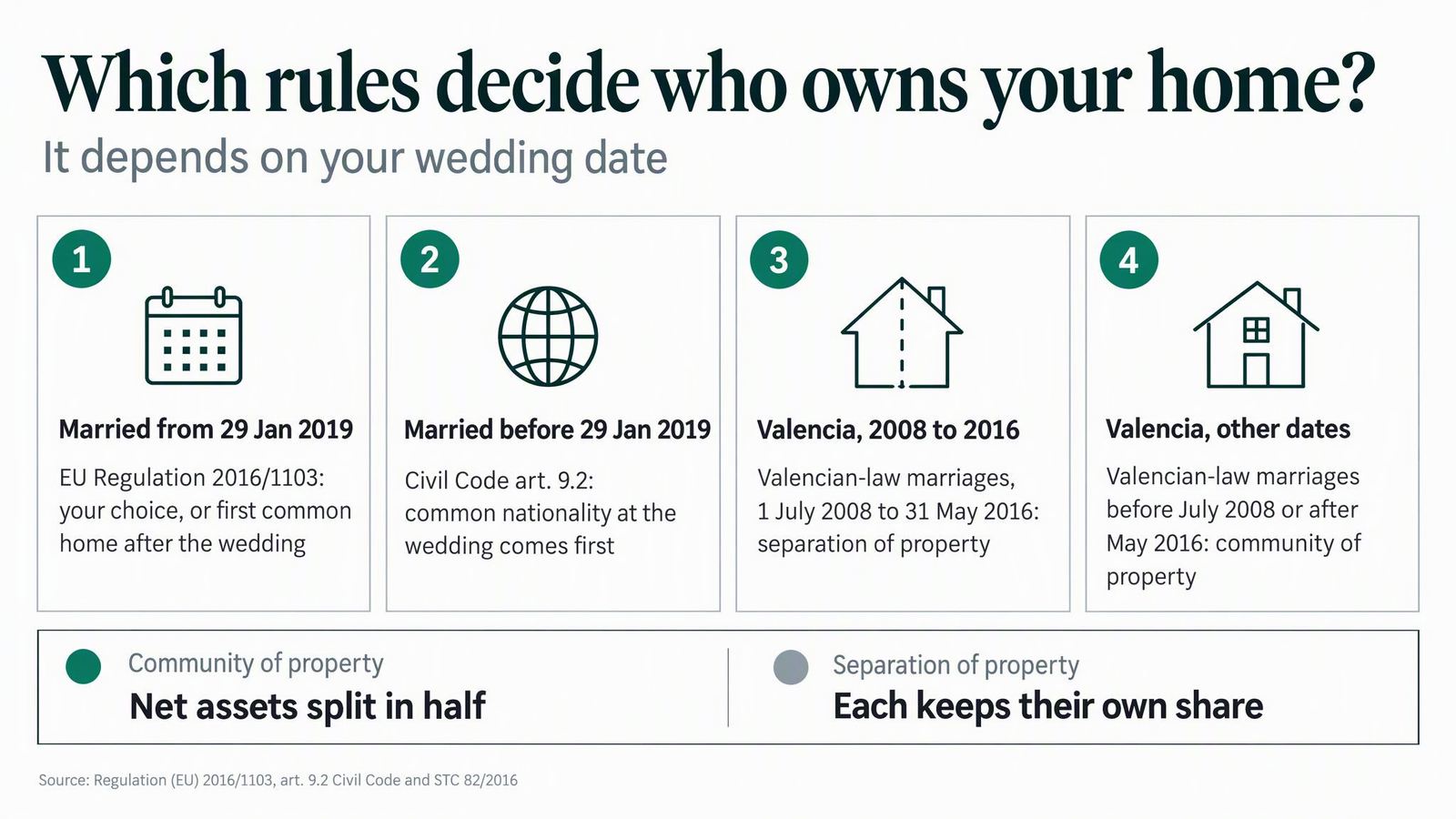
Married on or after 29 January 2019
Regulation (EU) 2016/1103 applies to spouses who married, or who chose the law of their property regime, on or after that date. You could choose the law of the habitual residence or of the nationality of either spouse. Without a valid choice, Article 26 sets a cascade:
- The law of your first common habitual residence after the wedding.
- Failing that, the law of your common nationality when you married.
- Failing that, the law of the country with which you both had the closest connection.
The law designated by the Regulation applies even if it is not the law of an EU country, and it covers all your assets wherever they are. A couple who moved to Valencia straight after a 2020 wedding will usually find that their property regime is Spanish.
Married before 29 January 2019
For older marriages, Spain applies its own conflict rule in art. 9.2 of the Civil Code, which looks at nationality first:
- The common nationality of the spouses at the time of the wedding.
- Failing that, the law of the nationality or habitual residence of either spouse, chosen by both in an authentic document before the wedding.
- Failing that, the law of your common habitual residence immediately after the wedding.
- Failing that, the law of the place where you married.
Two German nationals who married in 2005 will usually have German law governing their property, even after years in Spain. A marriage contract can change the picture: under art. 9.3 CC, it is valid if it complies with the law governing the marriage or with the law of the nationality or habitual residence of either spouse when it was signed.
Community of property or separation: what it means for your home
Each regime treats a home bought during the marriage very differently:
| Regime | Who owns the home | What happens on divorce |
|---|---|---|
| Spanish community of property (sociedad de gananciales) | A home bought during the marriage with common funds belongs to the community, even if only one name is on the deed (art. 1347 CC) | The community ends and, after paying its debts, what remains is split in half (arts. 1392 and 1404 CC) |
| Separation of property | Each spouse owns what they bought; a home bought together is co-owned in the shares stated in the deed | The co-ownership continues until you divide it, and neither of you can be forced to remain a co-owner (art. 400 CC) |
| Foreign regimes | Depends on the foreign law; under English law, for example, marriage does not change who owns what | The foreign rules apply and must be proven to the notary, court or registry |
Spanish registries add a twist for foreign owners. When married foreigners buy in Spain, the Land Registry often records that they acquire “subject to their matrimonial regime” (art. 92 of the Mortgage Regulation) without saying which one, and that regime then has to be proven when the property is sold or divided.
The Valencian case: why your wedding date matters
Spain does not have a single civil law, and several regions have their own rules. The Valencian Community changed its default regime twice in less than a decade, so for marriages governed by Valencian civil law the answer depends on the date:
- Before 1 July 2008: community of property under the Spanish Civil Code (art. 1316 CC).
- From 1 July 2008 to 31 May 2016: separation of property, introduced by Valencian Law 10/2007, unless the couple signed a marriage contract.
- After 31 May 2016: community of property again, because the Constitutional Court annulled Law 10/2007 in STC 82/2016, published in the BOE on that date.
The Constitutional Court ruled that its decision would not affect “consolidated legal situations”: couples who married while the Valencian law was in force and did not sign a marriage contract keep separation of property.
Whether these Valencian rules reach a foreign couple depends on how Spanish law became applicable to the marriage and on Spain’s internal rules for choosing between regional laws. Confirm it before you start negotiating.
Your options for the home
Once ownership is clear, there are three realistic ways forward, each with a different tax cost:
- Sell to a third party: you pay off the mortgage and the costs of the sale, and split what remains according to your shares.
- One spouse keeps it: the other is compensated, usually in money. With community property this happens when the community is liquidated; with separation of property, by dissolving the co-ownership (extinción de condominio).
- Keep it co-owned for now: common while the children still live there, but it should come with clear written rules on costs, repairs and an exit date.
The division can be included in the divorce agreement itself (art. 90.1.e CC) or agreed later, once the divorce is done.
The family home when you have children
Ownership and use are different things. Whoever owns the home, the divorce decides who lives in it, and when there are minor children the starting point is art. 96.1 CC:
“In the absence of an agreement approved by the court, the use of the family home and of the ordinary household items belongs to the minor children and to the spouse who keeps them, until all of them reach the age of majority.”
- Shared custody: the Civil Code has no automatic rule. Supreme Court case law generally grants the use for a limited period, weighing which parent needs more protection and who owns the home.
- Children with disabilities: the court can extend the use beyond the age of majority, for a period it sets.
- No children: the non-owner spouse may be granted the use for a limited time if their interest is the one most in need of protection (art. 96.2 CC).
Once the use has been assigned, the home cannot be sold or otherwise disposed of without the consent of both spouses or court authorization, and this restriction is noted in the Land Registry (art. 96.3 CC). In practice, a use right for one parent makes a quick sale or buyout much harder to negotiate.
What happens with the mortgage
A divorce agreement binds the spouses, not the bank. Under art. 1205 CC, replacing one debtor with another requires the creditor’s consent, so if one of you keeps the home and takes over the loan, both of you remain liable until the bank releases the departing spouse.
- Release by the bank: the lender agrees to the change of debtor, if the remaining spouse can afford the payments alone.
- Refinancing: the spouse who keeps the home takes out a new loan in their own name and repays the old one.
- Sale: the mortgage is cancelled with the sale price before the proceeds are shared.
Talk to the bank before the agreement is final, whether a judge will approve it or you sign a notary divorce by mutual consent. Otherwise, the spouse who leaves may keep a debt on a home they no longer own.
Taxes when you divide or sell the home
The tax bill depends on how the property changes hands:
| Operation | Transfer tax and stamp duty | Income tax | Municipal plusvalía |
|---|---|---|---|
| Award to one spouse when liquidating community property | Exempt (art. 45.I.B.3 of the Transfer Tax Act) | No gain arises and the original values are kept (art. 33.2 of the Personal Income Tax Act) | Not subject (art. 104.3 of the Local Finance Act) |
| One ex-spouse buys out the other’s share (separation of property) | No transfer tax on an indivisible home, but stamp duty (AJD) on the share acquired: 1.4% in the Valencian Community since 1 June 2026 | The spouse who is paid may have a taxable gain if the price reflects an increase in value (STS 1269/2022) | Not subject when made to comply with the divorce, whatever the regime |
| Sale to a third party | Paid by the buyer | Gain taxed at 19% to 30% for residents, or 19% for non-residents; the buyer withholds 3% of the price from a non-resident seller | Payable by the sellers, unless the land has not increased in value |
Residents selling their main home may reduce or avoid income tax through the reinvestment relief (art. 38 of the Personal Income Tax Act) or, from the age of 65, the main-home exemption. Both have strict conditions, so check them before you agree on a sale date.
Own a home in Spain and planning to separate? Our bilingual lawyers in Valencia review your title deeds, confirm which property regime applies and compare the cost of each option before you sign. Schedule a free consultation and leave with a clear plan for your property.
Frequently asked questions
We bought our home in Spain before the wedding. Is it shared?
It generally stays in the shares in which you bought it. Under Spanish community property there is one exception: if one spouse bought the family home in installments before the marriage and installments were later paid with community money, the community acquires a share in proportion to those payments (arts. 1354 and 1357 CC).
What if we cannot agree on what to do with the home?
Either co-owner can ask the court to divide it. If the home cannot be physically divided and you do not agree to award it to one of you with compensation, it is sold and the price is shared (art. 404 CC). Community property has its own court liquidation procedure (arts. 806 and following LEC).
I looked after the home and the property is in my spouse’s name. Do I get anything?
Under separation of property in the Spanish Civil Code, housework counts as a contribution to family expenses and gives a right to compensation when the regime ends, set by the judge if there is no agreement (art. 1438 CC). A compensatory payment under art. 97 CC may also apply if the divorce leaves you worse off.
Do we have to divide the property at the same time as the divorce?
No. If you prefer to remain co-owners for a while, you can agree in writing to keep the property undivided for up to ten years, and that agreement can be extended (art. 400 CC).
Every case has its own details. Our English-speaking lawyers in Valencia can review your situation and advise you on the best way forward. Get in touch with us for tailored legal advice.
