

A parent who retired to the Costa Blanca, an aunt with a flat in Valencia, a holiday home bought decades ago: sooner or later, many families abroad discover that they now own part of a Spanish property. The heirs usually live in London, Dublin or Chicago, speak little Spanish and have no idea where to start.
Inheriting property in Spain as a non-resident is perfectly manageable, and most of it can be done without spending months in Spain. What makes the difference is doing things in the right order, because some steps cannot start until others are finished, and the tax clock starts ticking on the day of death.
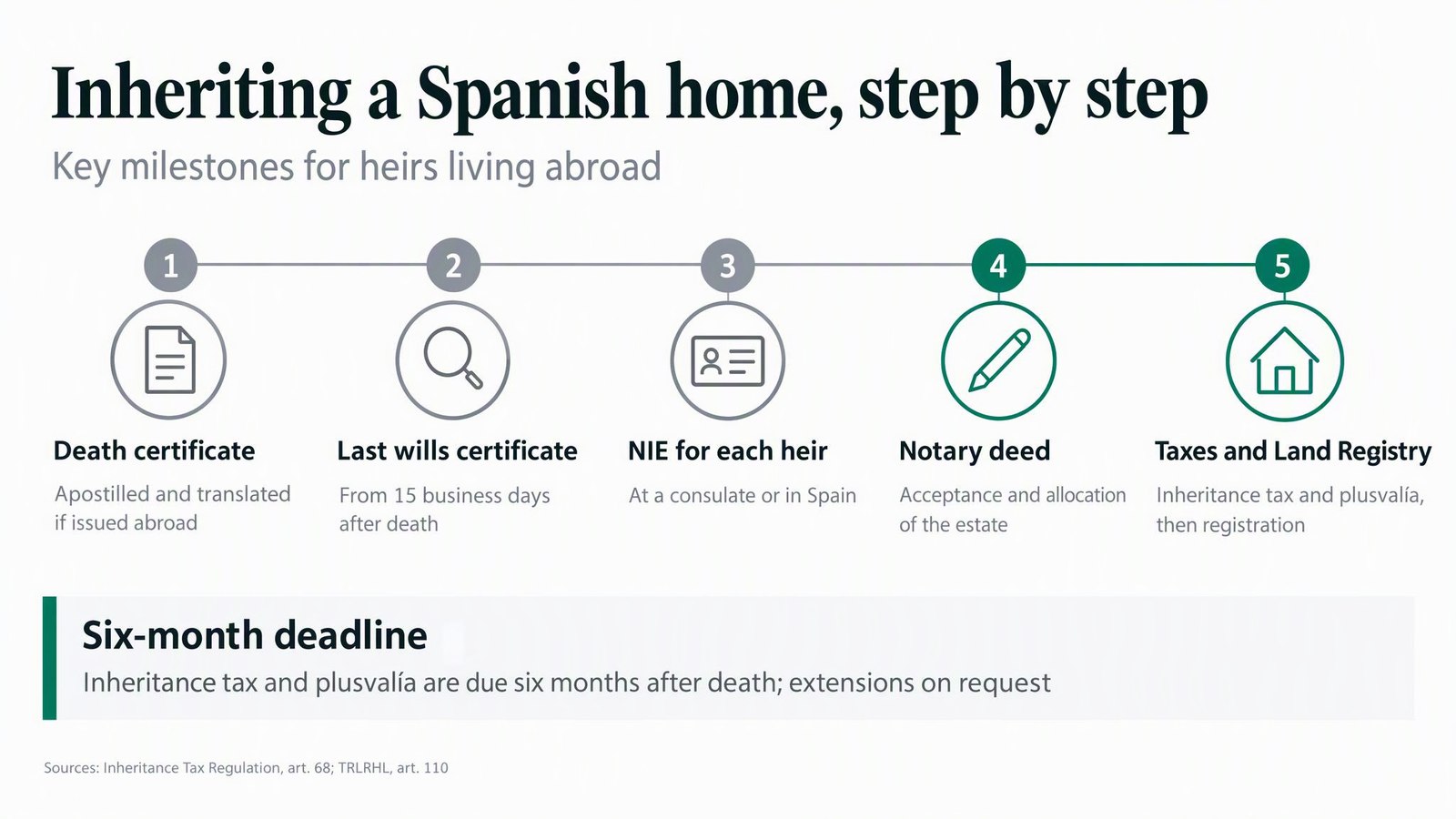
Step 1: The death certificate and the certificate of last wills
Everything starts with two documents. The first is the death certificate. If the death occurred in Spain, it is issued by the Spanish Civil Registry. If it occurred abroad, you will need the foreign certificate with an apostille (or legalization) and a sworn translation into Spanish.
The second is the certificate of last wills (certificado de actos de última voluntad), issued by the Ministry of Justice’s General Registry of Last Wills. It shows whether the deceased signed any will before a Spanish notary and, if so, which one is the most recent.
- It cannot be requested until 15 business days after the death.
- It can be requested online, by post or in person, together with the death certificate.
- A parallel certificate from the same ministry shows whether the deceased had life insurance covering death.
- If the deceased was a foreign national, the notary or the Land Registry may also ask for an equivalent certificate from the country whose law governs the inheritance, where such a registry exists.
Step 2: A Spanish will, a foreign will or no will at all
The certificate of last wills tells you which route you are on. The law that governs the inheritance itself is usually the law of the deceased’s last habitual residence under Regulation (EU) 650/2012, unless their will chose the law of their nationality. The documents the notary will ask for depend on the situation:
| Situation | What the heirs usually need |
|---|---|
| Spanish will | An authorized copy of the will, requested from the notary who keeps the original. |
| Foreign will | The will or its official copy with an apostille and a sworn translation, plus proof of the foreign law where it applies, such as a report from a notary, consul or competent official (art. 36 Reglamento Hipotecario). |
| European Certificate of Succession | If issued by another EU country bound by the regulation, it takes effect in Spain without any special procedure and can be used to register the property (art. 69 Regulation 650/2012 and art. 14 Ley Hipotecaria). |
| No will | A declaration of heirs (acta de notoriedad) issued by a Spanish notary, which identifies the legal heirs. |
Cross-border estates are where most delays happen: an untranslated document, a missing apostille or an unclear point of foreign law can stop the notary for weeks. Working with an inheritance lawyer in Spain who handles international estates means someone checks the whole file before the signing appointment is booked.
Step 3: An NIE for every heir
Every heir who signs the deed or pays tax needs a Spanish foreigner identification number, the NIE. It is not a formality you can skip: the Land Registry will not register a deed that lacks the tax identification numbers of everyone who appears in it (art. 254.2 Ley Hipotecaria), and the inheritance tax return cannot be filed without it.
- It can be requested at the Spanish consulate in your country of residence or directly in Spain.
- A representative holding a power of attorney can apply on your behalf.
- You must show why you need it, and an inheritance is an accepted reason.
Apply as early as possible. The NIE is often the step that holds up everything else, especially when several heirs live in different countries.
Step 4: Accepting the inheritance before a Spanish notary
The heirs formally accept the inheritance and share out the assets in a public deed: the deed of acceptance and allocation of the estate (escritura de aceptación y adjudicación de herencia). It lists the assets and debts, their values and who receives what. You do not need to travel for it: you can sign a power of attorney before a notary in your own country, with an apostille, or at a Spanish consulate.
Before signing, think about debts. Under Spanish law, accepting an inheritance “purely and simply” makes the heir liable for the estate’s debts not only with the inherited assets but also with their own (art. 1003 CC). If you are not sure what the deceased owed, there are safer options:
- Acceptance with benefit of inventory: you only answer for debts up to the value of what you inherit, and your own assets are kept separate (arts. 1010 and 1023 CC). It must be declared before a notary.
- Waiver: you can refuse the inheritance, also before a notary and in a public document (art. 1008 CC).
Step 5: Inheritance tax within six months
Spanish inheritance tax (Impuesto sobre Sucesiones y Donaciones) is paid by each heir on what they personally receive. The self-assessment, Form 650, is due within six months of the date of death. When the heir lives outside Spain, it is generally filed with the national Tax Agency (AEAT), but the heir has the right to apply the regional rules that correspond, such as those of Valencia when the deceased lived there.
- A single extension of six more months can be requested within the first five months after the death (art. 68 of the Inheritance Tax Regulation).
- If the extension is granted, late-payment interest is charged for the extra period.
- Spanish property is valued at least at its reference value (valor de referencia) set by the Cadastre.
- Heirs living outside the EU and EEA must appoint a representative in Spain for this tax.
How much each heir pays depends on their relationship with the deceased and on the regional rules, and the difference between regions can be enormous. Filing on time also matters, because some regional benefits only apply to assets correctly declared.
Step 6: Plusvalía, the town hall tax
Separately from inheritance tax, the town hall where the property is located charges the municipal tax on the increase in value of urban land, known as plusvalía municipal. In an inheritance, it is paid by the heirs who acquire the property.
- The return is due within six months of the death, extendable up to one year if the heirs request it (art. 110 TRLRHL).
- If the land has not increased in value since the deceased acquired it, there is no tax, but you must prove it with the deeds of both transfers.
- Town halls can grant relief of up to 95% on inheritances by descendants, spouses and ascendants, so check the local tax ordinance.
Step 7: Registering the property in your name
Registration in the Land Registry (Registro de la Propiedad) makes the heirs’ ownership public and protects it against third parties. In practice, you will need it to sell or mortgage the property without problems.
Before registering the deed, the registrar checks two tax points:
- That the inheritance tax due on the deed has been paid or properly declared (art. 254.1 Ley Hipotecaria).
- That the plusvalía return or communication has been filed with the town hall (art. 254.5 Ley Hipotecaria).
After inheriting: sell, rent or keep the property
Once the property is yours, your obligations as a non-resident owner begin. Spanish non-resident income tax (Impuesto sobre la Renta de no Residentes) is generally charged at 19% for residents of the EU and EEA and 24% for everyone else, and it is declared on Form 210. What you owe depends on what you do with the property:
| Option | Main tax consequences for a non-resident heir |
|---|---|
| Keep it empty or for your own use | An annual imputed income of 1.1% or 2% of the cadastral value, taxed at 19% or 24%. |
| Rent it out | Tax on the rental income: 19% on the net income for EU and EEA residents, who can deduct related expenses, or 24% on the gross income for other residents. |
| Sell it | 19% tax on the capital gain, with the buyer withholding 3% of the price as a payment on account (art. 25.2 TRLIRNR). The plusvalía municipal is due again, this time paid by you as the seller. |
The value declared for inheritance tax generally becomes your acquisition value when you sell (art. 36 LIRPF), so the figures you use in the inheritance affect the tax on a future sale. If selling is the plan, coordinate it from the start: the property must be registered in the heirs’ names, every heir needs an NIE and all of them must sign, in person or through a power of attorney. Our legal service for selling a property in Spain covers the whole process for owners who live abroad.
Have you inherited a property in Spain? Our bilingual lawyers in Valencia handle the certificates, the notary deed, the tax returns and the Land Registry, so you can manage the whole inheritance from home. Tell us about your case in a free consultation.
Frequently asked questions
Can I refuse an inheritance in Spain?
Yes. The waiver must be made before a notary, and it cannot be partial: you cannot keep the property and refuse the debts. Acceptance and waiver are irrevocable once made, except in very limited cases, so review the estate before deciding.
Do I have to travel to Spain to inherit?
Usually not. Most steps can be handled by a representative with a power of attorney signed before a notary in your country, with an apostille, or at a Spanish consulate. Some heirs prefer to travel only for the signing at the notary’s office.
What if the heirs disagree about selling?
No co-heir can be forced to stay in joint ownership indefinitely. Any of them can ask for the estate to be divided, and if a property cannot be divided and the heirs do not agree to give it to one of them, it is sold and the price shared (arts. 1051 and 404 CC).
Is a will made in my home country enough for the Spanish notary?
It can be, but it is rarely enough on its own. The notary will need it apostilled and translated, and often evidence of the foreign law and proof of the deceased’s latest will in that country. Starting this paperwork early avoids problems with the six-month tax deadline.
Every case has its own details. Our English-speaking lawyers in Valencia can review your situation and advise you on the best way forward. Get in touch with us for tailored legal advice.
