


Many foreigners who buy a home in Spain already have a will back home and assume it covers everything. On paper, it often does. The problems appear later, when grieving relatives discover that a perfectly valid English or American will has to be apostilled, translated and backed by evidence of foreign law before a Spanish notary will act on it.
A Spanish will for foreigners is not compulsory, but it is one of the cheapest ways to make life easier for your heirs. The key is to understand which law will govern your estate, how Spanish forced heirship works and how to make sure your Spanish will and your home-country will do not cancel each other out.
Is a Spanish will compulsory for foreigners?
No. Spanish law does not require foreigners who own property in Spain to make a Spanish will. A will made abroad can be valid in Spain if it meets the formal requirements of the country where it was signed, or those of the testator’s nationality, domicile or habitual residence, among other options. Spain applies the 1961 Hague Convention on the form of testamentary dispositions for this purpose.
The real question is practical. Compare what your heirs will face in each case:
| Issue | Foreign will only | Spanish will for your Spanish assets |
|---|---|---|
| Language | Needs a sworn translation into Spanish | Signed in Spain, in Spanish and, if needed, in your language |
| Formalities | Apostille or legalization, plus proof of the foreign law where it applies (art. 36 Reglamento Hipotecario) | A Spanish public document the notary can use directly |
| Finding it | Recorded in Spain only in specific cases | Automatically reported to the Spanish Registry of Last Wills |
Which law governs your estate: the EU Succession Regulation
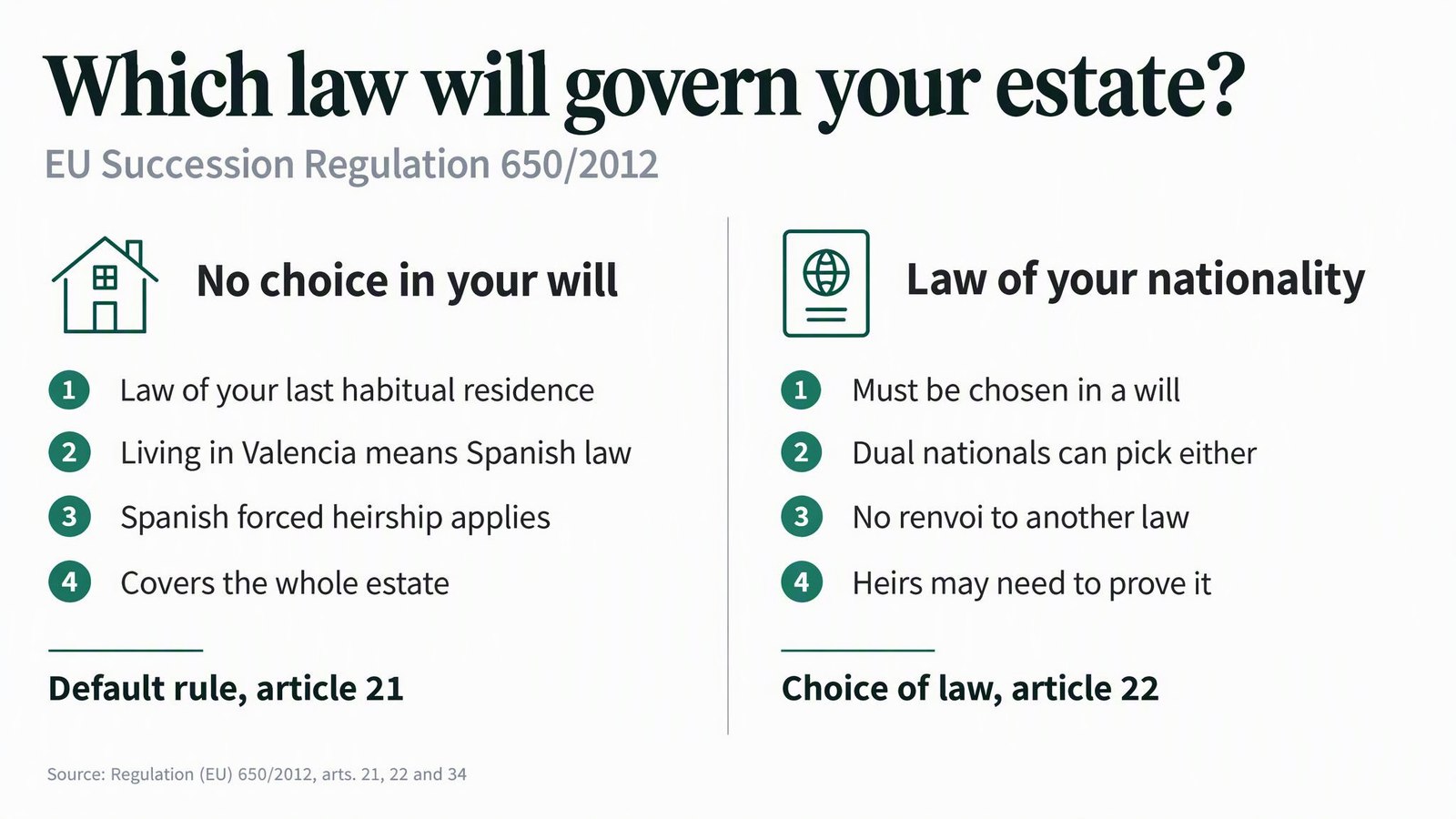
For anyone who dies on or after 17 August 2015, Spain decides which law governs the inheritance under Regulation (EU) 650/2012. It applies to EU and non-EU nationals alike, and the law it designates applies even when it is the law of a non-EU country (art. 20). Its two key rules are simple:
- Default rule (art. 21): the law of the country where you had your habitual residence when you died governs your whole estate, wherever the assets are located.
- Choice of law (art. 22): you can choose instead the law of your nationality, at the time of the choice or at the time of death. People with several nationalities can choose any of them.
The choice must be made expressly in a will, or result clearly from its terms. A will made before 17 August 2015 under the law the testator could have chosen is treated as a choice of that law (arts. 22.2 and 83.4 of the Regulation).
In practice, a British retiree living permanently in Valencia will have their estate governed by Spanish law unless their will chooses the law of their nationality. For countries with several legal systems, such as the United Kingdom or the United States, the will should be clear about which one it means (for example, English or Scots law), and art. 36 of the Regulation decides doubtful cases.
Because the decision changes who can inherit what, it is worth having our inheritance and estate planning lawyers compare both scenarios for your family before you sign anything.
Spanish forced heirship versus freedom to leave your assets
The choice matters because Spanish succession law is very different from systems built on freedom of testation, such as English law. The Spanish Civil Code reserves part of the estate for forced heirs (legítima). Valencia applies the Civil Code because it has no succession rules of its own, while Catalonia, the Balearic Islands, Aragon, Navarre, Galicia and the Basque Country have their own civil law with different rules.
| Forced heirs | Reserved share under the Civil Code |
|---|---|
| Children and descendants | Two thirds of the estate. One of those thirds can be used to favor any child or descendant (mejora); the remaining third is free (art. 808 CC). |
| Parents and ascendants, only if there are no descendants | Half of the estate, or one third if they inherit alongside the surviving spouse (art. 809 CC). |
| Surviving spouse, if not separated | A life interest (usufruct) over one third of the estate with descendants, half with ascendants and two thirds otherwise (arts. 834, 837 and 838 CC). |
Under the default rule, a foreigner living in Valencia who wants to leave everything to a second spouse, or to only one of their children, may find that Spanish law does not allow it. Choosing the law of their nationality can avoid that result if that law gives more freedom, but it has consequences:
- Your heirs may need to prove the content of the chosen foreign law before Spanish notaries and registries.
- Renvoi does not apply when you have made a valid choice (art. 34.2), so the chosen law applies directly and cannot send the case back to Spanish law.
- The choice of law does not decide where or how much inheritance tax is paid; tax follows its own rules.
Making your Spanish will work with your will back home
The most common mistake is signing a new will in one country that accidentally revokes the will in the other. Under Spanish law, a later valid will revokes an earlier one unless the testator says that the earlier will should remain in force, in whole or in part (art. 739 CC). Standard English and American wills also often begin with a clause revoking all former wills.
- Limit the scope: the Spanish will should state that it covers only your assets located in Spain.
- Protect the other will: it should expressly say that it does not revoke your will in your home country.
- Mirror the clause abroad: your home-country will should exclude your Spanish assets and leave the Spanish will untouched.
- Align the content: use the same choice of law and consistent heirs and executors, so the two wills never contradict each other.
- Review them together: whenever you change one of them, check the other.
Couples should also know that the Spanish Civil Code does not allow two people to make a will in the same document (art. 669 CC). Spouses and partners sign two separate wills, often with mirror content.
The Spanish Registry of Last Wills
Every will signed before a Spanish notary is reported to the General Registry of Last Wills (Registro General de Actos de Última Voluntad) of the Ministry of Justice. After a death, the heirs request a certificate showing whether the deceased made a Spanish will, when and before which notary.
- The certificate can be requested once 15 business days have passed since the death.
- Wills signed abroad before Spanish consuls are also recorded.
- Wills signed before foreign notaries can be recorded if the testator asks for it, as can wills from countries in the 1972 Basel Convention system for registering wills.
This is one of the quiet advantages of a Spanish will: your heirs find it straight away, and the notary can request an authorized copy without involving foreign authorities.
How to sign a will before a Spanish notary
The usual format is the open will (testamento abierto), signed before a notary. Once your instructions are clear, it normally takes a single appointment:
- Preparation: decide who inherits what, whether you will choose the law of your nationality and who will act as executor.
- Draft: the notary prepares the text based on your instructions, which you can review before the appointment.
- Identification: bring your passport or national ID; the notary checks your identity and your capacity to make a will.
- Reading and signature: the notary reads the will aloud, you confirm that it reflects your wishes and you sign it (art. 695 CC).
- Registration: the notary keeps the original, reports it to the Registry of Last Wills and gives you an authorized copy.
If you do not speak Spanish well, the will can be bilingual. When the testator expresses their wishes in a language the notary does not know, an interpreter chosen by the testator must be present, and the will is written in both languages (art. 684 CC). Witnesses are only needed in specific cases, such as when the testator cannot sign or when the testator or the notary asks for them (art. 697 CC).
Notary fees for wills are regulated and modest. According to the Spanish General Council of Notaries, a will usually costs between €38 and €50, and only exceptionally more. Remember, too, that a will decides who inherits, not how much tax they pay: if your heirs live abroad, read our guide to inheritance tax in Valencia for non-resident heirs.
Thinking about making a will in Spain? Our bilingual lawyers in Valencia draft Spanish wills that work alongside your home-country estate plan and explain every clause in plain English. Arrange a free consultation with our team.
Frequently asked questions
Do I need to live in Spain to make a Spanish will?
No. Non-residents who own property in Spain can sign a will before a Spanish notary during a visit. What matters is identifying yourself properly and understanding the content, with an interpreter if necessary.
I have two nationalities. Which law can I choose?
Either of them. The EU Succession Regulation lets people with several nationalities choose the law of any country whose nationality they hold, either when they make the choice or at the time of death.
Can I change my Spanish will later?
Yes, as often as you like, by signing a new will before a notary. Wills are always revocable, and the certificate of last wills will show your heirs which one is the most recent.
What happens if I die without any will and Spanish law applies?
The Civil Code decides: children and descendants inherit first, then parents and ascendants, then the surviving spouse, then siblings and other relatives up to the fourth degree, and finally the State. An unmarried partner is not on that list.
Every case has its own details. Our English-speaking lawyers in Valencia can review your situation and advise you on the best way forward. Get in touch with us for tailored legal advice.
