


For years, inheriting in Spain from abroad came with an unpleasant surprise: non-resident heirs were taxed under the national rules and could not use the far more generous regional allowances available to Spanish residents. That discrimination is gone, and in the Valencia region the difference is huge.
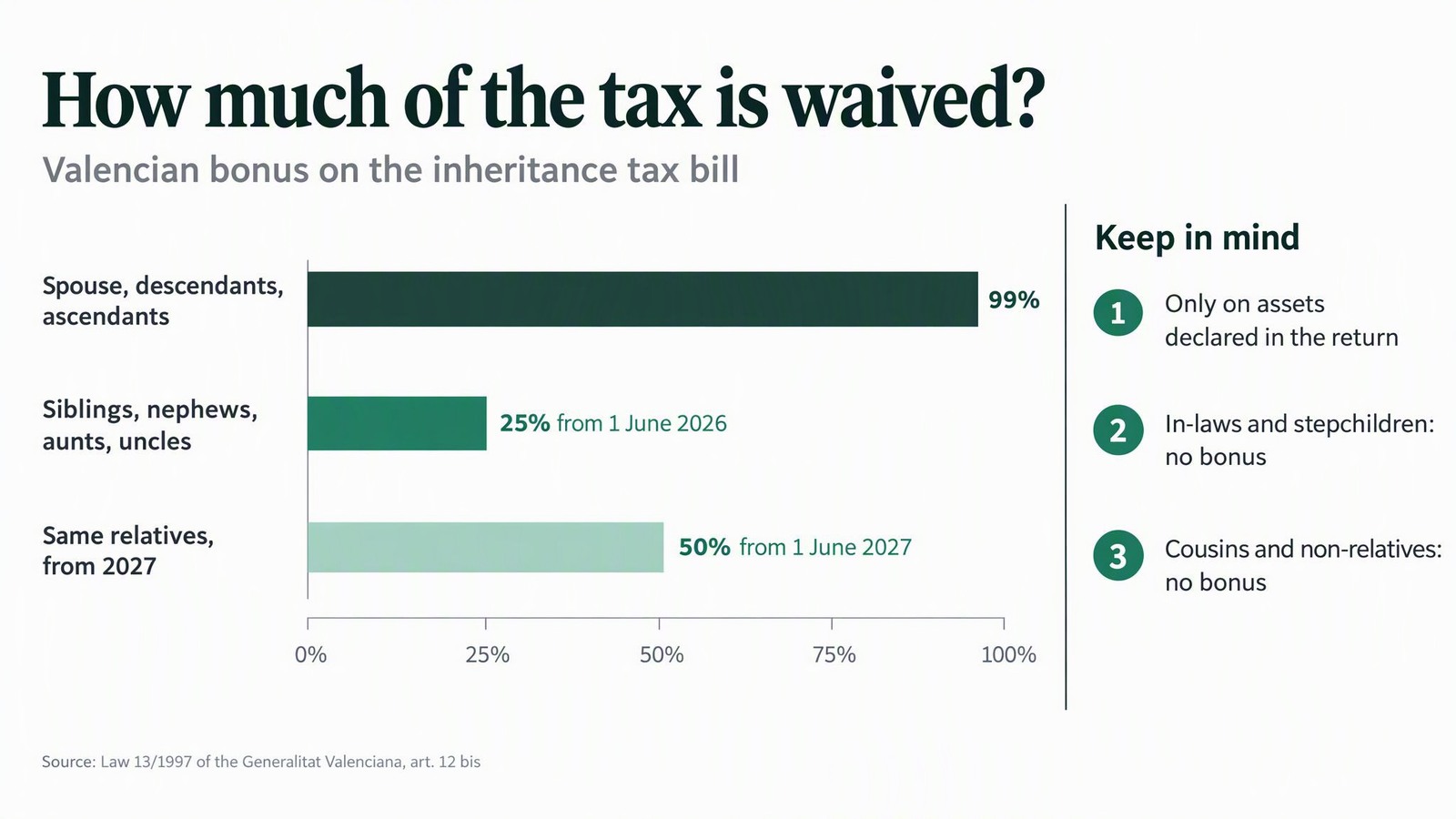
Today, inheritance tax in Valencia for non-residents works almost exactly as it does for residents. Children, spouses and parents pay just 1% of the tax bill, and since 1 June 2026 siblings, nephews, nieces, uncles and aunts also get a partial bonus. Here is what non-resident heirs need to check before filing.
Can non-resident heirs apply Valencia’s rules?
Yes. After the EU Court of Justice ruled in 2014 that Spain discriminated against non-residents (case C-127/12), the Inheritance Tax Law was amended, and since Law 11/2021 the rule covers all non-residents, whether they live in the EU or elsewhere. The second additional provision of Law 29/1987 sets the connection, and non-residents are taxed in Spain only on assets located here:
| Situation | Regional rules you can apply | Where you file |
|---|---|---|
| The deceased lived in Valencia, the heir lives abroad | Valencian rules | National Tax Agency (AEAT) |
| The deceased lived outside Spain | Rules of the region where the most valuable Spanish assets are located | National Tax Agency (AEAT) |
| The deceased lived in Valencia, the heir lives in Spain | Valencian rules | Valencian Tax Agency (ATV) |
A person counts as resident in a region when they spent more days there than anywhere else in Spain during the last five years. Because the answer depends on residence history and on where the assets are, an experienced inheritance lawyer in Valencia should confirm which rules apply before anything is filed.
Kinship groups: why your relationship matters
Spanish inheritance tax sorts heirs into four groups (art. 20.2.a Law 29/1987). Your group decides your allowance, the multiplier applied to the tax and whether you get the Valencian bonus.
- Group I: children and other descendants under 21.
- Group II: children and descendants aged 21 or over, spouses, parents and other ascendants.
- Group III: siblings, nephews and nieces, uncles and aunts, plus ascendants and descendants by marriage, such as parents-in-law and stepchildren.
- Group IV: cousins, more distant relatives and people outside the family.
How the tax is calculated, step by step
Each heir pays on their own share, not on the estate as a whole. The calculation always follows the same order:
- Taxable value: the net value of what the heir receives, after deductible debts. Property is valued at its Cadastre reference value, or at a higher declared value (art. 9 Law 29/1987).
- Allowances: the Valencian reductions are subtracted, for example for kinship, disability or the family home.
- Tax scale: a progressive scale from 7.65% to 34% is applied to the result (art. 11 Law 13/1997).
- Multiplier: the amount is multiplied by a coefficient that depends on your kinship group and your existing wealth.
- Bonus: the Valencian bonus, if any, is deducted from the final tax bill.
Allowances and the 99% bonus for children, spouses and parents
Valencia’s inheritance tax rules are set out in Law 13/1997 of the Generalitat Valenciana. Its main allowances for inheritances are:
| Allowance | Amount |
|---|---|
| Group I (descendants under 21) | €100,000 plus €8,000 for each year under 21, up to €156,000 |
| Group II (descendants 21+, spouses, ascendants) | €100,000 |
| Disability of 33% or more | €120,000 on top of the kinship allowance, or €240,000 from 65% (or 33% for intellectual or mental disability) |
| The deceased’s main home | 95% of its value, up to €150,000 per heir, for the spouse, descendants or ascendants, or a relative over 65 who lived with the deceased for the previous two years; the home must be kept for five years |
On top of that, heirs in groups I and II enjoy a 99% bonus on the tax bill (art. 12 bis Law 13/1997), in force since 28 May 2023 under Law 6/2023. It only applies to the part of the tax that corresponds to assets included in a complete return, filed on time or late but before any request from the tax authorities.
Simplified example: a 45-year-old son living in London inherits a holiday apartment in the Valencia region from his mother, who lived in Valencia. Its reference value is €300,000. After the €100,000 allowance, the scale gives about €31,853 of tax. The 99% bonus leaves roughly €319 to pay, plus any plusvalía municipal. The example assumes no debts, no other assets and existing wealth under €390,657.87.
Siblings, nephews and other relatives: the new 25% bonus
Until 2026, Valencian inheritance tax had no family bonus for heirs in group III. Law 5/2025, later amended by Law 5/2026, introduced a phased bonus for siblings, nephews, nieces, uncles and aunts:
- 25% of the tax bill for deaths from 1 June 2026.
- 50% of the tax bill for deaths from 1 June 2027.
- It covers only blood relatives of the second and third degree; in-laws and stepchildren in group III are excluded.
- Group IV heirs, such as cousins, friends or unregistered partners, get no bonus.
Heirs in groups III and IV also face higher multipliers, which increase the tax calculated with the scale:
| Heir’s existing wealth | Groups I and II | Group III | Group IV |
|---|---|---|---|
| Up to €390,657.87 | 1.0000 | 1.5882 | 2.0000 |
| €390,657.87 to €1,965,309.58 | 1.0500 | 1.6676 | 2.1000 |
| €1,965,309.58 to €3,936,629.28 | 1.1000 | 1.7471 | 2.2000 |
| Over €3,936,629.28 | 1.2000 | 1.9059 | 2.4000 |
Filing Form 650: deadline, extension and paperwork
Non-resident heirs file Form 650 with the national Tax Agency (AEAT), online or on paper, within six months of the death. The AEAT form does not calculate regional benefits for you, so the Valencian allowances and bonus have to be applied correctly when completing it.
- Extension: a single six-month extension can be requested within the first five months after the death, with late-payment interest for the extra time (art. 68 of the Inheritance Tax Regulation).
- NIE: every heir needs a Spanish tax identification number before filing.
- Representative: heirs living outside the EU and EEA must appoint a representative resident in Spain for this tax.
- Late returns: the Valencian bonuses can still apply to a late return, as long as it is filed before the tax authorities send a request.
Inheritance tax is only one part of the process. The certificates, the notary deed and the Land Registry are covered in our guide to inheriting property in Spain as a non-resident.
The reference value: the floor for Spanish property
Since 2022, Spanish property is valued for inheritance tax at its reference value (valor de referencia), calculated by the Cadastre (art. 9.3 Law 29/1987). If you declare a higher value, that value is used instead. If the property has no reference value, the taxable value is the higher of the declared value and the market value.
The reference value can only be challenged by appealing an assessment issued by the tax authorities or by asking to correct your own return (art. 9.4). It also matters later: when you sell, the value used for inheritance tax generally becomes your acquisition value for capital gains purposes (art. 36 LIRPF).
Plusvalía municipal: the separate town hall tax
The Valencian bonuses do not cover the plusvalía municipal (Impuesto sobre el Incremento de Valor de los Terrenos de Naturaleza Urbana), a local tax on the increase in value of urban land. It is charged by the town hall where the property is located and paid by the heirs.
- Each town hall sets its own rate, up to a legal maximum of 30%.
- If the real gain is lower than the standard calculation, you can ask for the real gain to be used; if there was no gain at all, there is no tax.
- Town halls may grant up to 95% relief on inheritances by descendants, spouses and ascendants, so check the local ordinance.
- The return is due within six months of the death, extendable up to one year on request (art. 110 TRLRHL).
- The Land Registry will not register the inheritance until the plusvalía has been declared (art. 254.5 Ley Hipotecaria).
Inheriting in Valencia from abroad? Our bilingual tax and inheritance lawyers work out what you owe under the Valencian rules, prepare Form 650 and deal with the plusvalía for you. Request a free consultation with our team.
Frequently asked questions
Is the 99% bonus applied automatically?
No. It has to be claimed in the self-assessment, and it only covers the tax on assets included in a complete return. Assets that are left out and later discovered by the tax authorities do not benefit from it.
Does a registered partner count as a spouse in Valencia?
Yes, if the partnership is registered in the Valencian registry of formalized unions or in an equivalent registry elsewhere in Spain, in another EU or EEA country, or in a non-EU country.
My brother died in May 2026. Do I get the 25% bonus?
No. Inheritance tax accrues on the date of death, so the group III bonus only applies to deaths from 1 June 2026. For deaths from 1 June 2027, it rises to 50%.
Will my home country also tax the inheritance?
Possibly. Spain taxes non-resident heirs on Spanish assets, but your country of residence may tax the same inheritance under its own rules. Whether you can offset the Spanish tax depends on that country’s law and any applicable treaty, so check both sides before filing.
Every case has its own details. Our English-speaking lawyers in Valencia can review your situation and advise you on the best way forward. Get in touch with us for tailored legal advice.
